Master cardiology by understanding how it is actually tested.
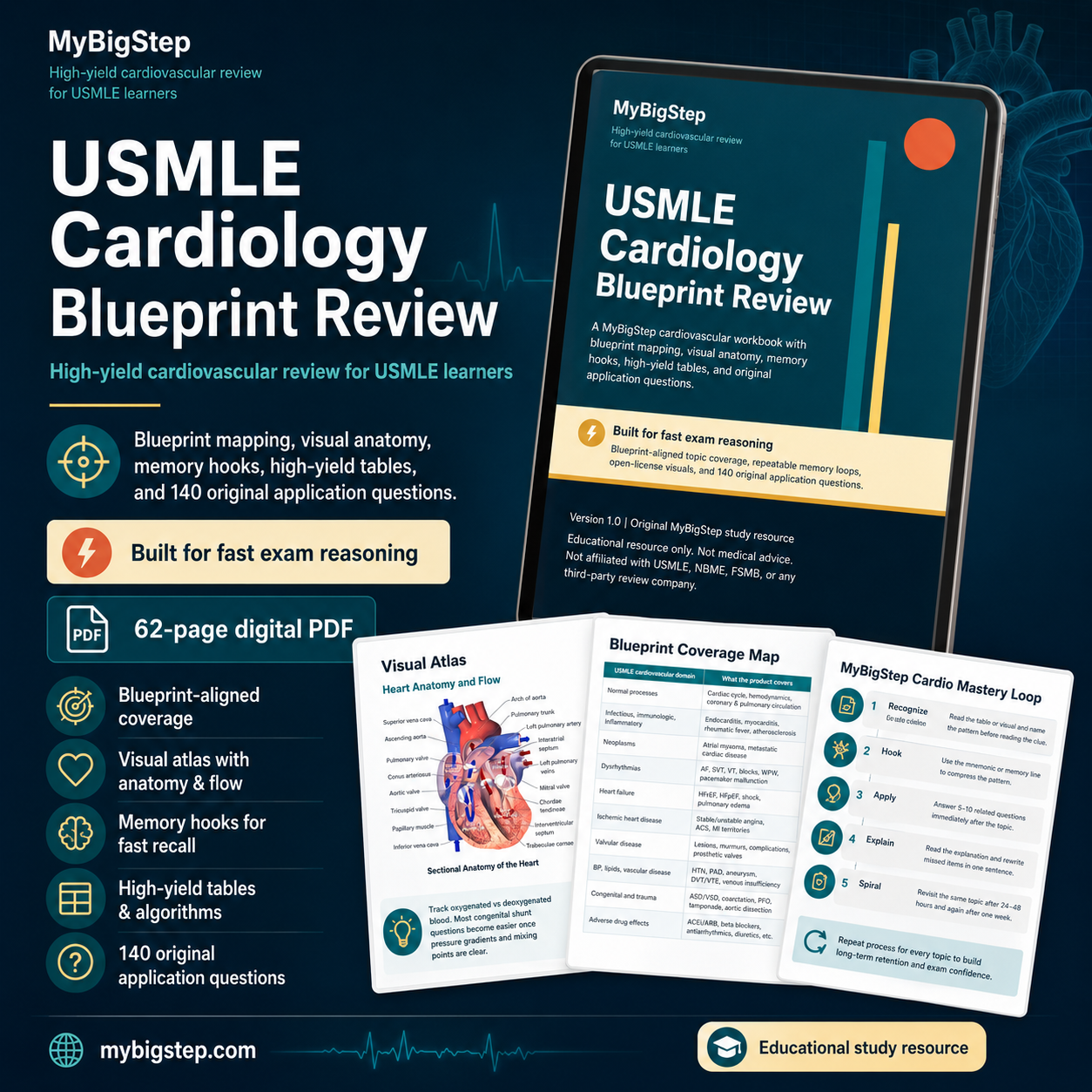
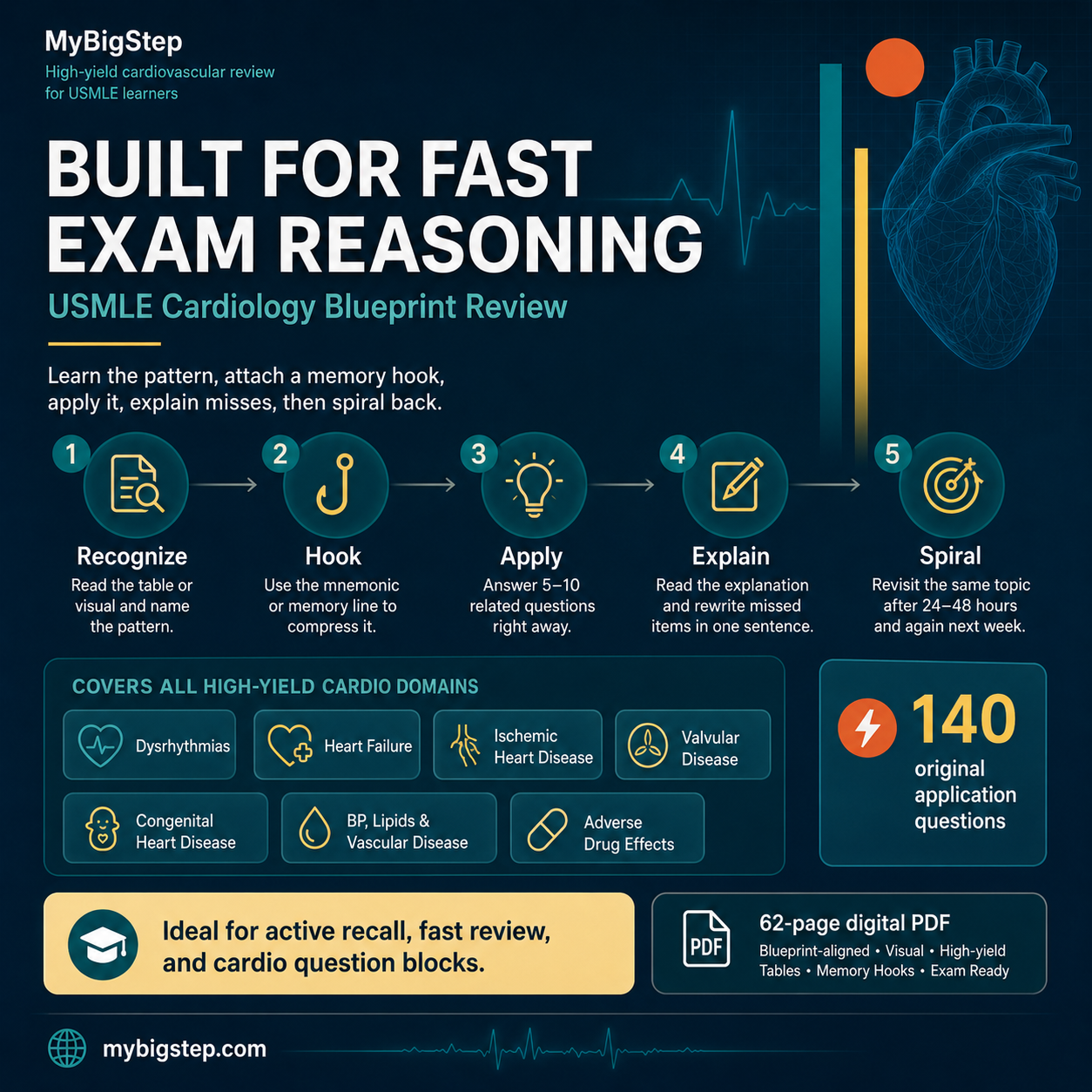
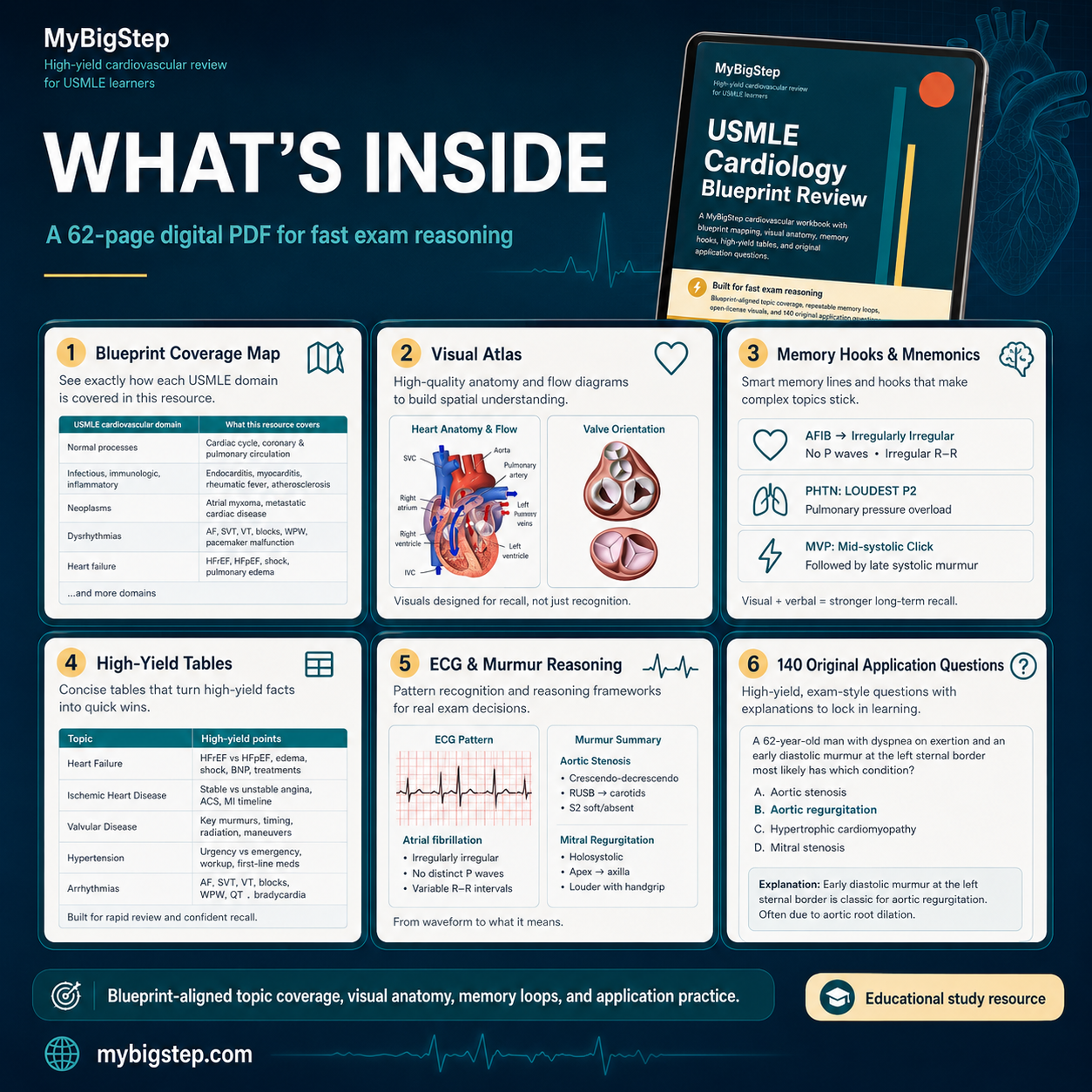
The MyBigStep USMLE Cardiology Review is a comprehensive 736-page digital review for USMLE Step 1 and Step 2 CK, built to help you move beyond memorization and develop the reasoning needed to solve cardiovascular questions with confidence.
85 focused chapters
120 original USMLE-style questions with detailed explanations
Explanations for why each incorrect option is wrong
18 original diagrams for high-yield cardiovascular concepts
Physiology, hemodynamics, ischemic heart disease, heart failure, murmurs, valvular disease, congenital heart disease, ECGs, arrhythmias, vascular disease, and pharmacology
Discrimination Index to separate commonly confused diagnoses
High-yield numbers, investigations, and rapid-review pages
2-week, 1-week, and 3-day study plans
Printable self-audit tracker
Guideline-referenced clinical content with verification dates
What makes this review different is its focus on the clues that actually change the answer. You learn how to recognize patterns, distinguish similar conditions, identify common traps, and understand the physiology behind the findings.
Designed to complement your question bank by strengthening the reasoning behind your answers.
Delivered as a searchable, bookmarked PDF for personal use.
Independent educational resource. Not affiliated with or endorsed by USMLE, NBME, or FSMB.
Master cardiology by understanding how it is actually tested.
The MyBigStep USMLE Cardiology Review is a comprehensive 736-page digital review for USMLE Step 1 and Step 2 CK, built to help you move beyond memorization and develop the reasoning needed to solve cardiovascular questions with confidence.
85 focused chapters
120 original USMLE-style questions with detailed explanations
Explanations for why each incorrect option is wrong
18 original diagrams for high-yield cardiovascular concepts
Physiology, hemodynamics, ischemic heart disease, heart failure, murmurs, valvular disease, congenital heart disease, ECGs, arrhythmias, vascular disease, and pharmacology
Discrimination Index to separate commonly confused diagnoses
High-yield numbers, investigations, and rapid-review pages
2-week, 1-week, and 3-day study plans
Printable self-audit tracker
Guideline-referenced clinical content with verification dates
What makes this review different is its focus on the clues that actually change the answer. You learn how to recognize patterns, distinguish similar conditions, identify common traps, and understand the physiology behind the findings.
Designed to complement your question bank by strengthening the reasoning behind your answers.
Delivered as a searchable, bookmarked PDF for personal use.
Independent educational resource. Not affiliated with or endorsed by USMLE, NBME, or FSMB.