Ethics items are not knowledge items in disguise. They are ordering items. The examination rarely asks whether you should respect a patient’s autonomy. It asks what you do first when respecting autonomy, gathering more information, and protecting a third party all point in different directions. That is why memorizing rules does not fix your score. You already know a patient can refuse treatment. The item that beats you gives you a refusing patient who is also frightened, whose spouse is in the room, whose blood sugar is 38, and whose surgeon is waiting.
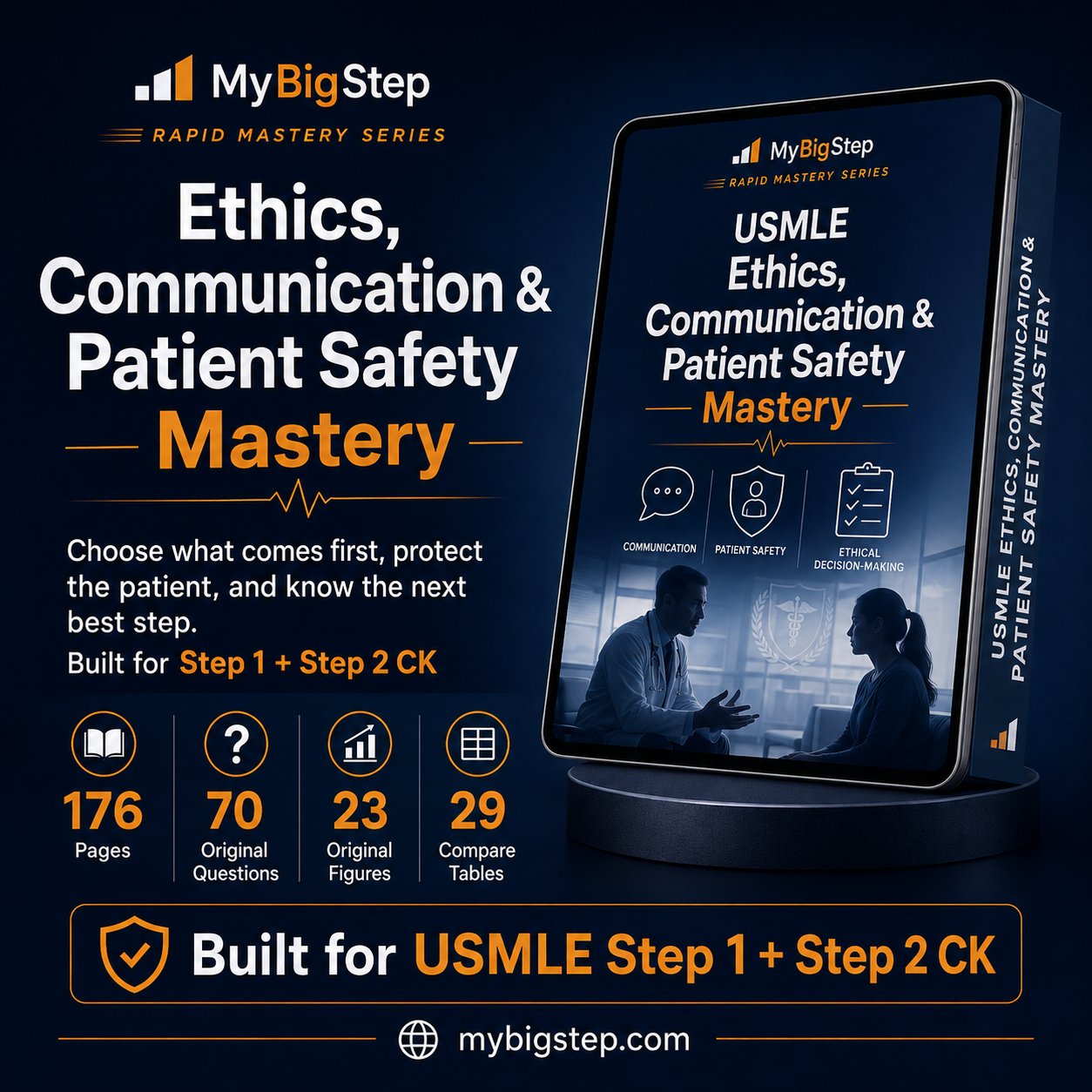
This 176 page guide is built for exactly that moment.
What is inside
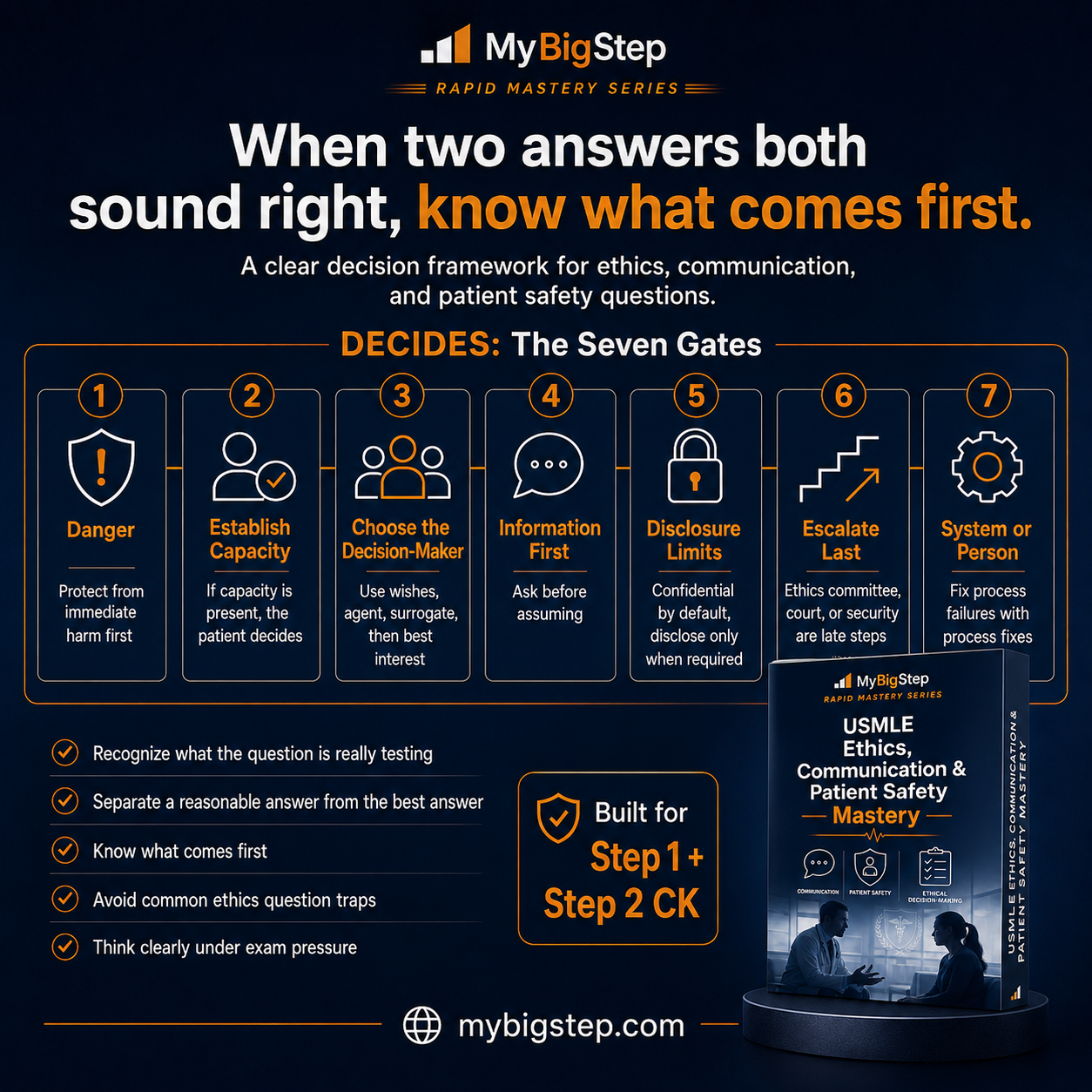
The DECIDES framework. Seven gates in a fixed order: Danger, Establish capacity, Choose the decision maker, Information first, Disclosure limits, Escalate last, System or person. Run them in order and stop at the first that applies. Every other page is an application of it.
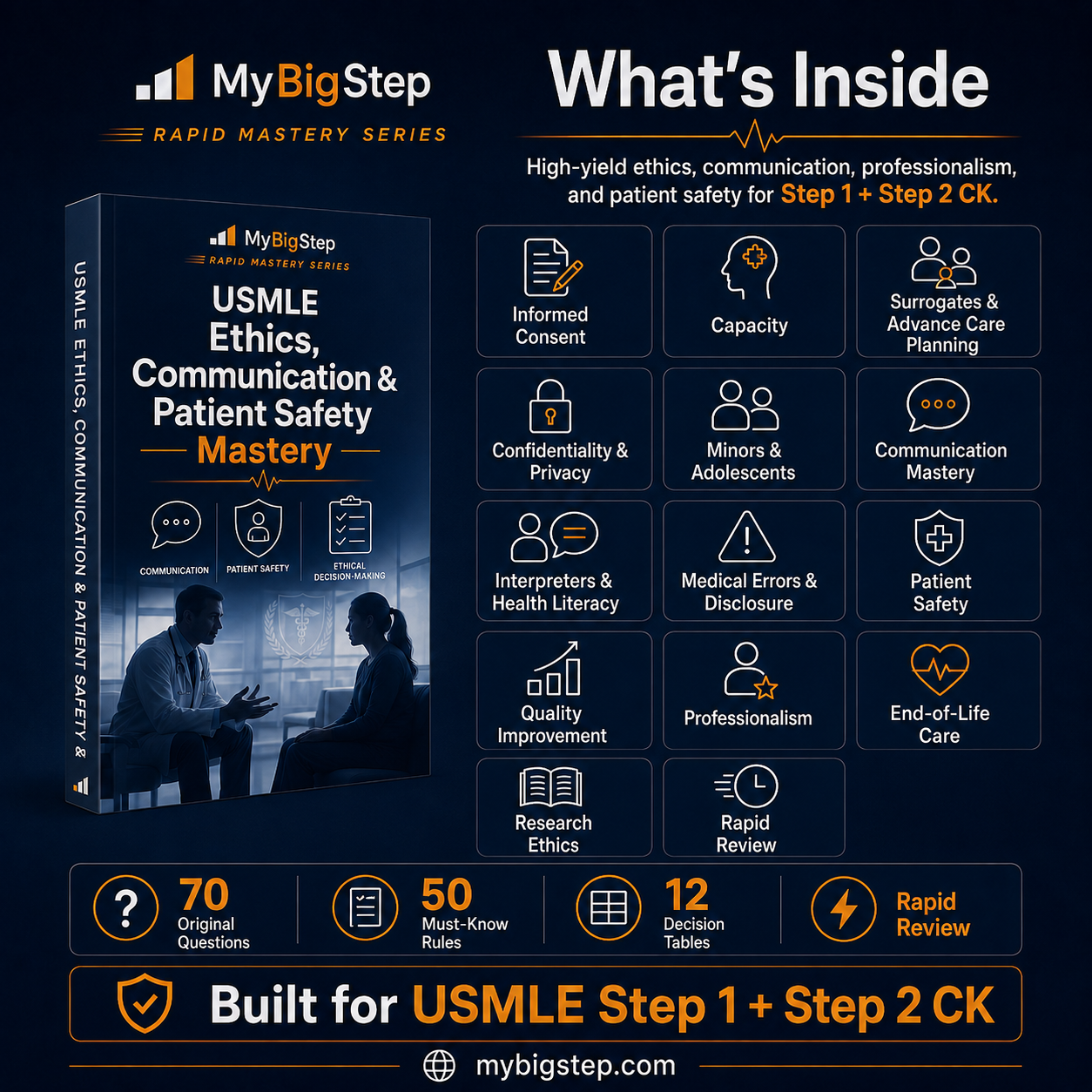
12 decision algorithms for the situations that keep returning: the patient who refuses, assessing capacity, who decides when the patient cannot, keep or disclose, the adolescent in front of you, the error that has just happened, which quality improvement tool, end of life decisions, the language barrier, whether to report, and delivering difficult news.
29 comparison tables, each with a column naming the one feature that separates the things you keep confusing. Capacity against competence. Error against near miss against adverse event. Withholding against withdrawing. Improvement against research.
35 Common Trap cards. Each pairs the wrong instinct with the reasoning that beats it, because the instinct is what the distractor is built from.
15 transfer drills. One scenario, then the same scenario with a single fact moved and a different correct answer. This is what turns recognizing an item into reasoning through a new one.
Communication on the official structure. The communication module is organized around the seven communication sub competencies exactly as the USMLE program names them, with Say This and Not This tables that teach the principle rather than a script.
Quality improvement and patient safety made concrete, not defined. Which tool for which timing. Which measure is which. Why the answer to a system failure is never to retrain one person.
70 original questions, five options each, with an explanation for the correct answer, an explanation for every distractor, the recognition clue, the tested principle, the exam trap, and how the answer would change if one fact moved. Answers sit in a separate section, so you commit before you see them.
A Rapid Review of 50 must know rules and 12 decision tables, sized for the night before.
Built for international medical graduates too
Several expectations on this examination are specific to United States practice, and they are explained where they arise rather than assumed: decision making capacity terminology, surrogate hierarchies, advance directives, the professional interpreter requirement, mandatory reporting, HIPAA, ethics committees, and disclosing your own errors to a patient.
Honest about the law
Ethics and law overlap here more than anywhere else in medicine, and much of the law varies by state. This guide does not present one state’s statute as a national rule. Where a rule genuinely varies it says so and teaches the underlying principle. Where a rule is nationally stable it says that too, and the two are marked differently on the page.
Who it is for
Step 1 candidates, for whom Communication and Interpersonal Skills is a named competency
Step 2 CK candidates, for whom Professionalism and Systems based Practice and Patient Safety are each separately scored categories
International medical graduates preparing for either examination
Anyone who reads four answer choices, thinks three are defensible, and picks the wrong one
Format
A 176 page PDF with a clickable table of contents and bookmarks, US Letter portrait. Nothing depends on color, so it reads correctly printed in black and white. Every figure carries a printed image description, so the content is real searchable text rather than pixels alone. Instant download after purchase.
Frequently asked
Is this a question bank? No. There are 70 original questions for self assessment. This is the reasoning layer around a question bank rather than a replacement for one.
Are these real exam questions? No. Every question and every scenario was written for this guide. No question here has ever appeared on a real examination, and every patient described is fictional.
Step 1 or Step 2 CK? Both. Content is tagged where the emphasis differs, and the guide explains what each examination weights. Most of the material applies to both because the underlying principles do not change.
Is it 176 pages of padding? The teaching content is 120 pages and the question bank with its explanations is 56. Nothing was added to reach a number.
From MyBigStep, drawing on over a decade of experience guiding medical students and graduates through the USMLE and into the Match.
Educational resource for examination preparation. Not medical or legal advice. Professional guidance and law change, and jurisdiction specific requirements vary. MyBigStep is not affiliated with or endorsed by the USMLE program, the NBME, the FSMB, ECFMG or Intealth, or any commercial preparation company. USMLE is a registered trademark of the FSMB and the NBME.
Ethics items are not knowledge items in disguise. They are ordering items. The examination rarely asks whether you should respect a patient’s autonomy. It asks what you do first when respecting autonomy, gathering more information, and protecting a third party all point in different directions. That is why memorizing rules does not fix your score. You already know a patient can refuse treatment. The item that beats you gives you a refusing patient who is also frightened, whose spouse is in the room, whose blood sugar is 38, and whose surgeon is waiting.
This 176 page guide is built for exactly that moment.
What is inside
The DECIDES framework. Seven gates in a fixed order: Danger, Establish capacity, Choose the decision maker, Information first, Disclosure limits, Escalate last, System or person. Run them in order and stop at the first that applies. Every other page is an application of it.
12 decision algorithms for the situations that keep returning: the patient who refuses, assessing capacity, who decides when the patient cannot, keep or disclose, the adolescent in front of you, the error that has just happened, which quality improvement tool, end of life decisions, the language barrier, whether to report, and delivering difficult news.
29 comparison tables, each with a column naming the one feature that separates the things you keep confusing. Capacity against competence. Error against near miss against adverse event. Withholding against withdrawing. Improvement against research.
35 Common Trap cards. Each pairs the wrong instinct with the reasoning that beats it, because the instinct is what the distractor is built from.
15 transfer drills. One scenario, then the same scenario with a single fact moved and a different correct answer. This is what turns recognizing an item into reasoning through a new one.
Communication on the official structure. The communication module is organized around the seven communication sub competencies exactly as the USMLE program names them, with Say This and Not This tables that teach the principle rather than a script.
Quality improvement and patient safety made concrete, not defined. Which tool for which timing. Which measure is which. Why the answer to a system failure is never to retrain one person.
70 original questions, five options each, with an explanation for the correct answer, an explanation for every distractor, the recognition clue, the tested principle, the exam trap, and how the answer would change if one fact moved. Answers sit in a separate section, so you commit before you see them.
A Rapid Review of 50 must know rules and 12 decision tables, sized for the night before.
Built for international medical graduates too
Several expectations on this examination are specific to United States practice, and they are explained where they arise rather than assumed: decision making capacity terminology, surrogate hierarchies, advance directives, the professional interpreter requirement, mandatory reporting, HIPAA, ethics committees, and disclosing your own errors to a patient.
Honest about the law
Ethics and law overlap here more than anywhere else in medicine, and much of the law varies by state. This guide does not present one state’s statute as a national rule. Where a rule genuinely varies it says so and teaches the underlying principle. Where a rule is nationally stable it says that too, and the two are marked differently on the page.
Who it is for
Step 1 candidates, for whom Communication and Interpersonal Skills is a named competency
Step 2 CK candidates, for whom Professionalism and Systems based Practice and Patient Safety are each separately scored categories
International medical graduates preparing for either examination
Anyone who reads four answer choices, thinks three are defensible, and picks the wrong one
Format
A 176 page PDF with a clickable table of contents and bookmarks, US Letter portrait. Nothing depends on color, so it reads correctly printed in black and white. Every figure carries a printed image description, so the content is real searchable text rather than pixels alone. Instant download after purchase.
Frequently asked
Is this a question bank? No. There are 70 original questions for self assessment. This is the reasoning layer around a question bank rather than a replacement for one.
Are these real exam questions? No. Every question and every scenario was written for this guide. No question here has ever appeared on a real examination, and every patient described is fictional.
Step 1 or Step 2 CK? Both. Content is tagged where the emphasis differs, and the guide explains what each examination weights. Most of the material applies to both because the underlying principles do not change.
Is it 176 pages of padding? The teaching content is 120 pages and the question bank with its explanations is 56. Nothing was added to reach a number.
From MyBigStep, drawing on over a decade of experience guiding medical students and graduates through the USMLE and into the Match.
Educational resource for examination preparation. Not medical or legal advice. Professional guidance and law change, and jurisdiction specific requirements vary. MyBigStep is not affiliated with or endorsed by the USMLE program, the NBME, the FSMB, ECFMG or Intealth, or any commercial preparation company. USMLE is a registered trademark of the FSMB and the NBME.