Most students do not forget microbiology. They lose the route back to it.
You learned each organism on the day you studied it, one at a time, in a chapter with a helpful title. Then a question hands you a pregnant woman, soft cheese and a neonate with meningitis, and never mentions a Gram positive rod at all. The fact was in your head. The route was not.
This guide adds routes. Every organism in it can be reached from several directions: from the stain, from the food, from the animal, from the vector, from the immune defect, from the syndrome. That repetition is deliberate, because a fact with one way in is a fact you will lose under time pressure.
The method
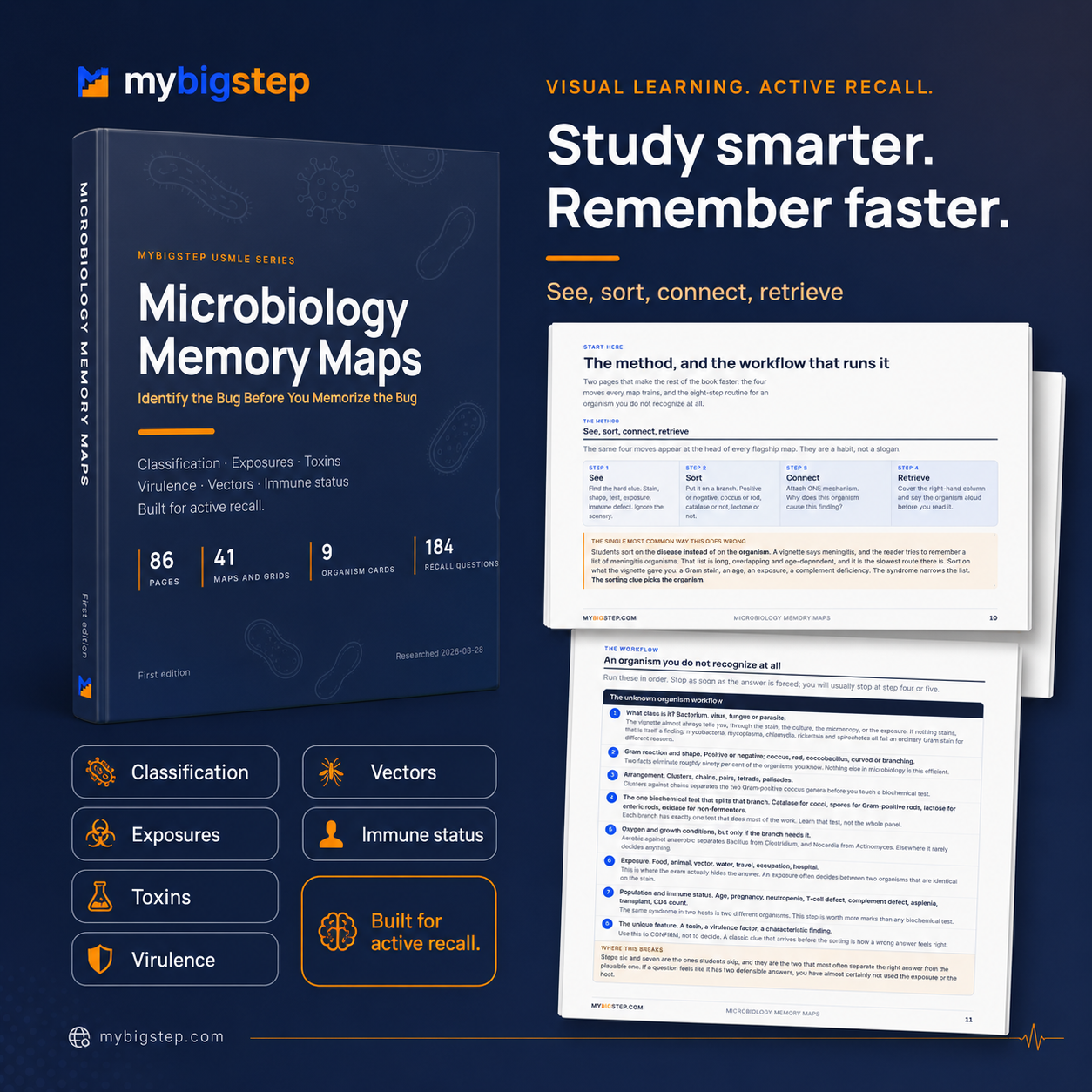
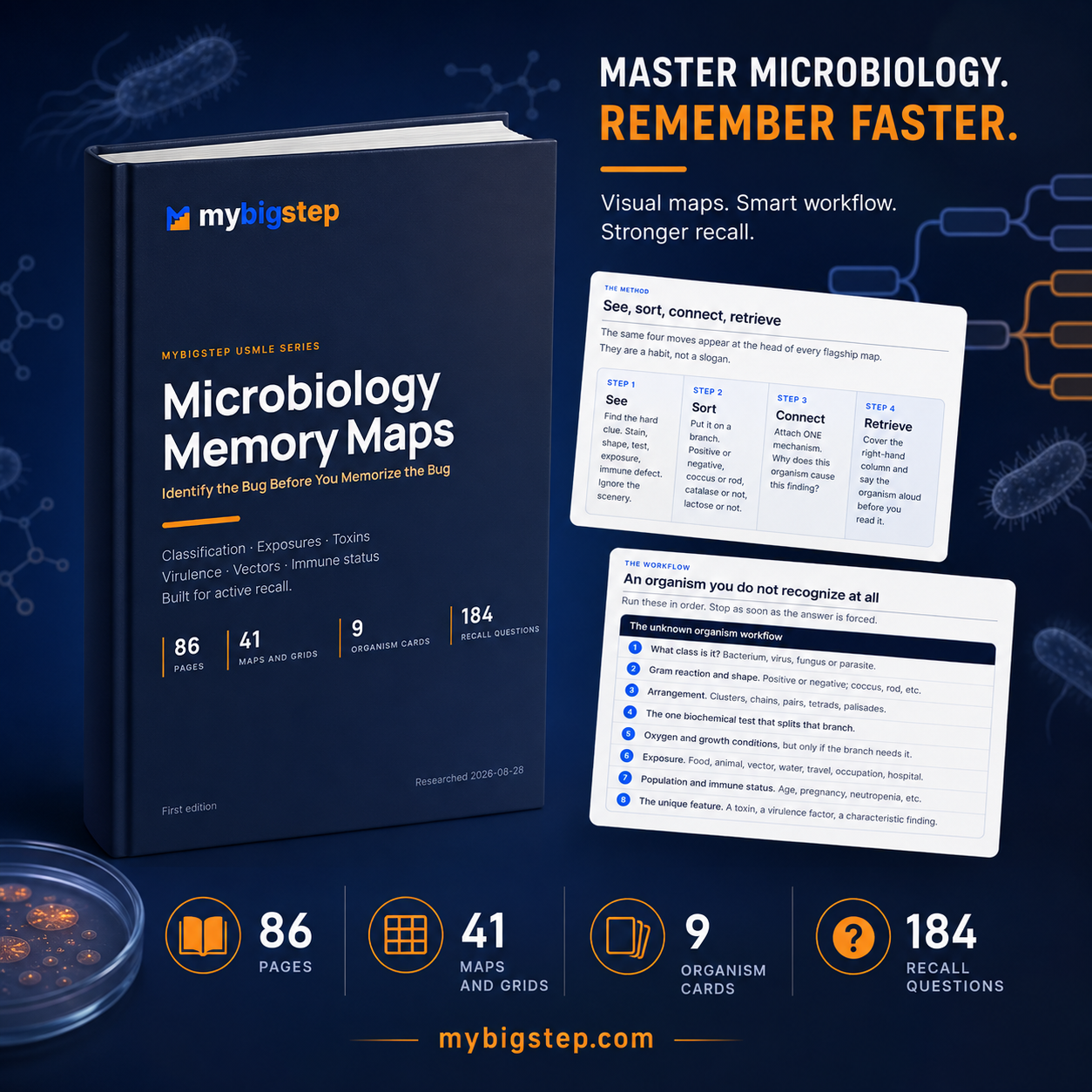
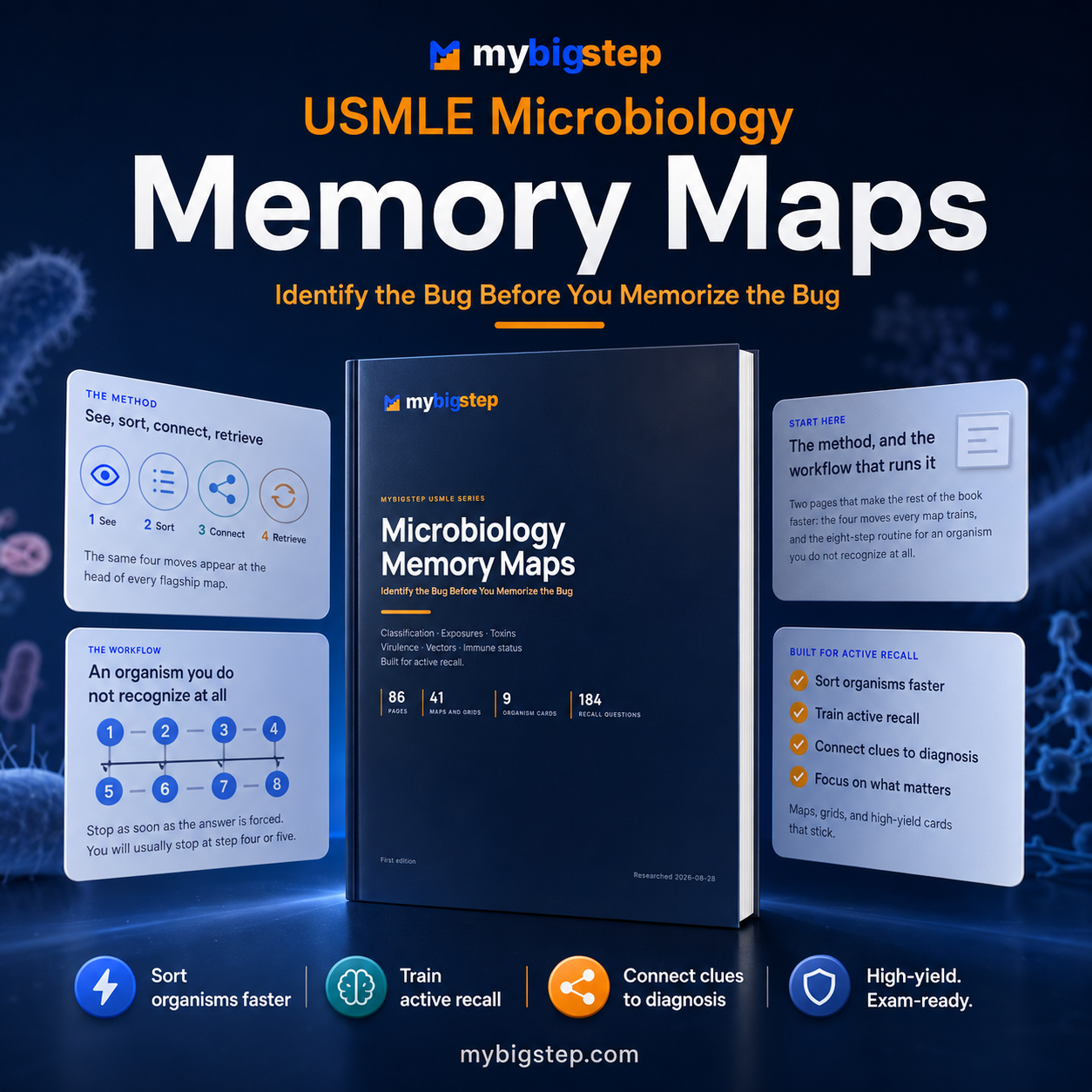
Four moves, printed at the head of every flagship map. See the clue you were actually given. Sort it onto a branch. Connect one mechanism that makes it stick. Retrieve the organism with the answer covered. Sorting is the skill almost nobody practices, because organism lists never require it.
What is inside
41 maps and grids. 9 original vector classification trees, 20 comparison grids carrying 132 rows, 8 exposure maps carrying 104 rows, 2 clue sheets and 2 reasoning algorithms.
Classification trees for Gram positive cocci, Gram positive rods, Gram negative organisms, the enteric group, viruses and fungi, each with the test result written on the branch so you can run the tree on a vignette rather than admire it.
Exposure maps for food, animals, vectors, travel, immune defect and CD4 count. These are where the exam actually hides the answer.
18 do not mix up cards for the pairs that cost marks, each naming the single feature that settles it rather than listing ten differences.
184 recall questions. 78 original questions with explanations and traps, plus 106 cover and retrieve prompts placed at the end of each part.
A Final 48 Hours section, 122 compressed associations, and 25 organisms you cannot afford to miss.
An index of 149 terms, so you can look up an organism, a stain, a toxin, a food, a vector, an immune defect or a classic clue and go straight to the map that sorts it.
PDF bookmarks and a clickable contents, because a reference you cannot navigate is a reference you do not open.
The part that makes it different
Every classic clue in this guide carries a discriminator, the finding that separates it from its nearest rival. Currant jelly sputum raises Klebsiella; it does not prove it. An eschar is not specific to anthrax. A negative Lyme serology early in disease does not exclude Lyme disease. Items are written to punish the clue equals organism reflex, because a resource that teaches that reflex trains the exact error being tested. A build gate refuses to ship a map row whose discriminator column is missing or empty.
What it deliberately leaves out
No antimicrobial treatment and no dosing. This guide recognizes organisms; it does not treat them, and MyBigStep sells the pharmacology separately. Also absent: biochemical trivia that does not separate two organisms anyone confuses, obscure species and serotypes, laboratory media except where the medium is itself the clue, and any claim about how much of your examination is microbiology, because no such figure is published.
On sources and on being current
Board review microbiology contains several confident simplifications. 5 individually verified claims in this guide are recorded on the sources page with the body that issued them and the date they were read, and three of them correct teaching that is still widely printed: MAC prophylaxis in HIV is no longer routine below a CD4 of 50 for someone starting effective therapy; antenatal group B streptococcus screening moved to 36 0/7 to 37 6/7 weeks; and the endemic fungal maps derive from 1950s skin testing and understate the true ranges. Settled classification carries no per line citation, because a tree with a citation on every branch is unusable.
The honest part
This is an educational aid for examination preparation. It is not medical advice and not a clinical reference. Nothing here guarantees a passing result, and no resource can honestly promise one. Modern AI assisted tools supported the research, organization and production, every claim was checked against the sources named at the end, and the finished guide was reviewed by a person before release. That review is editorial and source review by MyBigStep. It is not a specialty board certification and not an independent physician endorsement.
Delivered as a single searchable PDF with bookmarks. MyBigStep is not affiliated with, endorsed by, or sponsored by the NBME, the FSMB, or the USMLE program.
Most students do not forget microbiology. They lose the route back to it.
You learned each organism on the day you studied it, one at a time, in a chapter with a helpful title. Then a question hands you a pregnant woman, soft cheese and a neonate with meningitis, and never mentions a Gram positive rod at all. The fact was in your head. The route was not.
This guide adds routes. Every organism in it can be reached from several directions: from the stain, from the food, from the animal, from the vector, from the immune defect, from the syndrome. That repetition is deliberate, because a fact with one way in is a fact you will lose under time pressure.
The method
Four moves, printed at the head of every flagship map. See the clue you were actually given. Sort it onto a branch. Connect one mechanism that makes it stick. Retrieve the organism with the answer covered. Sorting is the skill almost nobody practices, because organism lists never require it.
What is inside
41 maps and grids. 9 original vector classification trees, 20 comparison grids carrying 132 rows, 8 exposure maps carrying 104 rows, 2 clue sheets and 2 reasoning algorithms.
Classification trees for Gram positive cocci, Gram positive rods, Gram negative organisms, the enteric group, viruses and fungi, each with the test result written on the branch so you can run the tree on a vignette rather than admire it.
Exposure maps for food, animals, vectors, travel, immune defect and CD4 count. These are where the exam actually hides the answer.
18 do not mix up cards for the pairs that cost marks, each naming the single feature that settles it rather than listing ten differences.
184 recall questions. 78 original questions with explanations and traps, plus 106 cover and retrieve prompts placed at the end of each part.
A Final 48 Hours section, 122 compressed associations, and 25 organisms you cannot afford to miss.
An index of 149 terms, so you can look up an organism, a stain, a toxin, a food, a vector, an immune defect or a classic clue and go straight to the map that sorts it.
PDF bookmarks and a clickable contents, because a reference you cannot navigate is a reference you do not open.
The part that makes it different
Every classic clue in this guide carries a discriminator, the finding that separates it from its nearest rival. Currant jelly sputum raises Klebsiella; it does not prove it. An eschar is not specific to anthrax. A negative Lyme serology early in disease does not exclude Lyme disease. Items are written to punish the clue equals organism reflex, because a resource that teaches that reflex trains the exact error being tested. A build gate refuses to ship a map row whose discriminator column is missing or empty.
What it deliberately leaves out
No antimicrobial treatment and no dosing. This guide recognizes organisms; it does not treat them, and MyBigStep sells the pharmacology separately. Also absent: biochemical trivia that does not separate two organisms anyone confuses, obscure species and serotypes, laboratory media except where the medium is itself the clue, and any claim about how much of your examination is microbiology, because no such figure is published.
On sources and on being current
Board review microbiology contains several confident simplifications. 5 individually verified claims in this guide are recorded on the sources page with the body that issued them and the date they were read, and three of them correct teaching that is still widely printed: MAC prophylaxis in HIV is no longer routine below a CD4 of 50 for someone starting effective therapy; antenatal group B streptococcus screening moved to 36 0/7 to 37 6/7 weeks; and the endemic fungal maps derive from 1950s skin testing and understate the true ranges. Settled classification carries no per line citation, because a tree with a citation on every branch is unusable.
The honest part
This is an educational aid for examination preparation. It is not medical advice and not a clinical reference. Nothing here guarantees a passing result, and no resource can honestly promise one. Modern AI assisted tools supported the research, organization and production, every claim was checked against the sources named at the end, and the finished guide was reviewed by a person before release. That review is editorial and source review by MyBigStep. It is not a specialty board certification and not an independent physician endorsement.
Delivered as a single searchable PDF with bookmarks. MyBigStep is not affiliated with, endorsed by, or sponsored by the NBME, the FSMB, or the USMLE program.