Neurology is not hard. Finding the lesion is.
You know what a corticospinal tract does. You know the medulla holds the twelfth nerve. What you cannot do at speed is turn four findings into one place, and that reverse step is a separate skill almost nobody practices.
This guide teaches it as a procedure with four moves, then makes you run it on findings rather than on diagnoses. Find the finding you were actually given. Follow it onto its pathway. Cross: ask whether that pathway has crossed yet. Localize: take the one place where all of it can be true at once.
What is inside
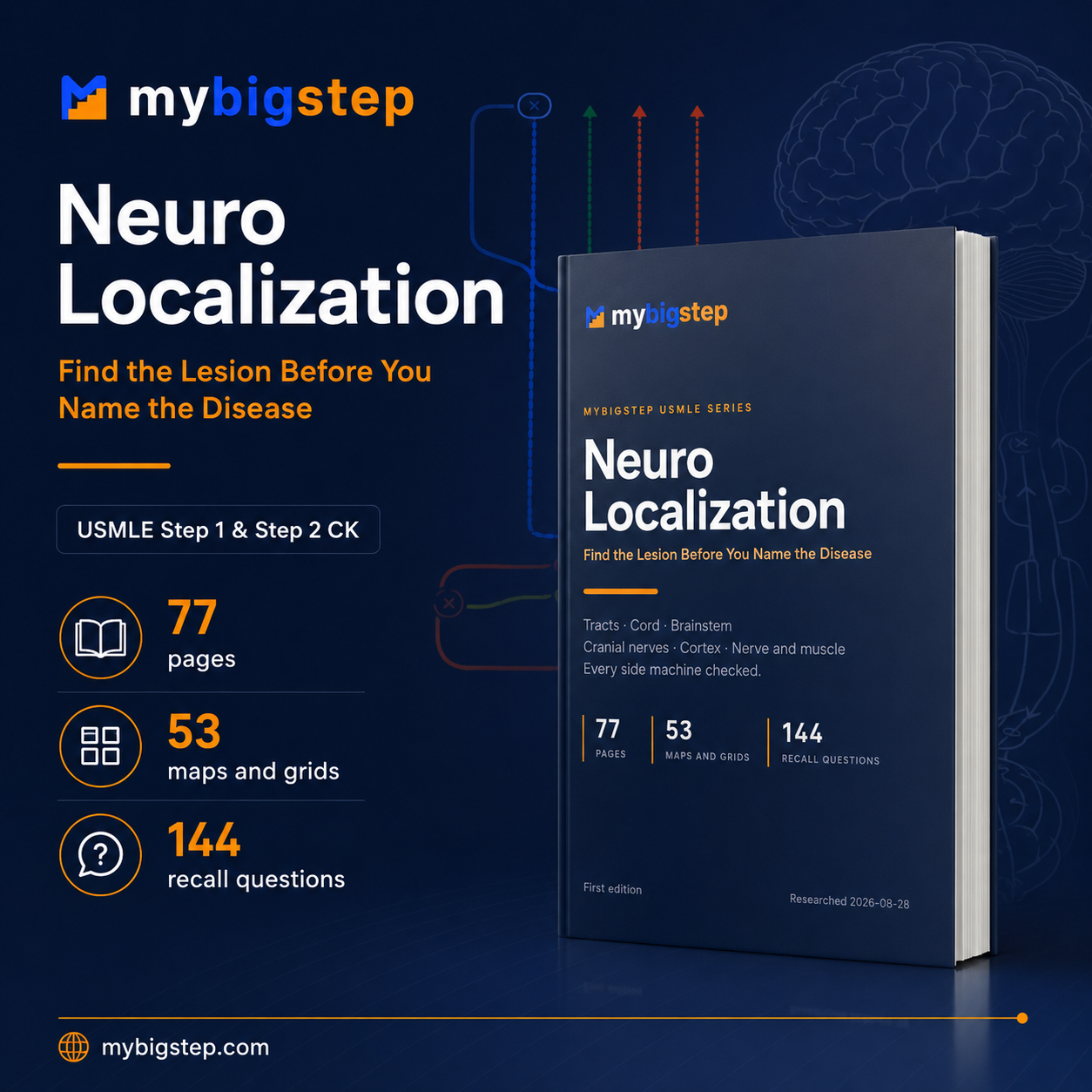
77 pages, built around the reverse question every stem asks
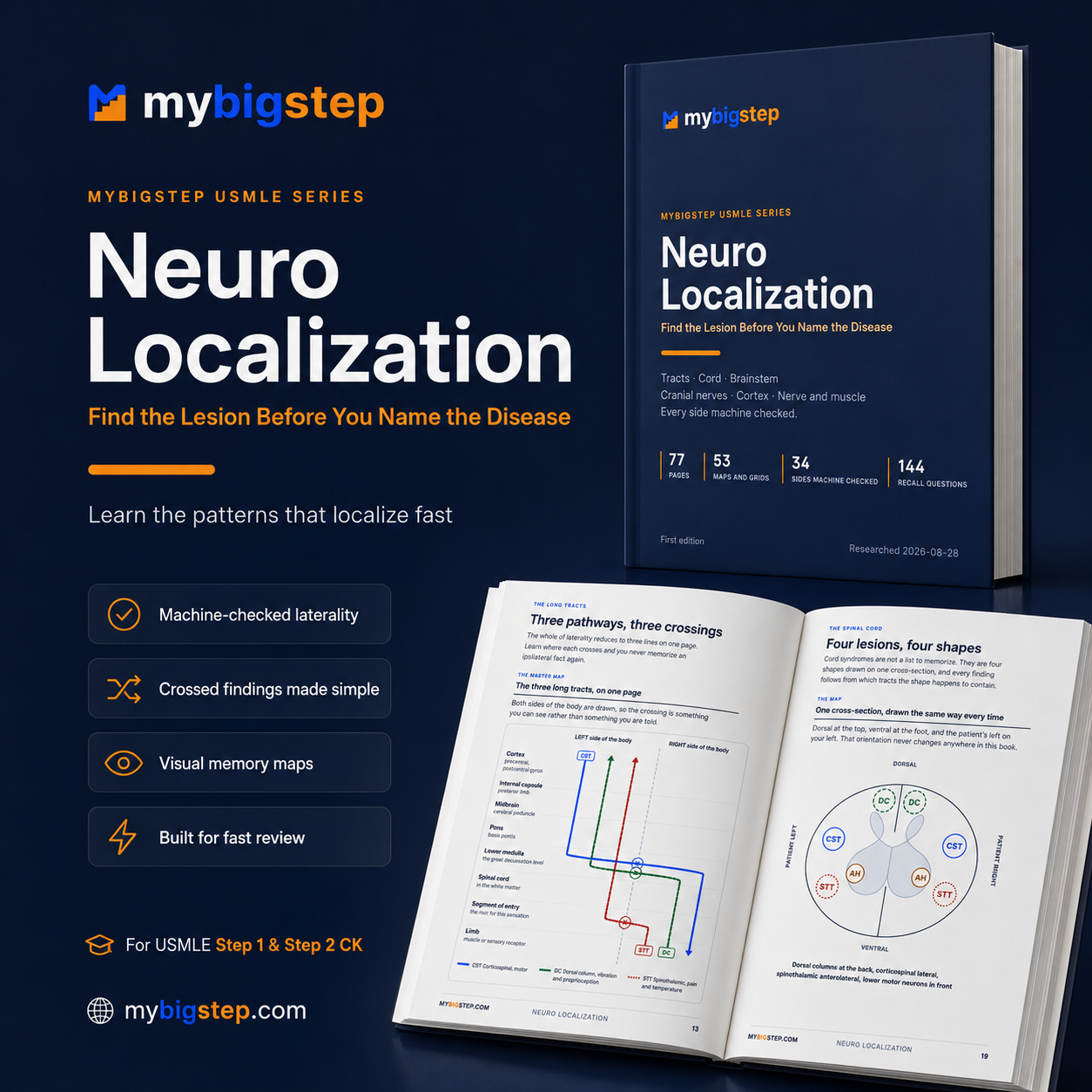
53 maps and grids, all original vector artwork drawn for this book
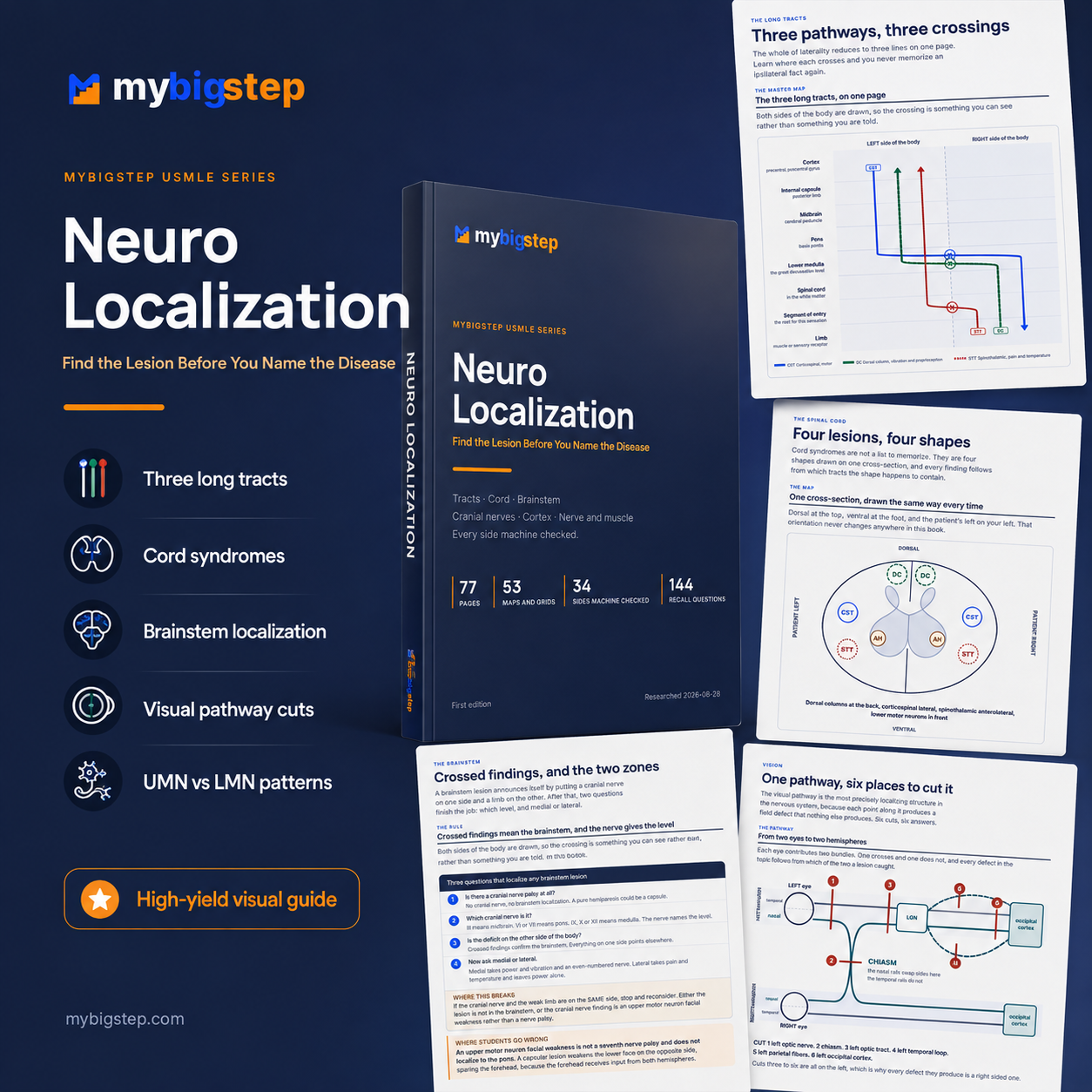
15 original figures, including pathway ladders that draw both sides of the body, so the decussation is something you can see rather than something you are told
16 site cards: which structures live there, what their loss looks like, and what separates that site from the one next door
14 do not mix up cards for the pairs items are built from
7 finder grids carrying 49 rows: if you see this, it localizes there, but first exclude this
17 comparison grids carrying 95 rows, for the distinctions that decide an answer
6 build the lesion drills where findings arrive one at a time and the answer narrows
80 original questions and 144 recall questions in total
120 final review rules and 25 sentences you cannot afford to forget
A clickable contents, PDF bookmarks, and an index of 154 terms
The differentiator: every side in this book is machine checked
The greatest risk in a localization resource is not a missing fact. It is one reversed side, because a reader who does not yet know which arm is weak cannot notice that one page contradicts another.
So laterality here is not prose that somebody proofread. Every statement of the form this lesion, that deficit, this side is written as structured data, and a program recomputes each one from a table of decussation levels held separately from the writing. The same program re-derives every crossing drawn in every figure. A disagreement stops the build. 34 sides checked this way, plus every drawn crossing.
It cannot prove the anatomy is right. It makes the whole book agree with itself, which is the failure a human reviewer misses precisely because catching it means holding two distant pages in mind at once. It has already earned its place: it caught a medial medullary lesion placed one level too low, and it refused a visual field defect written onto the motor pathway so the arithmetic would come out.
Where board teaching is out of date, this says so
3 individually verified claims, each with the issuing body and the date the source was read:
Lateral medullary syndrome is taught as a PICA stroke. The commoner culprit is the vertebral artery, and the anatomy makes both statements true at once.
The familiar somatotopic explanation for arm predominant central cord weakness was not found in primate tracing, and the reviews that examined it name the older account a fallacy.
The rule of the pupil in third nerve palsy points the right way but is not absolute, and imaging is indicated regardless of what the pupil is doing.
What it will not do
It will not manage anything. No imaging protocol, no thrombolysis window, no drug dosing. This product localizes the lesion; it does not manage it. It also carries no percentage attributed to neurology on the examination, because no such figure is published.
The honest part
This is an educational aid for examination preparation. It is not medical advice and not a clinical reference. Nothing here guarantees a passing result, and no resource can honestly promise one. Modern AI assisted tools supported the research, organization and production, every claim was checked against the sources named at the end, and the finished guide was reviewed by a person before release. That review is editorial and source review by MyBigStep. No clinician has reviewed this product, and the book says so on its own sources page.
Delivered as a single searchable PDF with bookmarks, for laptop, tablet or print. MyBigStep is not affiliated with, endorsed by, or sponsored by the NBME, the FSMB, or the USMLE program.
Neurology is not hard. Finding the lesion is.
You know what a corticospinal tract does. You know the medulla holds the twelfth nerve. What you cannot do at speed is turn four findings into one place, and that reverse step is a separate skill almost nobody practices.
This guide teaches it as a procedure with four moves, then makes you run it on findings rather than on diagnoses. Find the finding you were actually given. Follow it onto its pathway. Cross: ask whether that pathway has crossed yet. Localize: take the one place where all of it can be true at once.
What is inside
77 pages, built around the reverse question every stem asks
53 maps and grids, all original vector artwork drawn for this book
15 original figures, including pathway ladders that draw both sides of the body, so the decussation is something you can see rather than something you are told
16 site cards: which structures live there, what their loss looks like, and what separates that site from the one next door
14 do not mix up cards for the pairs items are built from
7 finder grids carrying 49 rows: if you see this, it localizes there, but first exclude this
17 comparison grids carrying 95 rows, for the distinctions that decide an answer
6 build the lesion drills where findings arrive one at a time and the answer narrows
80 original questions and 144 recall questions in total
120 final review rules and 25 sentences you cannot afford to forget
A clickable contents, PDF bookmarks, and an index of 154 terms
The differentiator: every side in this book is machine checked
The greatest risk in a localization resource is not a missing fact. It is one reversed side, because a reader who does not yet know which arm is weak cannot notice that one page contradicts another.
So laterality here is not prose that somebody proofread. Every statement of the form this lesion, that deficit, this side is written as structured data, and a program recomputes each one from a table of decussation levels held separately from the writing. The same program re-derives every crossing drawn in every figure. A disagreement stops the build. 34 sides checked this way, plus every drawn crossing.
It cannot prove the anatomy is right. It makes the whole book agree with itself, which is the failure a human reviewer misses precisely because catching it means holding two distant pages in mind at once. It has already earned its place: it caught a medial medullary lesion placed one level too low, and it refused a visual field defect written onto the motor pathway so the arithmetic would come out.
Where board teaching is out of date, this says so
3 individually verified claims, each with the issuing body and the date the source was read:
Lateral medullary syndrome is taught as a PICA stroke. The commoner culprit is the vertebral artery, and the anatomy makes both statements true at once.
The familiar somatotopic explanation for arm predominant central cord weakness was not found in primate tracing, and the reviews that examined it name the older account a fallacy.
The rule of the pupil in third nerve palsy points the right way but is not absolute, and imaging is indicated regardless of what the pupil is doing.
What it will not do
It will not manage anything. No imaging protocol, no thrombolysis window, no drug dosing. This product localizes the lesion; it does not manage it. It also carries no percentage attributed to neurology on the examination, because no such figure is published.
The honest part
This is an educational aid for examination preparation. It is not medical advice and not a clinical reference. Nothing here guarantees a passing result, and no resource can honestly promise one. Modern AI assisted tools supported the research, organization and production, every claim was checked against the sources named at the end, and the finished guide was reviewed by a person before release. That review is editorial and source review by MyBigStep. No clinician has reviewed this product, and the book says so on its own sources page.
Delivered as a single searchable PDF with bookmarks, for laptop, tablet or print. MyBigStep is not affiliated with, endorsed by, or sponsored by the NBME, the FSMB, or the USMLE program.