In June 2026 the USMLE program enhanced nutrition content across all three Step examinations, and started reporting how you did on it. Both of those are real. Almost everything else you have read about the change is not.
There is no separate nutrition section. There is no published percentage of the examination that is nutrition. The USMLE states directly that nutrition content does not receive separate weighting that can disproportionately affect a score, and that it remains integrated into system based and discipline based questions. This guide opens by quoting that sentence, because it is the single most useful thing anyone can tell you about the change, and because a study aid that begins by overstating its own subject has told you what it is on page one.
What did change is worth preparing for. The enhanced content is aligned to a 2024 consensus statement on nutrition competencies, and that framework is weighted toward assessment, diagnosis and clinical application rather than toward reciting which vitamin does what. So this guide puts most of its weight on the Step 2 CK side: who is at risk, what the laboratory pattern shows, which nutrition route to choose, and what you actually do next.
Nutrition for the USMLE, not nutrition for nutritionists.
What is inside
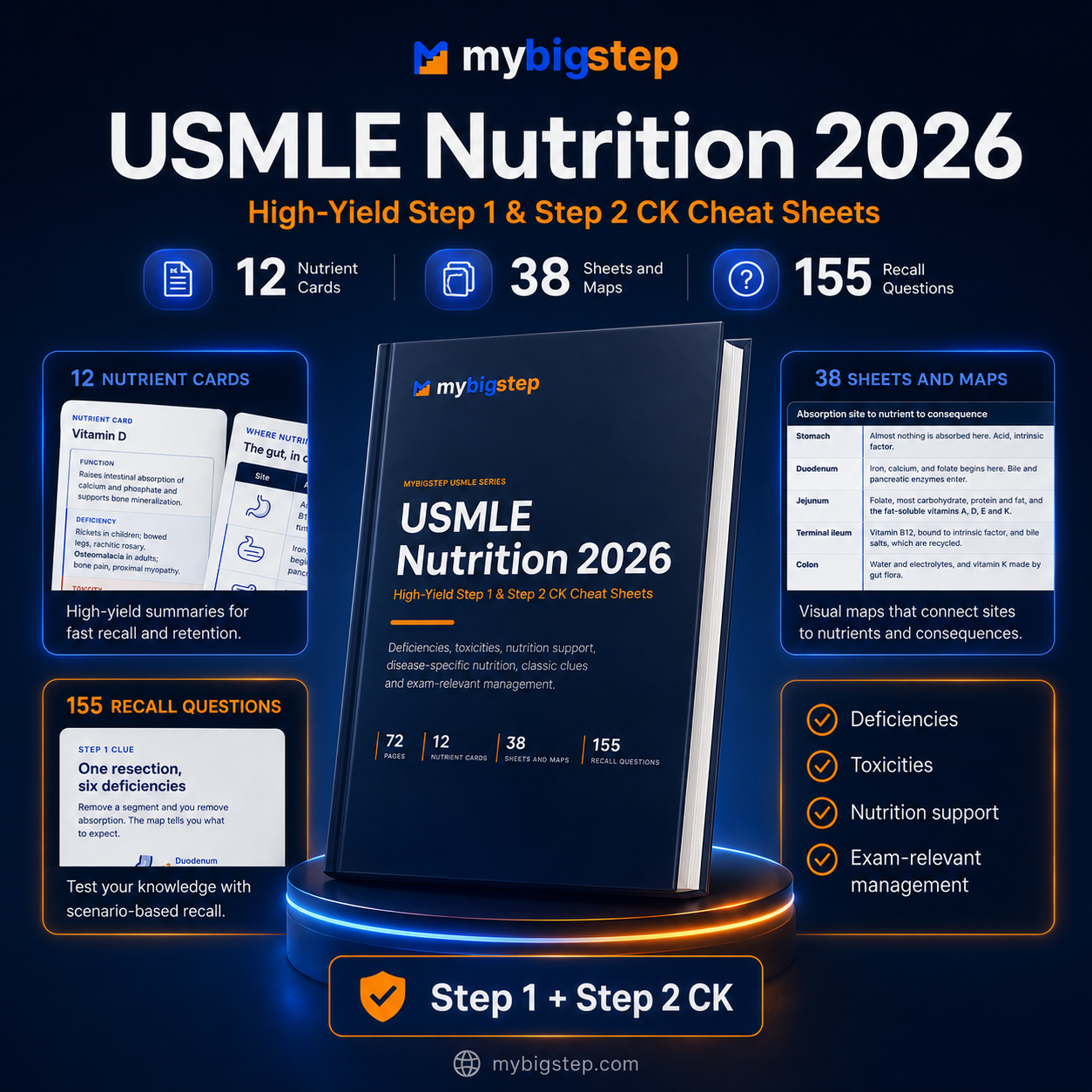
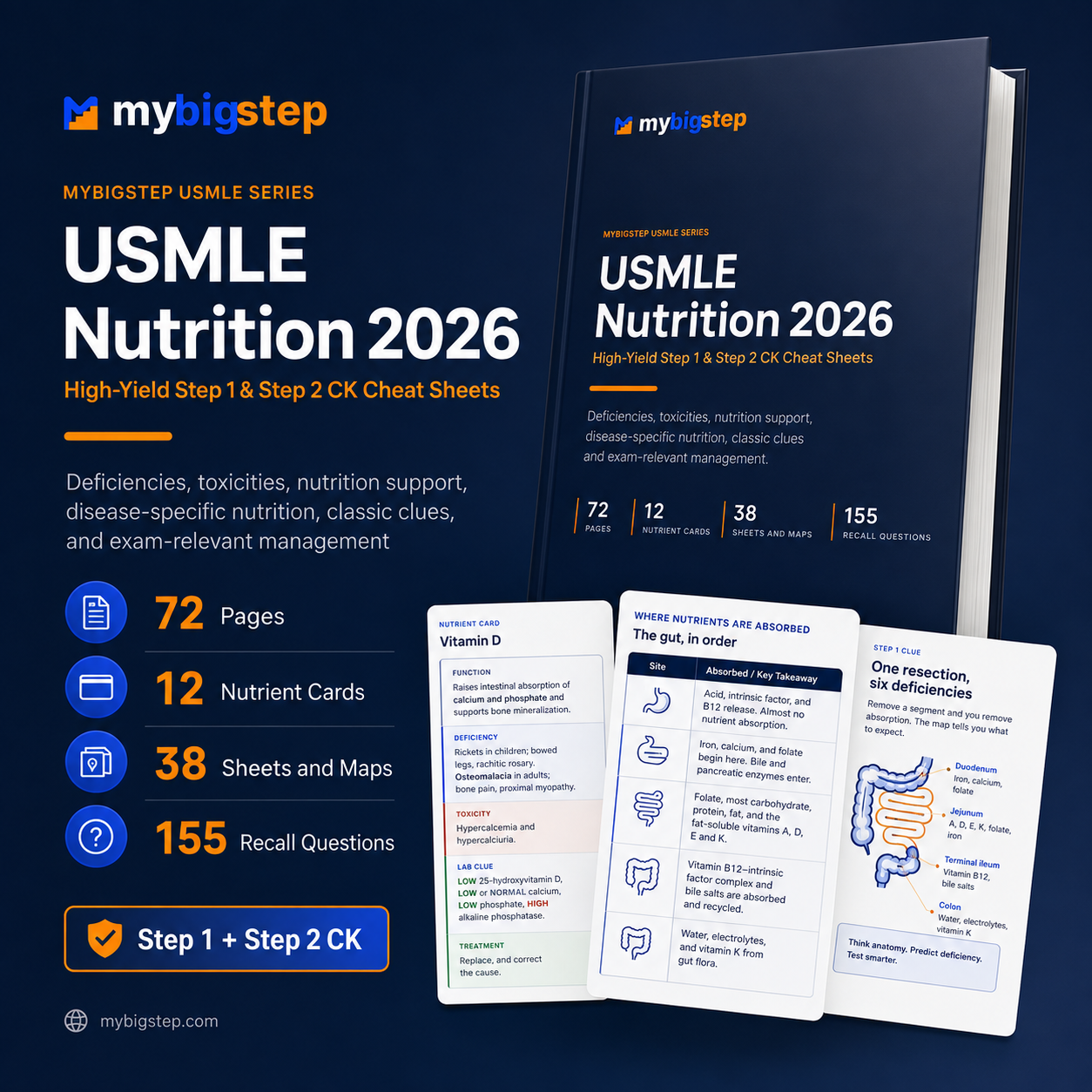
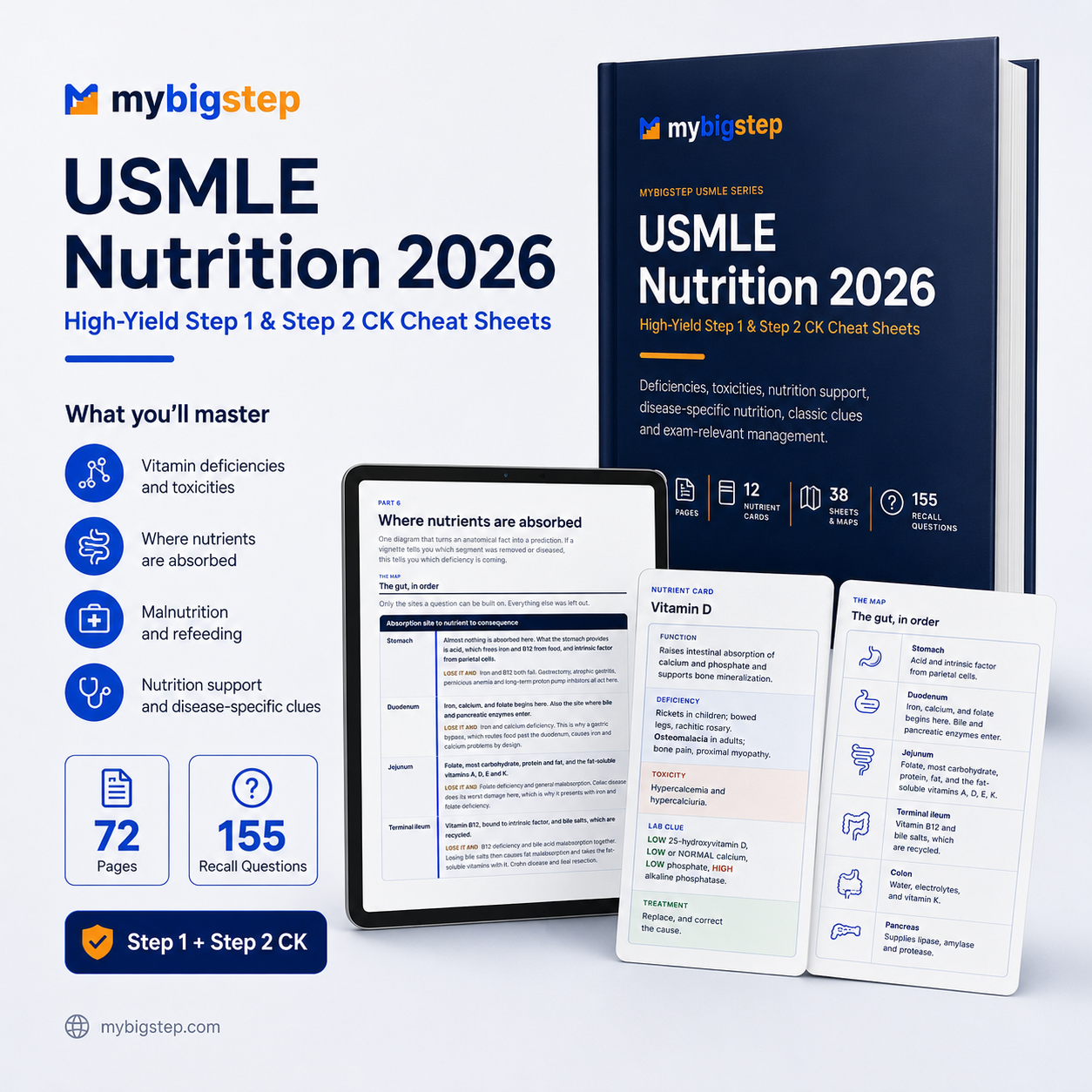
12 nutrient cards in a fixed format: function, deficiency, toxicity, who gets it, the laboratory clue, treatment, and the exam trap attached to it.
38 sheets and maps, including 25 comparison tables, 5 laboratory pattern sheets, and one absorption map that turns an anatomical fact into a prediction about which deficiency is coming.
9 do not mix up cards for the pairs that actually get reversed: B12 against folate, Wernicke against Korsakoff, B12 against copper, marasmus against kwashiorkor, starvation against cachexia.
5 if you see this sheets, 53 classic clue rows in total, each pairing the line in a vignette with the nutrient and the move it calls for.
4 calculations worth carrying, each with a worked example and the trap that comes with it.
A what changes management sheet: the clinical situation, the nutritional implication, and the next action, in three columns. This is the part that separates the guide from a vitamin list.
155 recall questions: 55 original questions with explanations and traps, plus 100 cover the answer prompts placed at the end of each part.
A Final 48 Hours review of 90 compressed lines, and twenty five facts to carry into the building.
A rapid index at the back, 89 terms pointing at the sheet that answers each one.
How it is labelled
Almost every card and sheet carries a label: Step 1 for mechanism and the pathology of the deficiency, Step 2 CK for recognition, laboratory interpretation and the decision that follows, or Both. A fourth label, 2026 focus, is used exactly twice, on the two sheets that most directly reflect the newer emphasis.
What it deliberately leaves out
No food composition tables. No recommended daily allowances. No wellness or weight loss content. No dietetics calculations. And no supplement doses at all, apart from the two folic acid figures used in pregnancy, where the difference between them is itself the examinable fact.
On sources
Nutrition guidance is revised, so every claim in this guide that a professional body could change was checked against that body and is listed on the sources page with the date it was read. There are 4 individually verified claims of that kind, covering the 2026 announcement itself, refeeding syndrome, thiamine and glucose sequencing, and post bariatric deficiency. The settled deficiency and toxicity associations carry no per line citation, because a cheat sheet with a citation on every row is unusable, and the sources page says so plainly. Separately, all 40 ranking claims in the guide, every commonest, highest and only, are registered with the reason each one is allowed to stand.
Format
A single searchable PDF, 72 pages, with a linked contents and a rapid index. Instant download after purchase.
Frequently asked
Is nutrition a bigger part of the exam now? Not in the way the posts suggest. The content was enhanced and is now reported back to you, but the USMLE says it does not receive separate weighting and stays integrated into system based questions. This guide quotes that sentence in full rather than talking around it.
Is this a review book? No. It is a set of cheat sheets built for recall and for the decision that follows, and it assumes you already know the underlying pathology.
Are these real exam questions? No. Every card, sheet, table and question is original work created for this product. No question from any question bank or examination has been reproduced or paraphrased.
Has a physician reviewed it? No, and the guide says so on its own pages. Human review here means editorial and source review by MyBigStep, which is not a specialty board certification and not an independent physician endorsement.
From MyBigStep, drawing on over a decade of experience guiding medical students and graduates through the USMLE and into the Match.
An educational aid for examination preparation. It is not medical advice and not a clinical reference, and nothing in it should be used to make a decision about the care of a real patient. No outcome is promised, and nothing here guarantees a passing result or any particular score. Modern AI assisted tools supported the research, organization and production; every claim was checked against the sources named at the end, and the finished guide was reviewed by a person before release. MyBigStep is not affiliated with, endorsed by, or sponsored by the National Board of Medical Examiners, the Federation of State Medical Boards, or the United States Medical Licensing Examination program.
In June 2026 the USMLE program enhanced nutrition content across all three Step examinations, and started reporting how you did on it. Both of those are real. Almost everything else you have read about the change is not.
There is no separate nutrition section. There is no published percentage of the examination that is nutrition. The USMLE states directly that nutrition content does not receive separate weighting that can disproportionately affect a score, and that it remains integrated into system based and discipline based questions. This guide opens by quoting that sentence, because it is the single most useful thing anyone can tell you about the change, and because a study aid that begins by overstating its own subject has told you what it is on page one.
What did change is worth preparing for. The enhanced content is aligned to a 2024 consensus statement on nutrition competencies, and that framework is weighted toward assessment, diagnosis and clinical application rather than toward reciting which vitamin does what. So this guide puts most of its weight on the Step 2 CK side: who is at risk, what the laboratory pattern shows, which nutrition route to choose, and what you actually do next.
Nutrition for the USMLE, not nutrition for nutritionists.
What is inside
12 nutrient cards in a fixed format: function, deficiency, toxicity, who gets it, the laboratory clue, treatment, and the exam trap attached to it.
38 sheets and maps, including 25 comparison tables, 5 laboratory pattern sheets, and one absorption map that turns an anatomical fact into a prediction about which deficiency is coming.
9 do not mix up cards for the pairs that actually get reversed: B12 against folate, Wernicke against Korsakoff, B12 against copper, marasmus against kwashiorkor, starvation against cachexia.
5 if you see this sheets, 53 classic clue rows in total, each pairing the line in a vignette with the nutrient and the move it calls for.
4 calculations worth carrying, each with a worked example and the trap that comes with it.
A what changes management sheet: the clinical situation, the nutritional implication, and the next action, in three columns. This is the part that separates the guide from a vitamin list.
155 recall questions: 55 original questions with explanations and traps, plus 100 cover the answer prompts placed at the end of each part.
A Final 48 Hours review of 90 compressed lines, and twenty five facts to carry into the building.
A rapid index at the back, 89 terms pointing at the sheet that answers each one.
How it is labelled
Almost every card and sheet carries a label: Step 1 for mechanism and the pathology of the deficiency, Step 2 CK for recognition, laboratory interpretation and the decision that follows, or Both. A fourth label, 2026 focus, is used exactly twice, on the two sheets that most directly reflect the newer emphasis.
What it deliberately leaves out
No food composition tables. No recommended daily allowances. No wellness or weight loss content. No dietetics calculations. And no supplement doses at all, apart from the two folic acid figures used in pregnancy, where the difference between them is itself the examinable fact.
On sources
Nutrition guidance is revised, so every claim in this guide that a professional body could change was checked against that body and is listed on the sources page with the date it was read. There are 4 individually verified claims of that kind, covering the 2026 announcement itself, refeeding syndrome, thiamine and glucose sequencing, and post bariatric deficiency. The settled deficiency and toxicity associations carry no per line citation, because a cheat sheet with a citation on every row is unusable, and the sources page says so plainly. Separately, all 40 ranking claims in the guide, every commonest, highest and only, are registered with the reason each one is allowed to stand.
Format
A single searchable PDF, 72 pages, with a linked contents and a rapid index. Instant download after purchase.
Frequently asked
Is nutrition a bigger part of the exam now? Not in the way the posts suggest. The content was enhanced and is now reported back to you, but the USMLE says it does not receive separate weighting and stays integrated into system based questions. This guide quotes that sentence in full rather than talking around it.
Is this a review book? No. It is a set of cheat sheets built for recall and for the decision that follows, and it assumes you already know the underlying pathology.
Are these real exam questions? No. Every card, sheet, table and question is original work created for this product. No question from any question bank or examination has been reproduced or paraphrased.
Has a physician reviewed it? No, and the guide says so on its own pages. Human review here means editorial and source review by MyBigStep, which is not a specialty board certification and not an independent physician endorsement.
From MyBigStep, drawing on over a decade of experience guiding medical students and graduates through the USMLE and into the Match.
An educational aid for examination preparation. It is not medical advice and not a clinical reference, and nothing in it should be used to make a decision about the care of a real patient. No outcome is promised, and nothing here guarantees a passing result or any particular score. Modern AI assisted tools supported the research, organization and production; every claim was checked against the sources named at the end, and the finished guide was reviewed by a person before release. MyBigStep is not affiliated with, endorsed by, or sponsored by the National Board of Medical Examiners, the Federation of State Medical Boards, or the United States Medical Licensing Examination program.