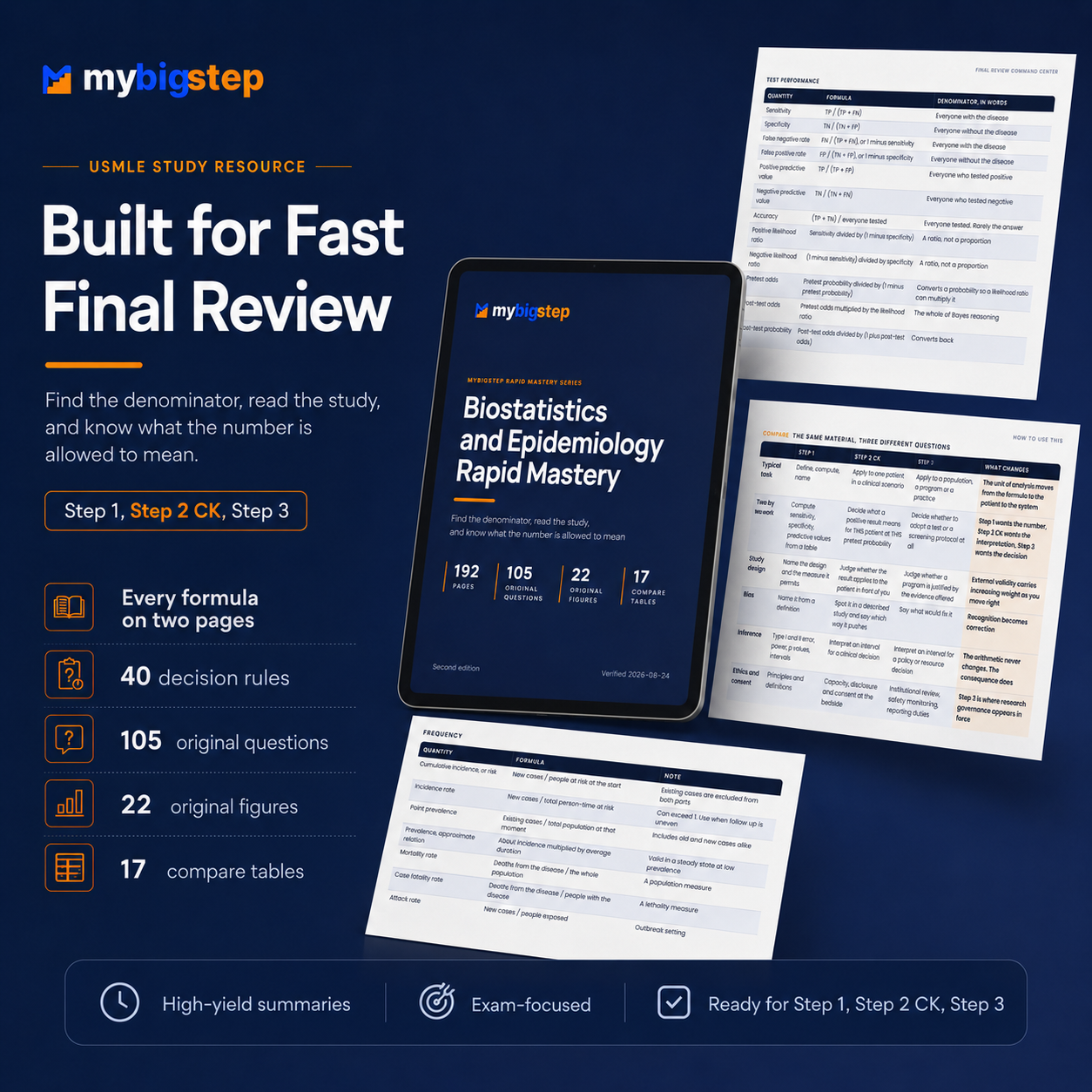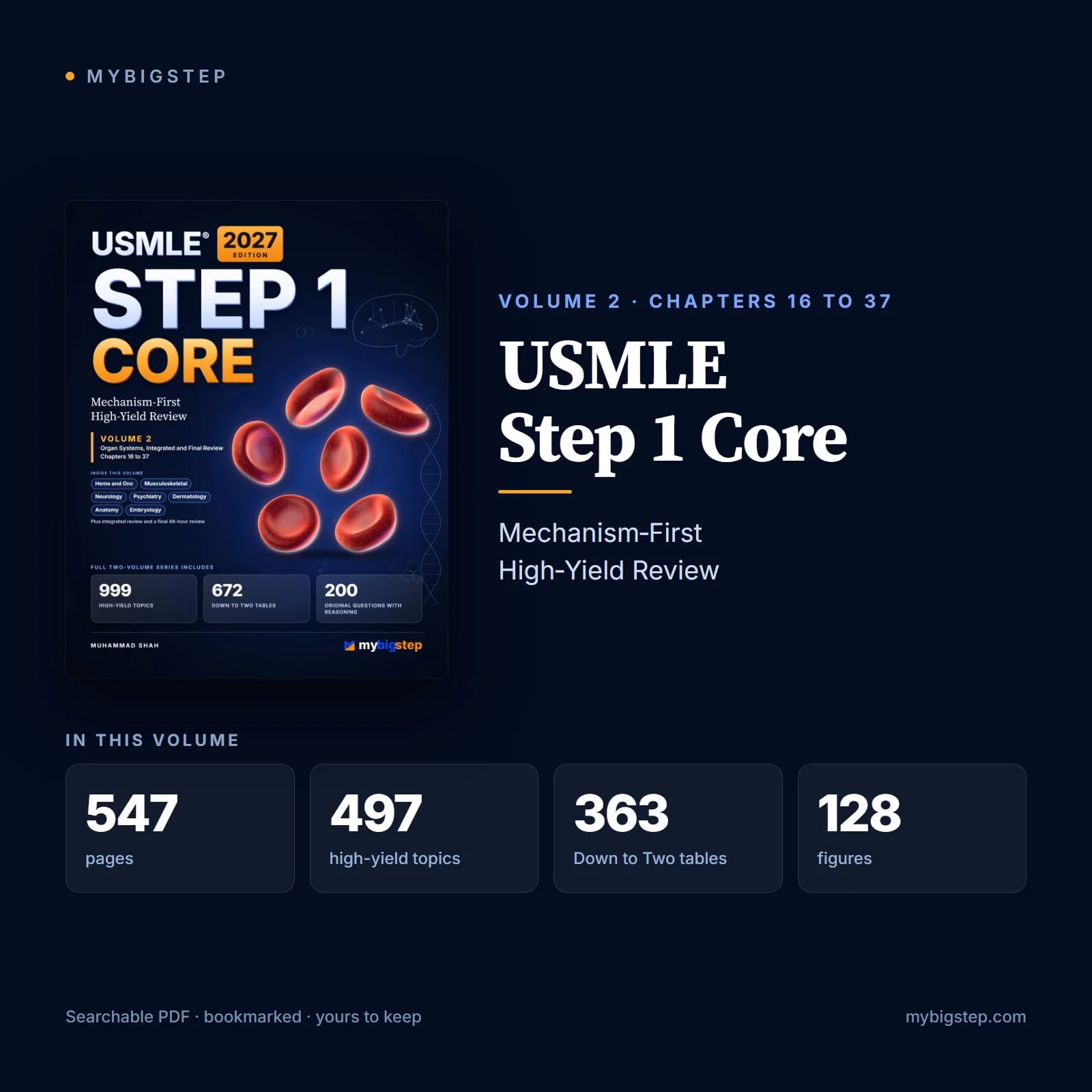
Volume 2 of the two volume USMLE Step 1 Core set: Organ Systems, Integrated and Final Review, chapters 16 to 37.
A review of Step 1 built around how questions are actually reasoned: the fact, the mechanism behind it, the clues that point at it, and the single detail that separates it from the answer choice beside it.
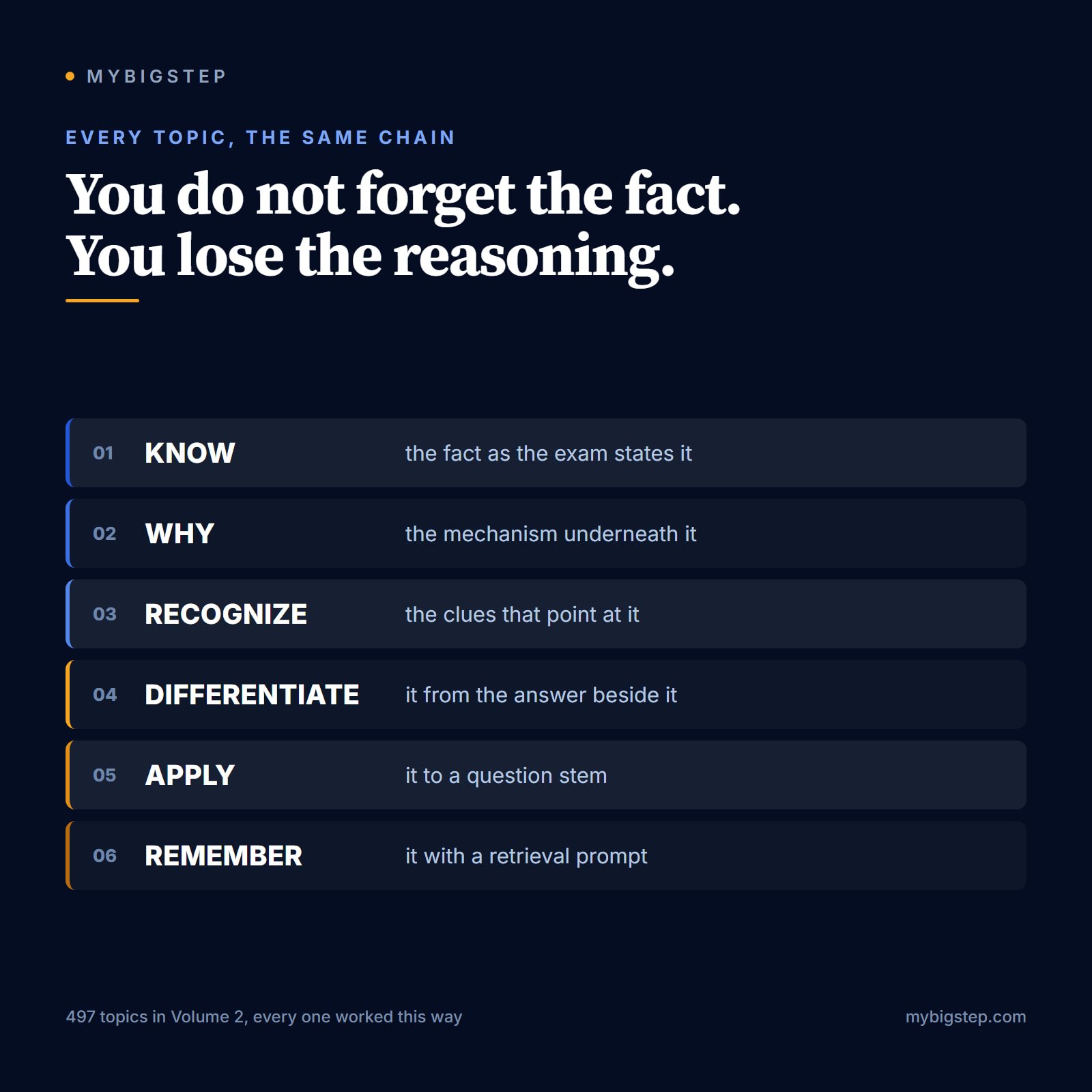
Every topic runs the same chain, so you always know what kind of thinking a block is asking for. KNOW the fact. WHY it happens. RECOGNIZE the clues. DIFFERENTIATE it from its neighbor. APPLY it. REMEMBER it.
What this volume covers
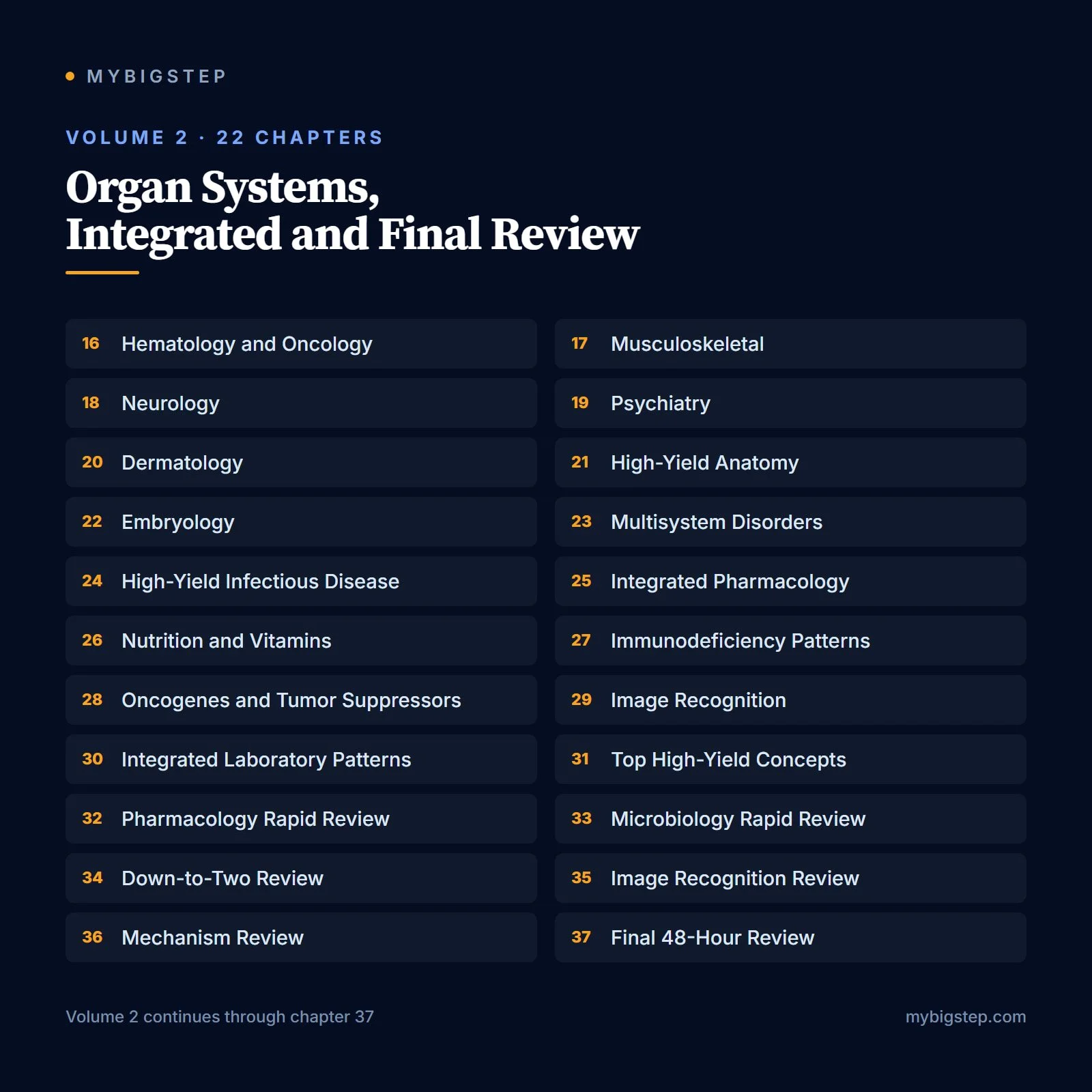
Hematology and Oncology, Musculoskeletal, Neurology, Psychiatry, Dermatology, High-Yield Anatomy, Embryology, Multisystem Disorders, High-Yield Infectious Disease, Integrated Pharmacology, Nutrition and Vitamins, Immunodeficiency Patterns, Oncogenes and Tumor Suppressors, Image Recognition, Integrated Laboratory Patterns, Top High-Yield Concepts, Pharmacology Rapid Review, Microbiology Rapid Review, Down-to-Two Review, Image Recognition Review, Mechanism Review, and a Final 48-Hour Review.
Inside this volume
547 pages at 8 by 10 inches, with PDF bookmarks, a clickable contents and cross references that jump.
497 high-yield topics, each one worked through the same six step chain.
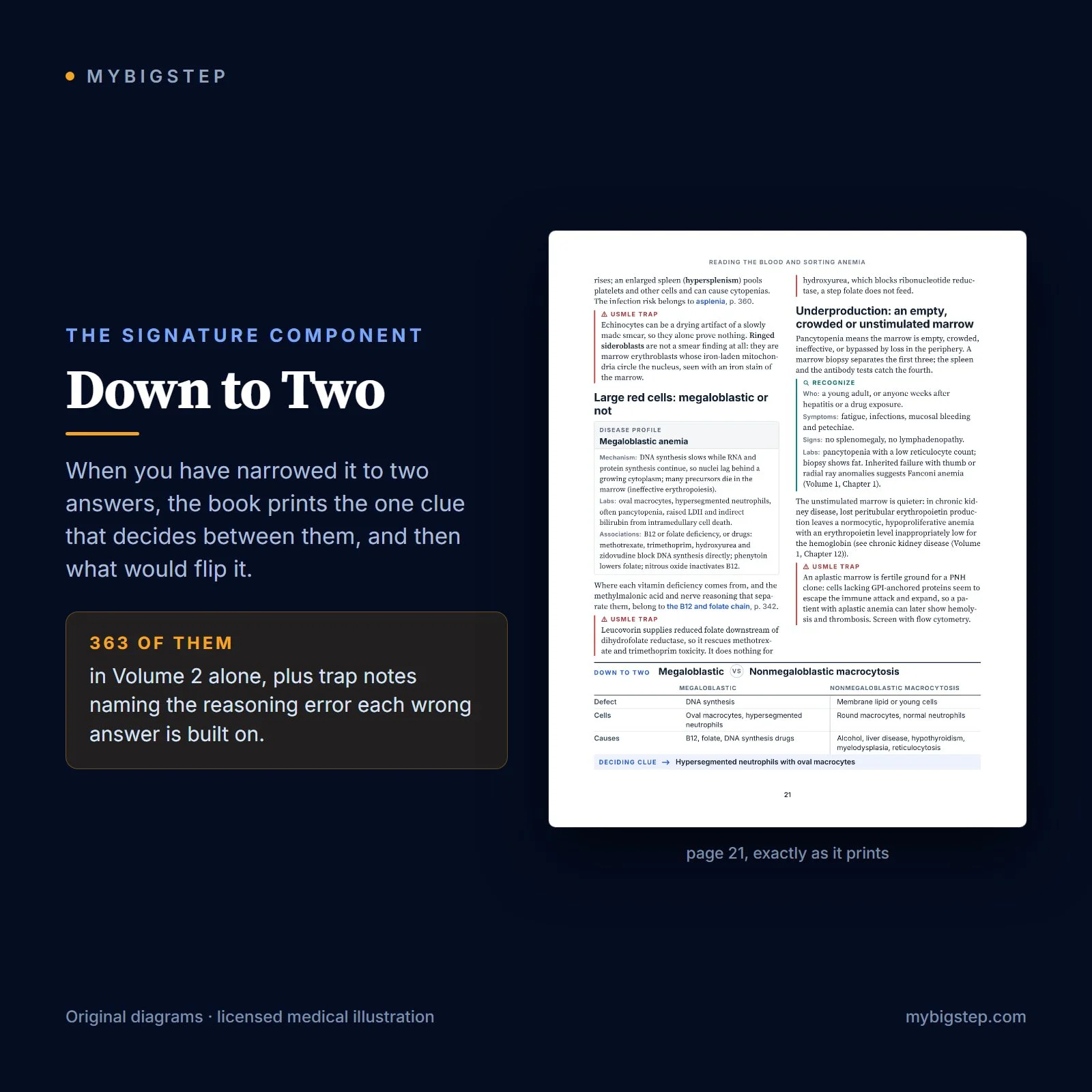
363 DOWN TO TWO tables that print the one clue deciding between the last two answers. This is the component the whole book is built around, and Volume 2 carries more of them than Volume 1.
ONE DETAIL CHANGES EVERYTHING blocks showing how a single new fact overturns a first impression.
IF YOU SEE THIS pairings that tie a strong clue to the diagnosis it should bring to mind, and USMLE TRAP notes that name the reasoning error a plausible wrong answer is built on.
128 figures: licensed medical illustrations for real anatomy, and original diagrams drawn for this book for every mechanism. Color always comes with a label or a shape, so nothing depends on color alone.
96 original quick-check questions with the reasoning for every option, right and wrong, and a one page review closing each chapter.
Built to be the last thing you read
The closing chapters are a rapid review layer rather than new material: pharmacology and microbiology at speed, a Down-to-Two review that drills only the decisions, image recognition, a mechanism review, and a final 48-hour sweep. They point back into the chapters rather than restating them.
Every idea has one home
Organ system chapters point back to the foundation chapter that explains a mechanism rather than repeating it, so there is one correct explanation to learn instead of three slightly different ones. Where a mechanism lives in Volume 1, this volume says so by chapter rather than repeating it.
On sources
Every topic is tied to named sources recorded in the book's provenance files, and each source records whether it was checked in full text, in abstract or in metadata only. The complete reference list is a free companion PDF from mybigstep.com rather than a hundred printed pages. Corrections are posted there too, by volume, page and date.
The honest part
Built with AI assistance and reviewed by a person before release. That is stated exactly as narrowly as it should be: it is not a board certification, not an independent physician endorsement, and not a substitute for a current guideline or a treating clinician's judgment.
This is an educational study aid for examination preparation. It is not medical advice and must not be used to make decisions about the care of a patient. USMLE is a registered trademark of the National Board of Medical Examiners. This independent study aid is not affiliated with, sponsored by or endorsed by the FSMB, the NBME or the USMLE program.
Volume 1, chapters 1 to 15, covers the foundations and the first organ systems. Delivered as a single searchable PDF, for laptop, tablet or personal printing.
Volume 2 of the two volume USMLE Step 1 Core set: Organ Systems, Integrated and Final Review, chapters 16 to 37.
A review of Step 1 built around how questions are actually reasoned: the fact, the mechanism behind it, the clues that point at it, and the single detail that separates it from the answer choice beside it.
Every topic runs the same chain, so you always know what kind of thinking a block is asking for. KNOW the fact. WHY it happens. RECOGNIZE the clues. DIFFERENTIATE it from its neighbor. APPLY it. REMEMBER it.
What this volume covers
Hematology and Oncology, Musculoskeletal, Neurology, Psychiatry, Dermatology, High-Yield Anatomy, Embryology, Multisystem Disorders, High-Yield Infectious Disease, Integrated Pharmacology, Nutrition and Vitamins, Immunodeficiency Patterns, Oncogenes and Tumor Suppressors, Image Recognition, Integrated Laboratory Patterns, Top High-Yield Concepts, Pharmacology Rapid Review, Microbiology Rapid Review, Down-to-Two Review, Image Recognition Review, Mechanism Review, and a Final 48-Hour Review.
Inside this volume
547 pages at 8 by 10 inches, with PDF bookmarks, a clickable contents and cross references that jump.
497 high-yield topics, each one worked through the same six step chain.
363 DOWN TO TWO tables that print the one clue deciding between the last two answers. This is the component the whole book is built around, and Volume 2 carries more of them than Volume 1.
ONE DETAIL CHANGES EVERYTHING blocks showing how a single new fact overturns a first impression.
IF YOU SEE THIS pairings that tie a strong clue to the diagnosis it should bring to mind, and USMLE TRAP notes that name the reasoning error a plausible wrong answer is built on.
128 figures: licensed medical illustrations for real anatomy, and original diagrams drawn for this book for every mechanism. Color always comes with a label or a shape, so nothing depends on color alone.
96 original quick-check questions with the reasoning for every option, right and wrong, and a one page review closing each chapter.
Built to be the last thing you read
The closing chapters are a rapid review layer rather than new material: pharmacology and microbiology at speed, a Down-to-Two review that drills only the decisions, image recognition, a mechanism review, and a final 48-hour sweep. They point back into the chapters rather than restating them.
Every idea has one home
Organ system chapters point back to the foundation chapter that explains a mechanism rather than repeating it, so there is one correct explanation to learn instead of three slightly different ones. Where a mechanism lives in Volume 1, this volume says so by chapter rather than repeating it.
On sources
Every topic is tied to named sources recorded in the book's provenance files, and each source records whether it was checked in full text, in abstract or in metadata only. The complete reference list is a free companion PDF from mybigstep.com rather than a hundred printed pages. Corrections are posted there too, by volume, page and date.
The honest part
Built with AI assistance and reviewed by a person before release. That is stated exactly as narrowly as it should be: it is not a board certification, not an independent physician endorsement, and not a substitute for a current guideline or a treating clinician's judgment.
This is an educational study aid for examination preparation. It is not medical advice and must not be used to make decisions about the care of a patient. USMLE is a registered trademark of the National Board of Medical Examiners. This independent study aid is not affiliated with, sponsored by or endorsed by the FSMB, the NBME or the USMLE program.
Volume 1, chapters 1 to 15, covers the foundations and the first organ systems. Delivered as a single searchable PDF, for laptop, tablet or personal printing.