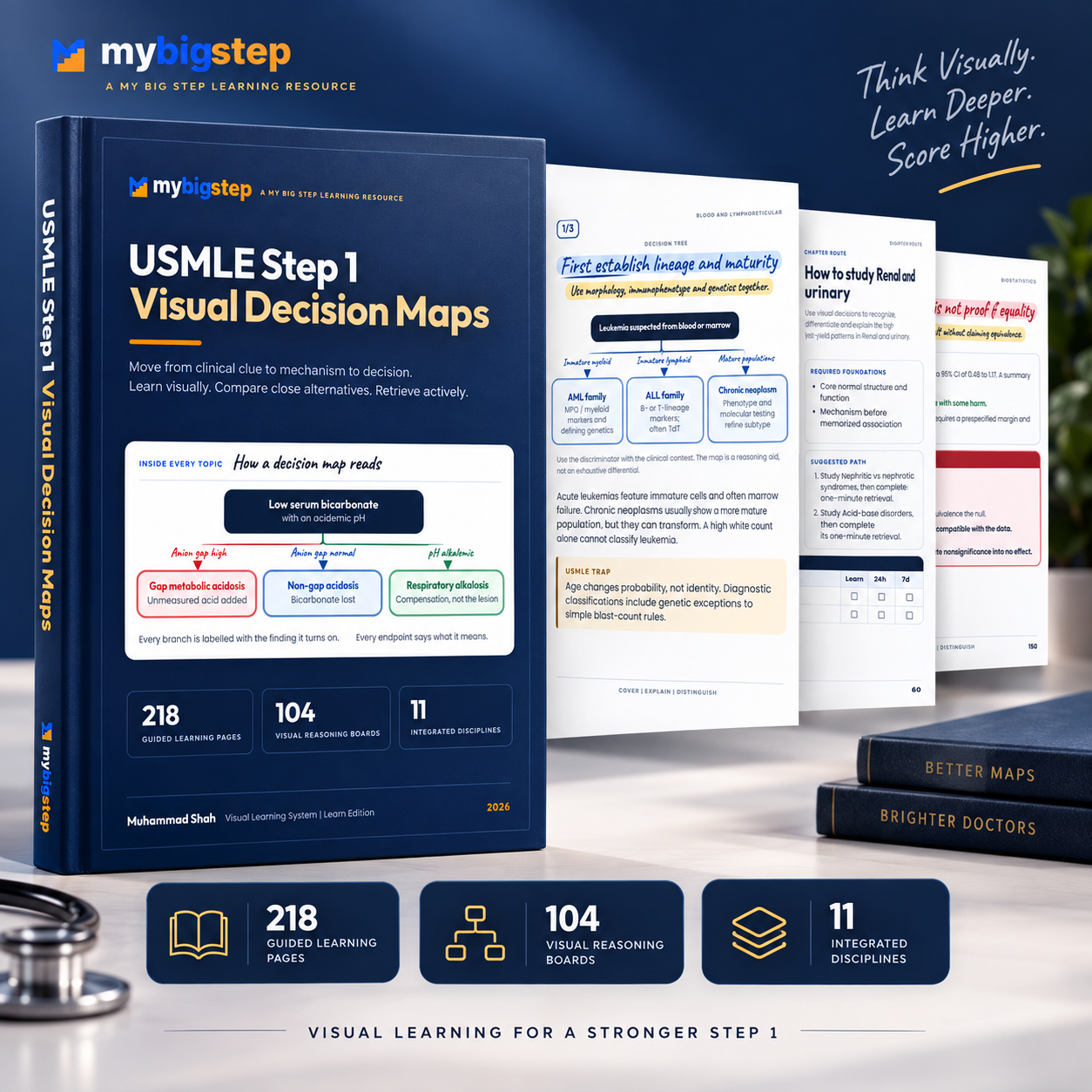
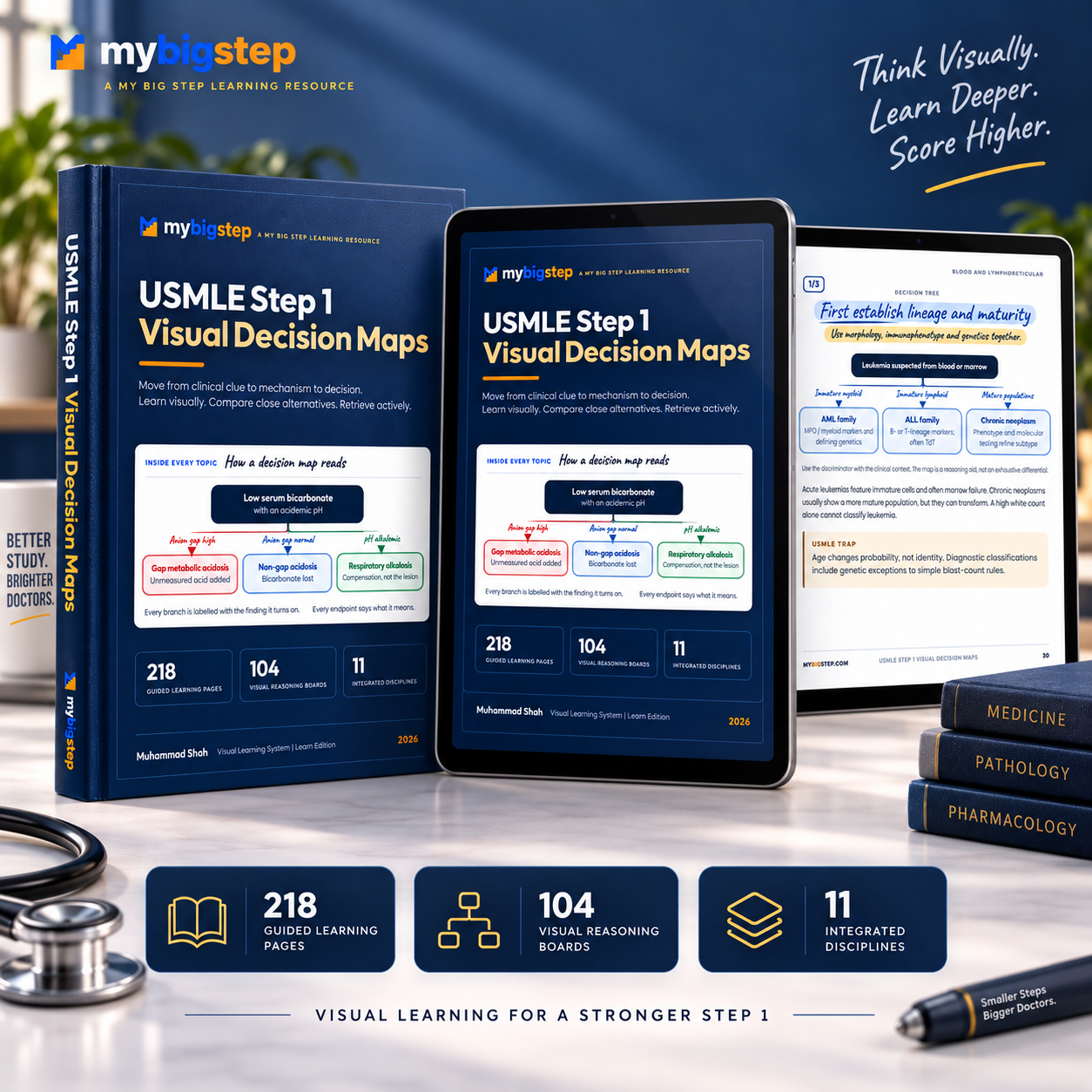
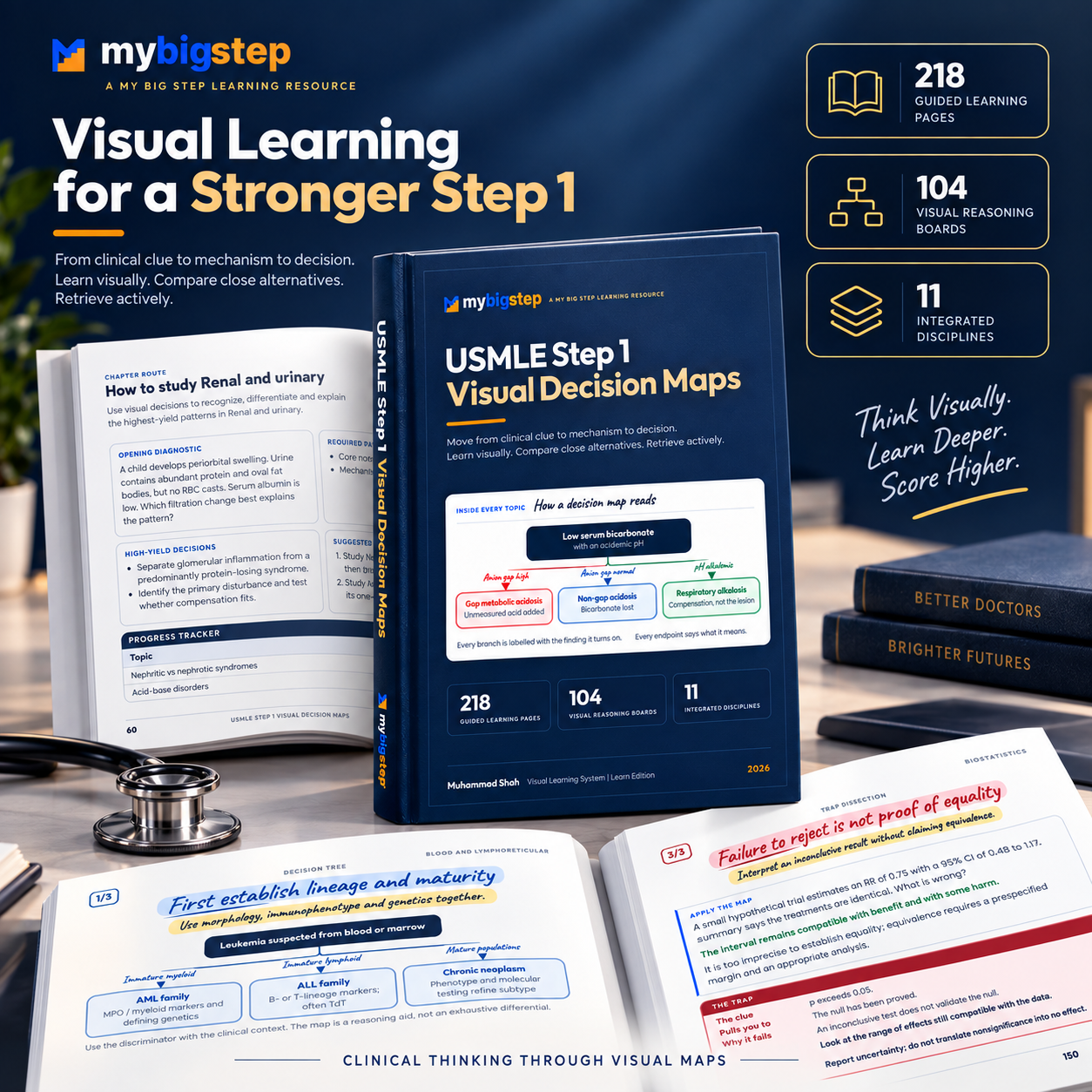
The clue, the branch it turns on, the mechanism underneath it, and the wrong answer the item was built to pull you toward. Every branch is labelled with the finding it turns on, and every endpoint says what it means. It assumes you have met the material once and that your difficulty is deciding quickly rather than finding information.
Scope, stated plainly. This edition contains 36 selected topics across 11 Step 1 curriculum areas, worked at roughly six pages and three teaching boards each. It goes deep on what it covers rather than wide: it is a focused learning collection, not a complete Step 1 curriculum, and if you want one resource covering all of Step 1 this is not it.
What is inside
218 guided learning pages, 104 visual reasoning boards, 11 integrated disciplines: immunology, blood and lymphoreticular, cardiovascular, respiratory, renal and urinary, gastrointestinal, endocrine, multisystem and biochemistry, microbiology, integrated pharmacology, and biostatistics and population health.
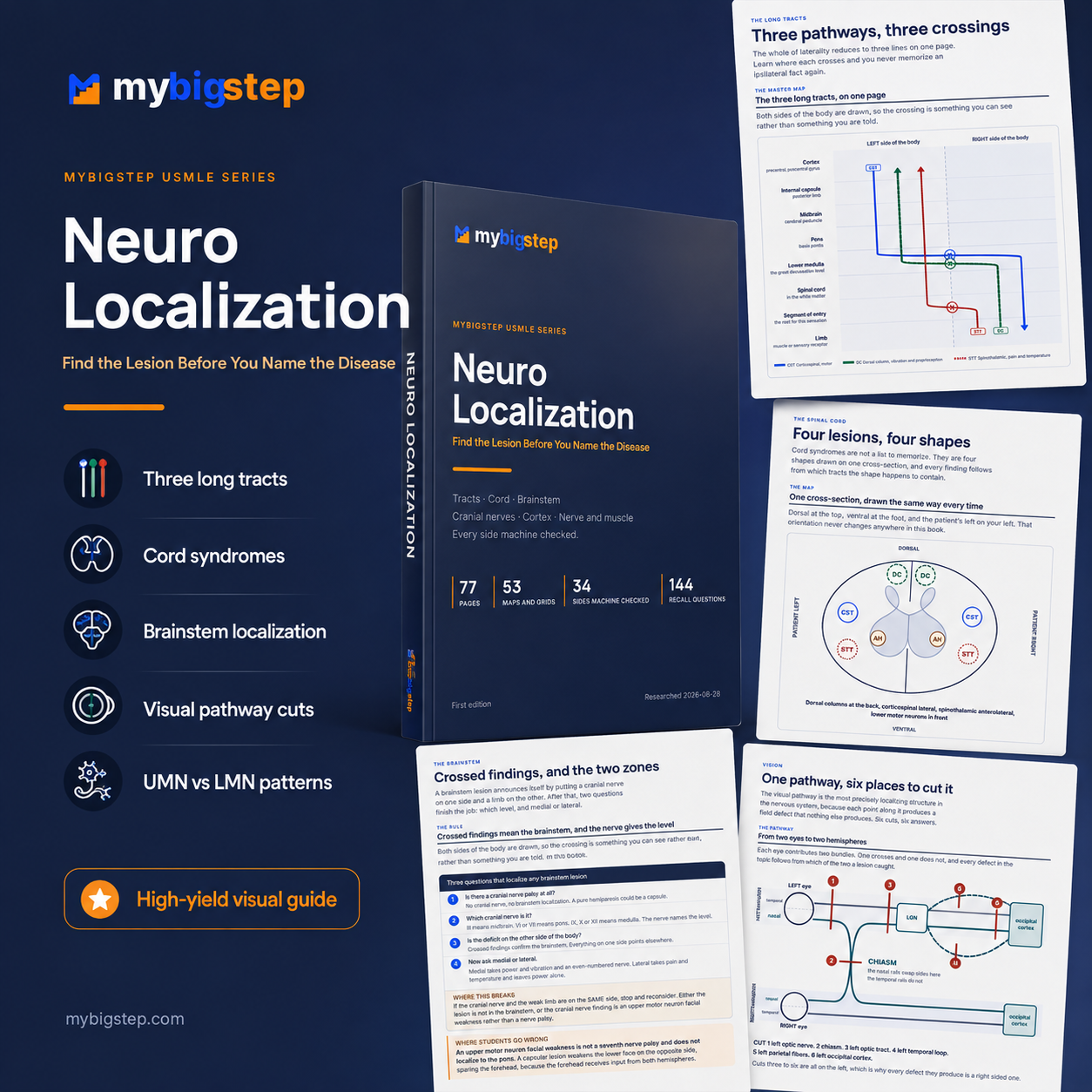
Decision maps that move from clinical clue to mechanism to decision. A three way branch is never presented as a complete list of possible diagnoses, and the guide says so.
Mechanism maps where every arrow links a cause with its consequence.
Original vector illustrations. Every diagram is generated from data in the project source, which is why they are sharp at any zoom and consistent with one another.
A consistent visual language: red for injury or pathology, blue for physiology or diagnostic structure, green for preserved function, purple for genetics and associations, yellow for a clue worth noticing. Text labels carry the meaning where colour is unavailable.
Eight freely licensed clinical images for the image dependent topics, each printed with its creator, source and licence on the page it appears on.
Active recall built into the page. Predict the decision, work the boards, cover the answer and solve the original vignette, then redraw one map from memory and explain one wrong alternative.
A six week study plan, per chapter study guidance, chapter retrieval checklists, answers and rationales.
Bookmarks, a linked contents and live source links, so the reasoning can be checked rather than taken on trust.
The biostatistics and population health chapter is the deepest in the book, at 16 of the 36 topics and 42 of the 104 boards, covering test interpretation, study design, measures of association and the traps that decide those items.
What it does not claim
Step 1 has been reported as pass or fail only since 26 January 2022. There is no score to raise and this book does not offer one. It promises no pass, no percentile, no time saving and no other outcome. No testimonials, user counts or pass rates appear anywhere in it, because there are none that could honestly be reported.
Every diagram, decision tree, comparison, vignette and memory anchor here was written or generated for this book. Nothing has been copied or adapted from another review resource, and no question from any question bank has been reproduced or reconstructed.
How it was made, and who checked it
AI assisted tools supported the research, organization, editing and visual production. No tool determined or verified a clinical claim on its own: every claim was checked against the primary sources in the source notes, and the book was reviewed by a person before release. That review is editorial and source review by My Big Step. It is not a board certification, not an independent physician endorsement, and not a substitute for a current guideline or a treating clinician's judgment.
An educational aid for examination preparation. It is not clinical guidance and must not be used to make decisions about the care of a patient. Guidance changes; verify anything you intend to act on against a current primary source. My Big Step is not affiliated with, endorsed by or sponsored by the Federation of State Medical Boards, the National Board of Medical Examiners, the United States Medical Licensing Examination program or the National Board of Osteopathic Medical Examiners. USMLE is a registered trademark of its owners, used here only to describe the examination this book prepares you for.
Delivered as a single searchable PDF with bookmarks, for laptop, tablet or personal printing. The personal licence permits one purchaser to download, study and print one copy.
The clue, the branch it turns on, the mechanism underneath it, and the wrong answer the item was built to pull you toward. Every branch is labelled with the finding it turns on, and every endpoint says what it means. It assumes you have met the material once and that your difficulty is deciding quickly rather than finding information.
Scope, stated plainly. This edition contains 36 selected topics across 11 Step 1 curriculum areas, worked at roughly six pages and three teaching boards each. It goes deep on what it covers rather than wide: it is a focused learning collection, not a complete Step 1 curriculum, and if you want one resource covering all of Step 1 this is not it.
What is inside
218 guided learning pages, 104 visual reasoning boards, 11 integrated disciplines: immunology, blood and lymphoreticular, cardiovascular, respiratory, renal and urinary, gastrointestinal, endocrine, multisystem and biochemistry, microbiology, integrated pharmacology, and biostatistics and population health.
Decision maps that move from clinical clue to mechanism to decision. A three way branch is never presented as a complete list of possible diagnoses, and the guide says so.
Mechanism maps where every arrow links a cause with its consequence.
Original vector illustrations. Every diagram is generated from data in the project source, which is why they are sharp at any zoom and consistent with one another.
A consistent visual language: red for injury or pathology, blue for physiology or diagnostic structure, green for preserved function, purple for genetics and associations, yellow for a clue worth noticing. Text labels carry the meaning where colour is unavailable.
Eight freely licensed clinical images for the image dependent topics, each printed with its creator, source and licence on the page it appears on.
Active recall built into the page. Predict the decision, work the boards, cover the answer and solve the original vignette, then redraw one map from memory and explain one wrong alternative.
A six week study plan, per chapter study guidance, chapter retrieval checklists, answers and rationales.
Bookmarks, a linked contents and live source links, so the reasoning can be checked rather than taken on trust.
The biostatistics and population health chapter is the deepest in the book, at 16 of the 36 topics and 42 of the 104 boards, covering test interpretation, study design, measures of association and the traps that decide those items.
What it does not claim
Step 1 has been reported as pass or fail only since 26 January 2022. There is no score to raise and this book does not offer one. It promises no pass, no percentile, no time saving and no other outcome. No testimonials, user counts or pass rates appear anywhere in it, because there are none that could honestly be reported.
Every diagram, decision tree, comparison, vignette and memory anchor here was written or generated for this book. Nothing has been copied or adapted from another review resource, and no question from any question bank has been reproduced or reconstructed.
How it was made, and who checked it
AI assisted tools supported the research, organization, editing and visual production. No tool determined or verified a clinical claim on its own: every claim was checked against the primary sources in the source notes, and the book was reviewed by a person before release. That review is editorial and source review by My Big Step. It is not a board certification, not an independent physician endorsement, and not a substitute for a current guideline or a treating clinician's judgment.
An educational aid for examination preparation. It is not clinical guidance and must not be used to make decisions about the care of a patient. Guidance changes; verify anything you intend to act on against a current primary source. My Big Step is not affiliated with, endorsed by or sponsored by the Federation of State Medical Boards, the National Board of Medical Examiners, the United States Medical Licensing Examination program or the National Board of Osteopathic Medical Examiners. USMLE is a registered trademark of its owners, used here only to describe the examination this book prepares you for.
Delivered as a single searchable PDF with bookmarks, for laptop, tablet or personal printing. The personal licence permits one purchaser to download, study and print one copy.