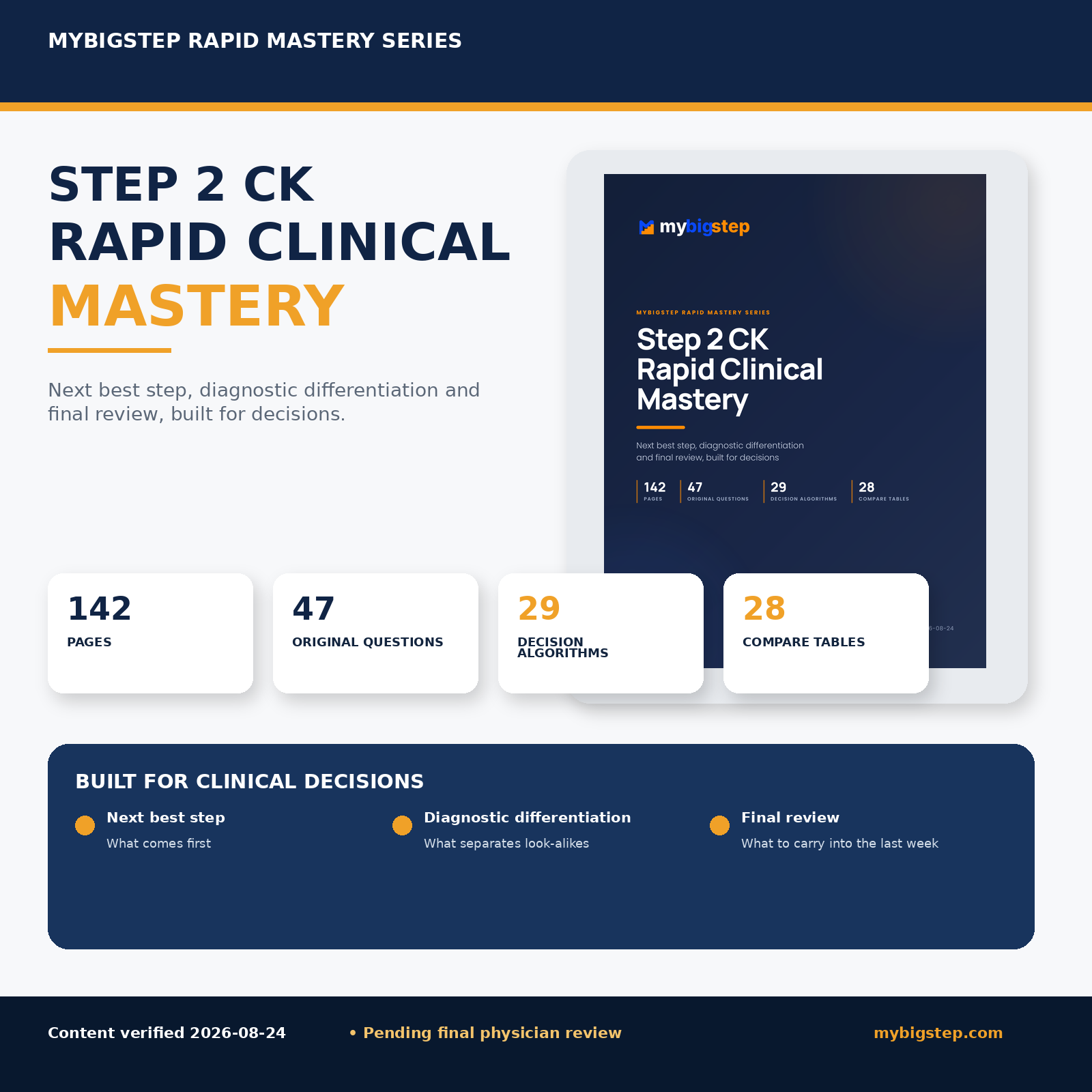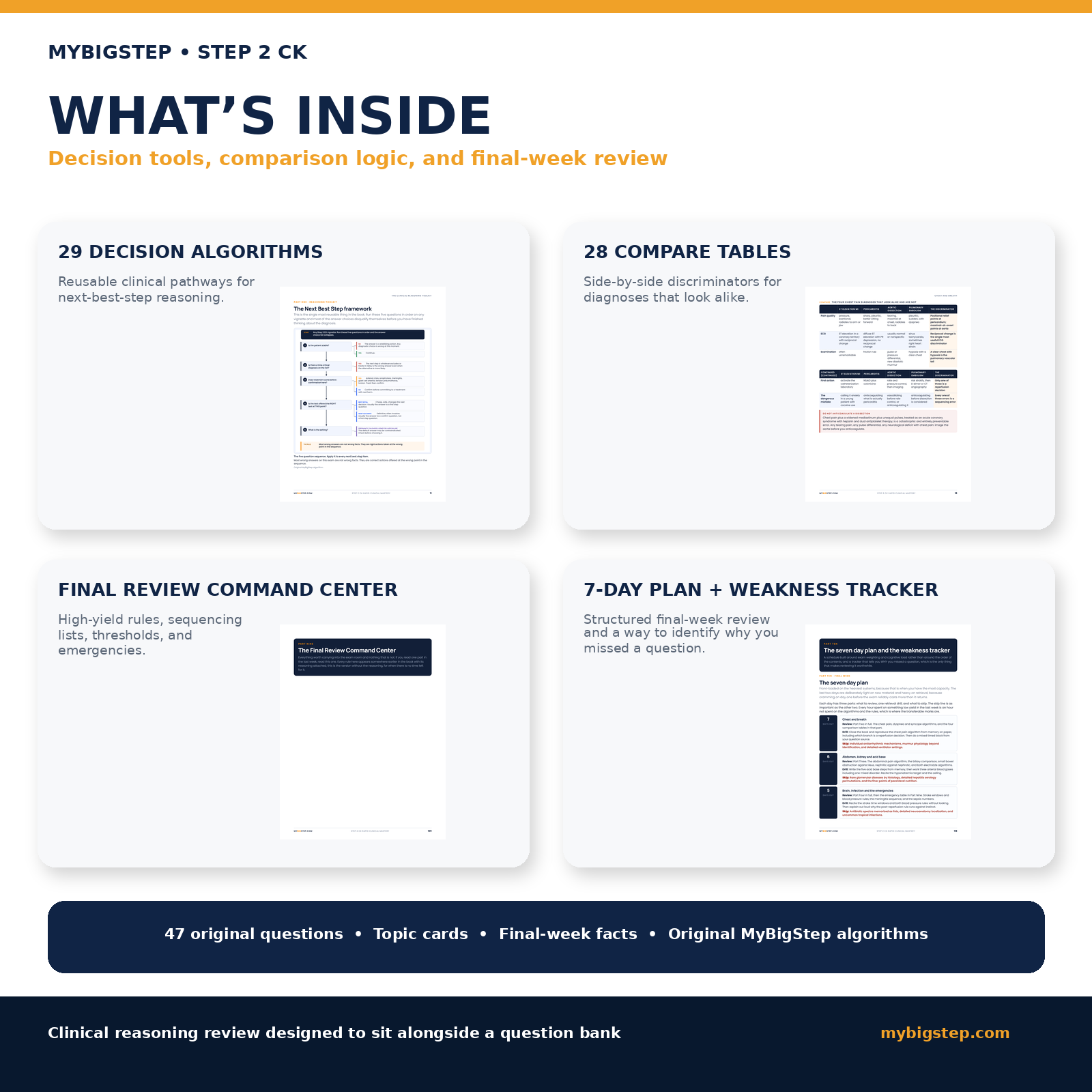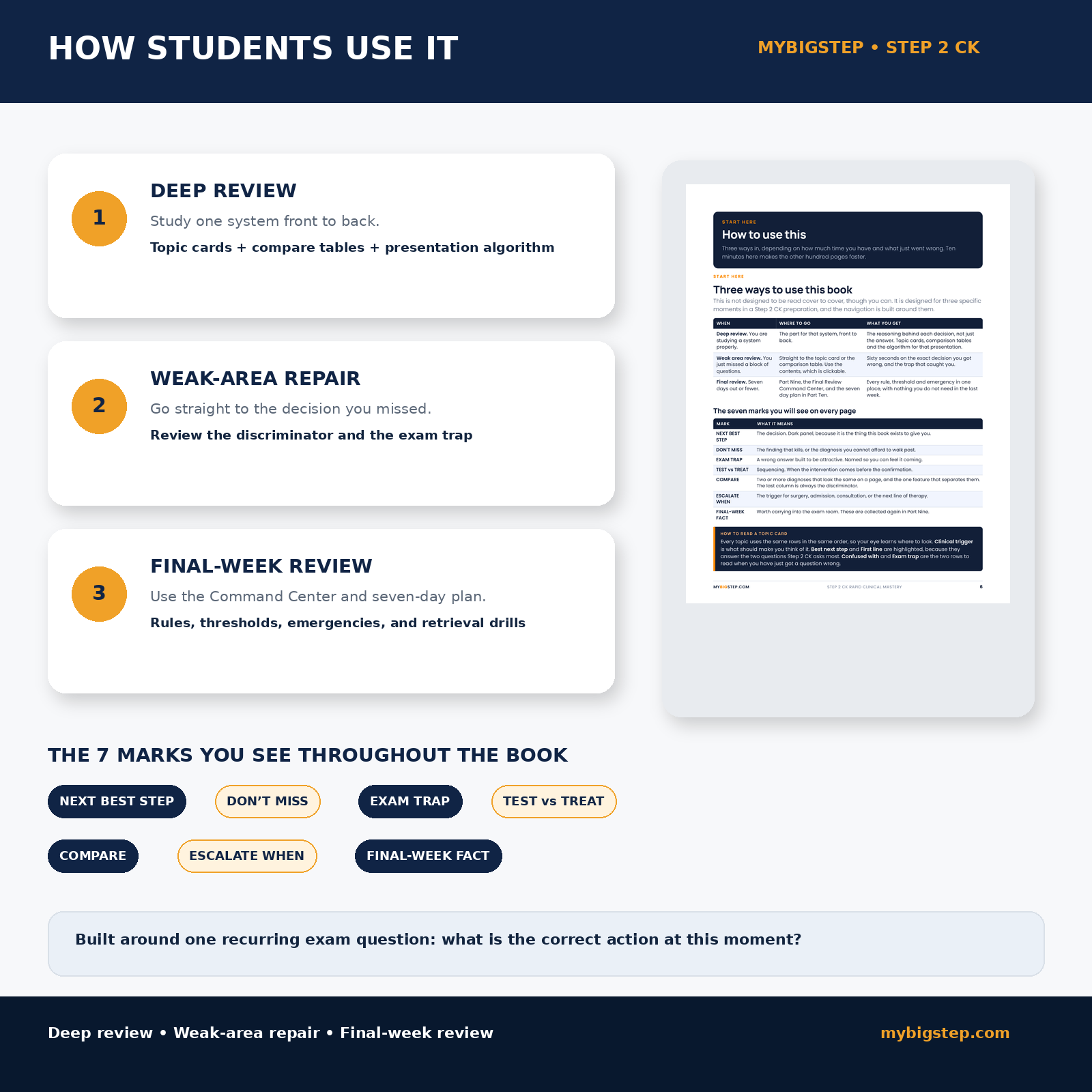
Most diagnostic questions on Step 2 CK are not asking whether you know the test. They are asking whether you know which test, in this patient, right now.
That is a different skill, and almost nothing teaches it directly. Question banks teach it one vignette at a time. Review books teach the disease and leave the sequencing implicit. So students arrive at the examination able to name the confirmatory test for a condition and still unable to choose between two options that both look correct.
This guide teaches the choice itself.
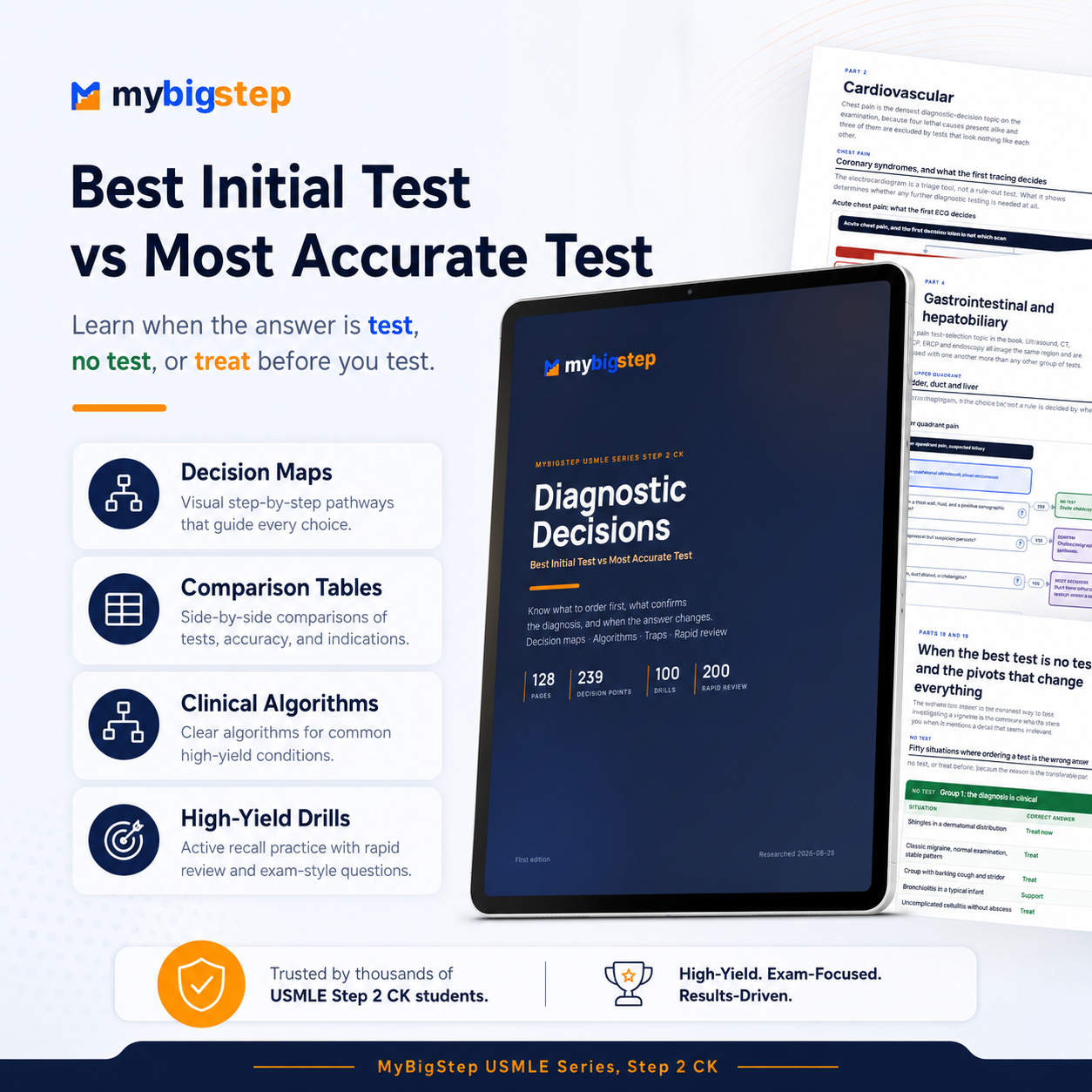
Every presentation is worked as a decision rather than a description: what the probability is before you order anything, whether the patient is stable enough for the sequence to apply, what to order first, what confirms it, why the more accurate test is not the first one, and the exception that reverses all of it. 239 decision points are worked this way across thirteen specialty parts, from acute coronary syndrome to the febrile infant.
The centerpiece is the pivot. A best initial test is not a property of a disease; it is a property of a situation, and the situation is what the vignette is describing when it mentions a detail that seems irrelevant. 358 pivots are printed on the cards themselves, in the form the examination uses them: if the patient is unstable, if she is pregnant, if the creatinine is raised, if this is day two rather than day six, then the answer becomes something else.
It also teaches the answer students find hardest to select: no test at all. 50 no test situations where ordering something is the wrong choice, grouped by the four reasons: the diagnosis is clinical, the result will not change management, the probability is too low for the test to help, or testing would delay something time critical.
What is inside
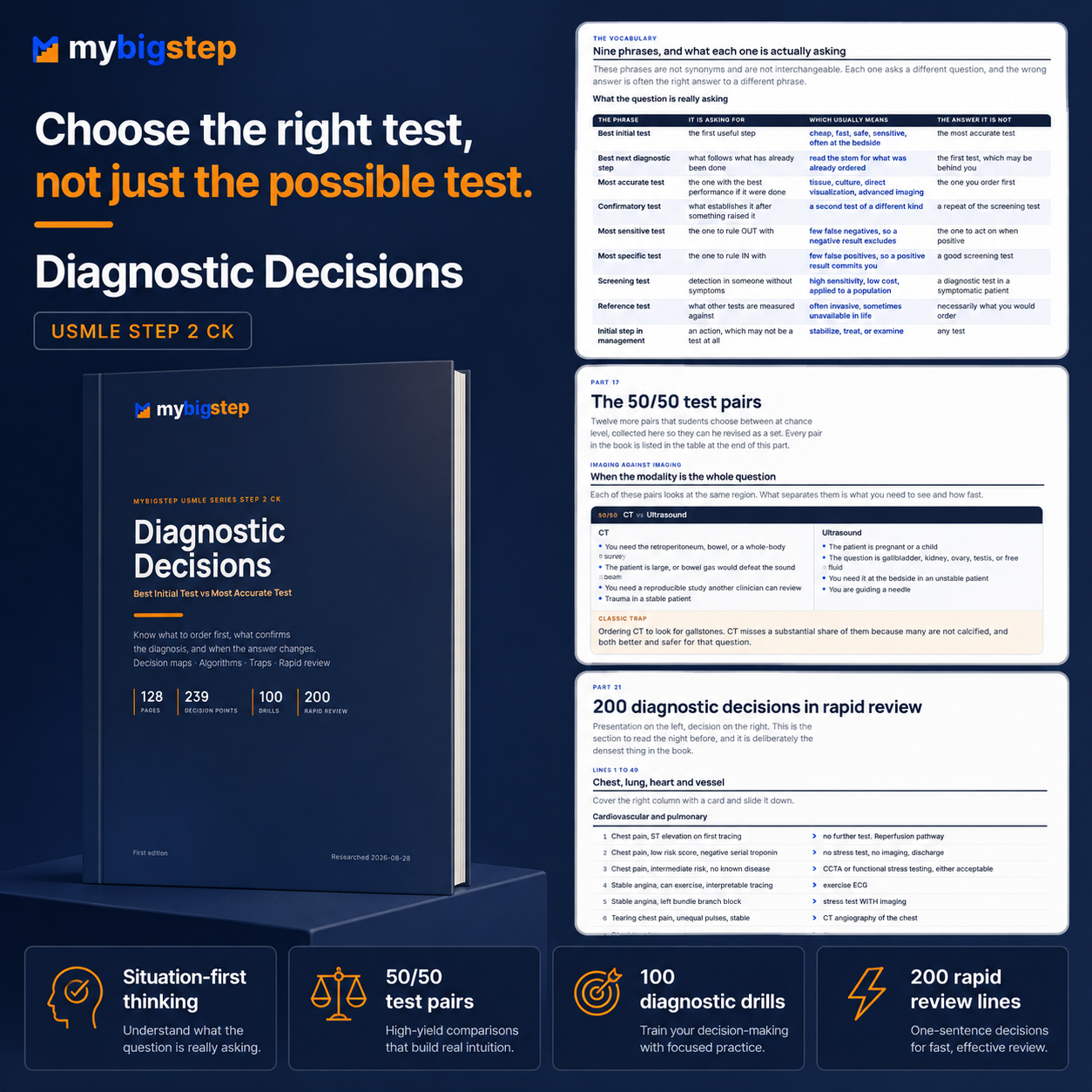
Part 1, the framework. Eight sections on the vocabulary itself: what best initial, most accurate, confirmatory, screening and reference actually mean in an examination stem; sensitivity against specificity as a choosing tool rather than a definition; how pretest probability decides whether a test helps at all; how instability overrides every sequence; when treatment comes before testing; and the four reasons the answer is no test.
Thirteen specialty parts. Cardiovascular, pulmonary, gastrointestinal and hepatobiliary, renal and genitourinary, endocrine, hematology and oncology, infectious disease, neurology, obstetrics and gynecology, pediatrics, surgery and trauma, rheumatology and psychiatry, and dermatology, ophthalmology and ENT.
26 fifty-fifty test pairs. CT against MRI, ultrasound against CT, D-dimer against imaging, troponin against stress testing, MRCP against ERCP, FAST against CT, urinalysis against culture, surface swab against deep culture, and nineteen more, each with the deciding feature stated in one line.
13 comparison grids carrying 103 rows, and 2 finder grids carrying 9 rows.
17 original figures: decision flows, forks, and a probability strip. Every figure was drawn for this book.
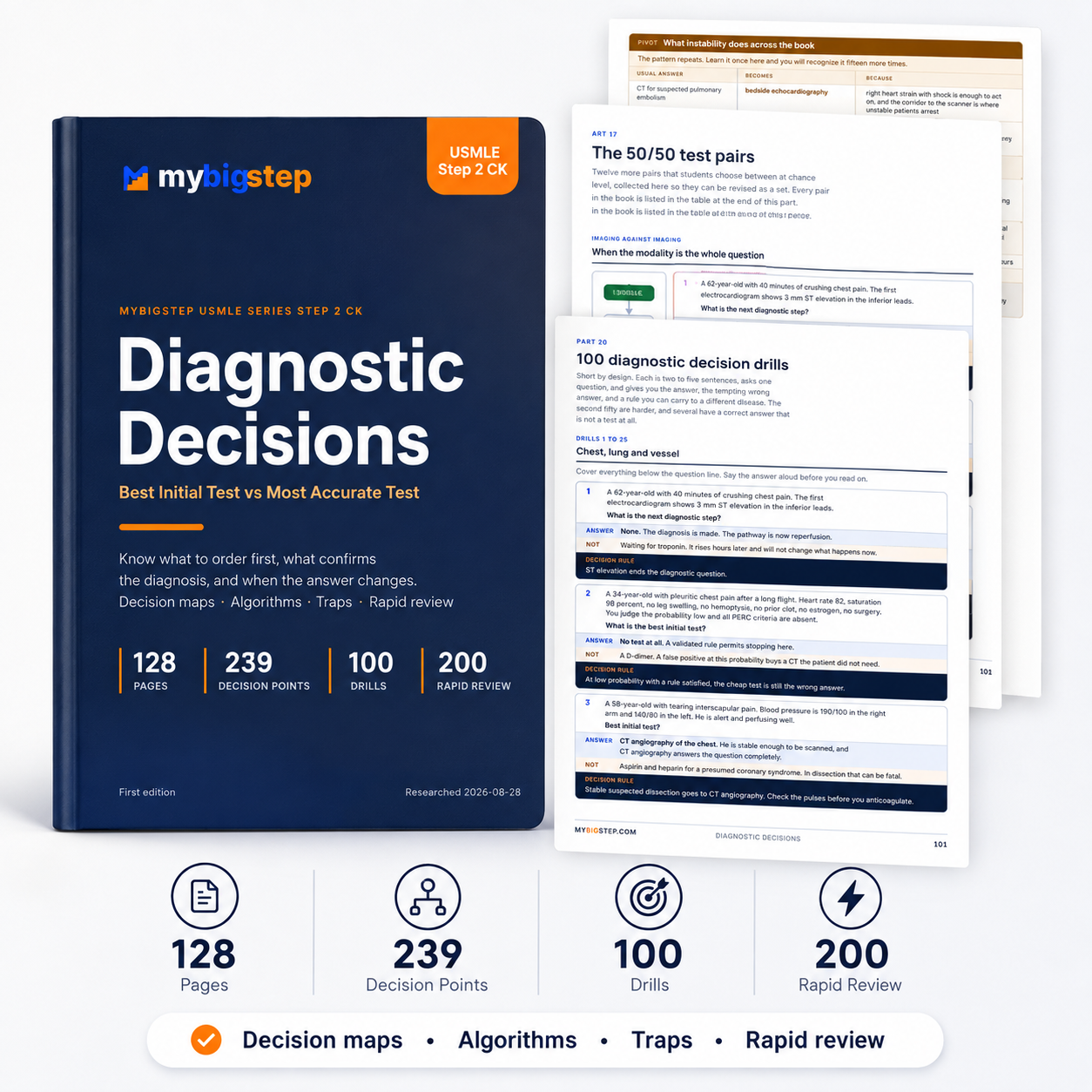
100 diagnostic decision drills. Two to five sentences each, then the answer, why the tempting alternative is wrong, and the transferable rule. These are decision drills, not question bank stems.
200 diagnostic decisions in rapid review. Presentation on the left, answer on the right. Built to be read the night before.
A working index of 174 terms, PDF bookmarks and a clickable contents.
The rule the build system enforces
This product refuses to print a decision card that has collapsed into a lookup. A card naming a confirmatory test must state why that test is not first, and every card must carry at least one pivot. Those are not editorial preferences; they are checks in the build, and a card that fails them stops the build rather than reaching the page. The phrase gold standard is banned outright in the content for the same reason: it describes a property of a disease, and the correct test is a property of a situation.
Where classic teaching has changed, this says so
13 individually verified claims, each recorded with the source and the date it was read, including the 2026 change to postmenopausal bleeding evaluation and the current HIV testing algorithm. Where two societies differ the book says so rather than picking one and presenting it as settled. No retired gold standard claims are repeated.
What this is not
It is not a disease review, a list of tests, or a replacement for a question bank. It carries almost no epidemiology, no treatment dosing, and no pathophysiology beyond what is needed to choose between two tests. It is one skill, taught to depth. Written for Step 2 CK: the diagnostic vocabulary in Part 1 transfers directly to Step 1, and the sequencing sections transfer to Step 3.
Where it sits beside the rest of the store
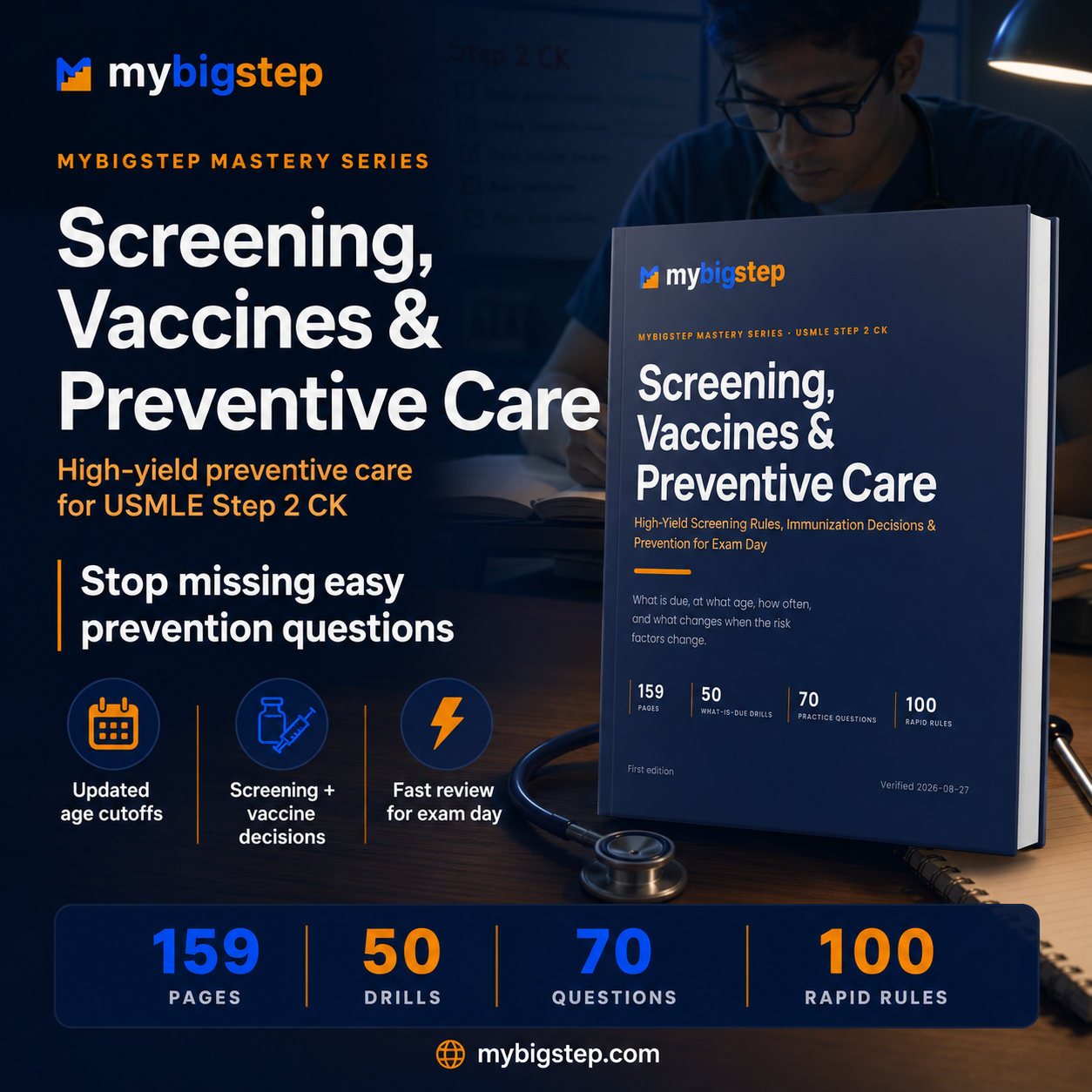
Next Best Step owns what to do next. Screening, Vaccines and Preventive Care owns the well patient. This one owns which test, in this patient, right now. Where it touches a presentation that Next Best Step also covers, it stops at the diagnosis and hands over, and that boundary is stated inside the book so buyers of both do not feel they have paid twice.
The honest part
This is an educational aid for examination preparation. It is not medical advice and not a clinical reference. Nothing here guarantees a passing result, and no resource can honestly promise one. Modern AI assisted tools supported the research, organization and production, every claim was checked against the sources named at the end, and the finished guide was reviewed by a person before release. That review is editorial and source review by MyBigStep. It is not a specialty board certification and not an independent physician endorsement.
There is not a single photograph, radiograph or borrowed illustration in these pages. Every figure is original vector artwork generated from the project source. Delivered as a single searchable PDF with bookmarks. MyBigStep is not affiliated with, endorsed by, or sponsored by the NBME, the FSMB, or the USMLE program.
Most diagnostic questions on Step 2 CK are not asking whether you know the test. They are asking whether you know which test, in this patient, right now.
That is a different skill, and almost nothing teaches it directly. Question banks teach it one vignette at a time. Review books teach the disease and leave the sequencing implicit. So students arrive at the examination able to name the confirmatory test for a condition and still unable to choose between two options that both look correct.
This guide teaches the choice itself.
Every presentation is worked as a decision rather than a description: what the probability is before you order anything, whether the patient is stable enough for the sequence to apply, what to order first, what confirms it, why the more accurate test is not the first one, and the exception that reverses all of it. 239 decision points are worked this way across thirteen specialty parts, from acute coronary syndrome to the febrile infant.
The centerpiece is the pivot. A best initial test is not a property of a disease; it is a property of a situation, and the situation is what the vignette is describing when it mentions a detail that seems irrelevant. 358 pivots are printed on the cards themselves, in the form the examination uses them: if the patient is unstable, if she is pregnant, if the creatinine is raised, if this is day two rather than day six, then the answer becomes something else.
It also teaches the answer students find hardest to select: no test at all. 50 no test situations where ordering something is the wrong choice, grouped by the four reasons: the diagnosis is clinical, the result will not change management, the probability is too low for the test to help, or testing would delay something time critical.
What is inside
Part 1, the framework. Eight sections on the vocabulary itself: what best initial, most accurate, confirmatory, screening and reference actually mean in an examination stem; sensitivity against specificity as a choosing tool rather than a definition; how pretest probability decides whether a test helps at all; how instability overrides every sequence; when treatment comes before testing; and the four reasons the answer is no test.
Thirteen specialty parts. Cardiovascular, pulmonary, gastrointestinal and hepatobiliary, renal and genitourinary, endocrine, hematology and oncology, infectious disease, neurology, obstetrics and gynecology, pediatrics, surgery and trauma, rheumatology and psychiatry, and dermatology, ophthalmology and ENT.
26 fifty-fifty test pairs. CT against MRI, ultrasound against CT, D-dimer against imaging, troponin against stress testing, MRCP against ERCP, FAST against CT, urinalysis against culture, surface swab against deep culture, and nineteen more, each with the deciding feature stated in one line.
13 comparison grids carrying 103 rows, and 2 finder grids carrying 9 rows.
17 original figures: decision flows, forks, and a probability strip. Every figure was drawn for this book.
100 diagnostic decision drills. Two to five sentences each, then the answer, why the tempting alternative is wrong, and the transferable rule. These are decision drills, not question bank stems.
200 diagnostic decisions in rapid review. Presentation on the left, answer on the right. Built to be read the night before.
A working index of 174 terms, PDF bookmarks and a clickable contents.
The rule the build system enforces
This product refuses to print a decision card that has collapsed into a lookup. A card naming a confirmatory test must state why that test is not first, and every card must carry at least one pivot. Those are not editorial preferences; they are checks in the build, and a card that fails them stops the build rather than reaching the page. The phrase gold standard is banned outright in the content for the same reason: it describes a property of a disease, and the correct test is a property of a situation.
Where classic teaching has changed, this says so
13 individually verified claims, each recorded with the source and the date it was read, including the 2026 change to postmenopausal bleeding evaluation and the current HIV testing algorithm. Where two societies differ the book says so rather than picking one and presenting it as settled. No retired gold standard claims are repeated.
What this is not
It is not a disease review, a list of tests, or a replacement for a question bank. It carries almost no epidemiology, no treatment dosing, and no pathophysiology beyond what is needed to choose between two tests. It is one skill, taught to depth. Written for Step 2 CK: the diagnostic vocabulary in Part 1 transfers directly to Step 1, and the sequencing sections transfer to Step 3.
Where it sits beside the rest of the store
Next Best Step owns what to do next. Screening, Vaccines and Preventive Care owns the well patient. This one owns which test, in this patient, right now. Where it touches a presentation that Next Best Step also covers, it stops at the diagnosis and hands over, and that boundary is stated inside the book so buyers of both do not feel they have paid twice.
The honest part
This is an educational aid for examination preparation. It is not medical advice and not a clinical reference. Nothing here guarantees a passing result, and no resource can honestly promise one. Modern AI assisted tools supported the research, organization and production, every claim was checked against the sources named at the end, and the finished guide was reviewed by a person before release. That review is editorial and source review by MyBigStep. It is not a specialty board certification and not an independent physician endorsement.
There is not a single photograph, radiograph or borrowed illustration in these pages. Every figure is original vector artwork generated from the project source. Delivered as a single searchable PDF with bookmarks. MyBigStep is not affiliated with, endorsed by, or sponsored by the NBME, the FSMB, or the USMLE program.