You did not miss the question because you did not know the medicine. You got it down to two and picked the wrong one.
That is a different failure from not knowing, and almost nothing is written to fix it. A review book teaches the disease. A question bank shows you one vignette at a time and moves on. Neither one puts the two answers you were actually torn between side by side and tells you what separates them.
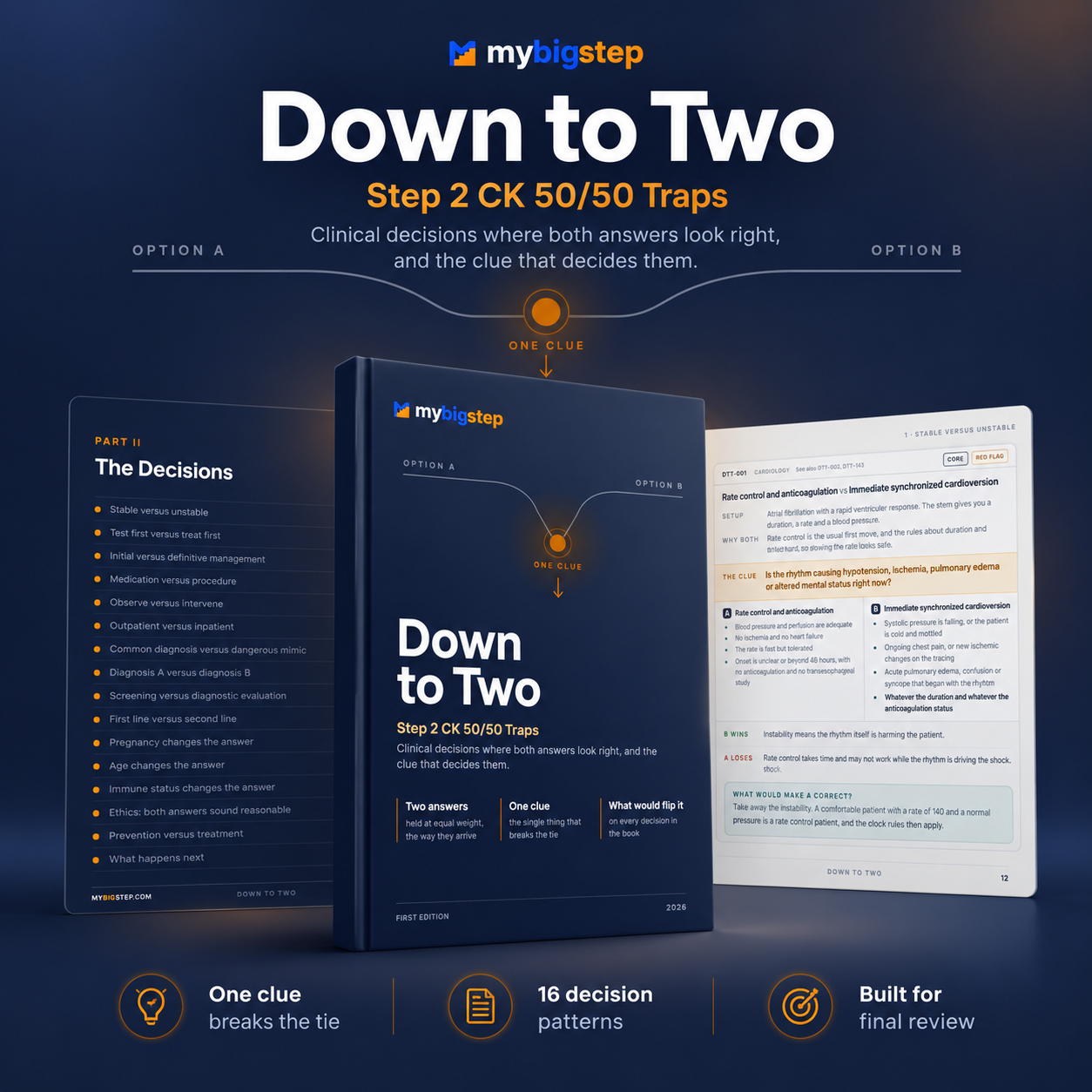
This book does nothing else. Every page is two options held at equal weight, the way they arrive in the stem, and the single clue that breaks the tie.
What is inside
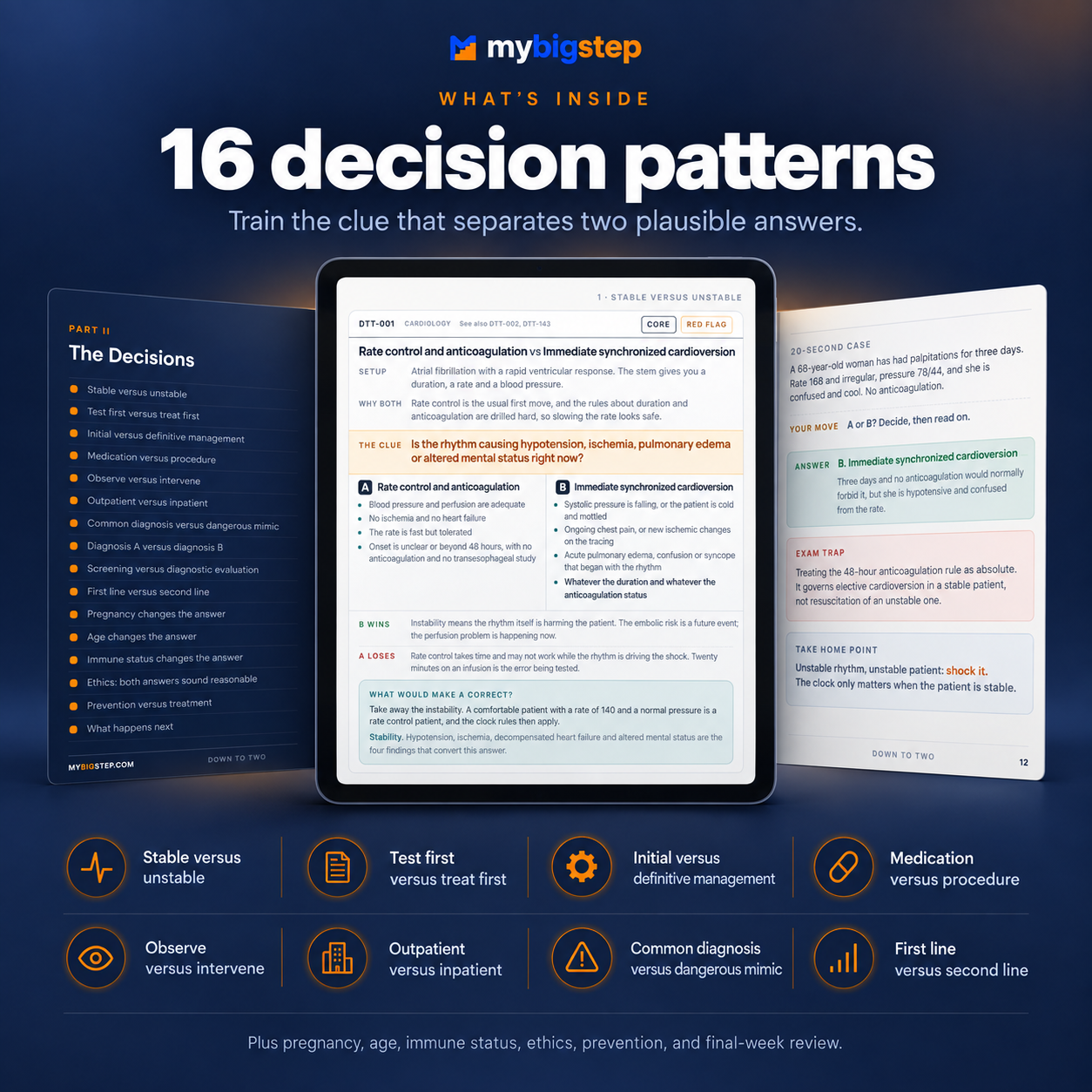
339 decisions, one per page, across 16 sections. Stable against unstable, test first against treat first, initial against definitive, medication against procedure, observe against intervene, outpatient against inpatient, common diagnosis against dangerous mimic, diagnosis A against diagnosis B, screening against diagnostic evaluation, first line against second line.
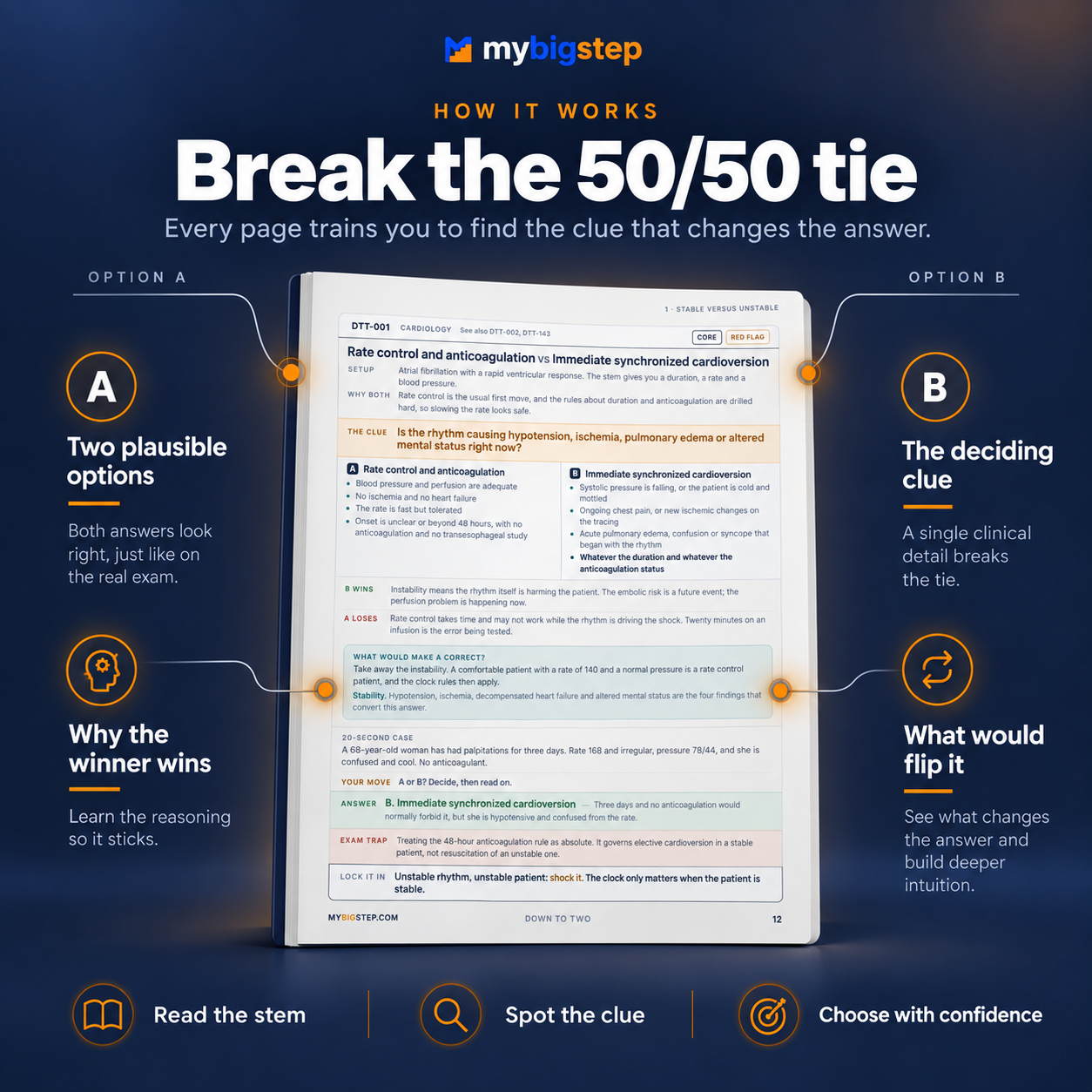
Option A, Option B, one clue. Each decision states both options as a reader would meet them, names the one thing that decides it, and then says what would flip it. That last part is the one most resources leave out.
31 trap dissections, one every eleven decisions, taking apart why the wrong option was attractive in the first place.
16 checkpoints carrying 96 drill items, one at the end of every section, written to be read with the answer covered.
The Final 100. One hundred rows of situation, deciding clue and direction, built for the last pass.
A 50/50 error log worksheet, 35 rows, so your own misses become the revision list.
Three indexes: by decision, by specialty, and by high yield clue, all carrying real printed page numbers rather than section names.
449 pages, with PDF bookmarks and a clickable contents.
The part that is easy to promise and hard to do
The correct answer is A on 165 decisions and B on 174, and the longest run of either is four. That balance is produced by the build and checked by it, because a book where the answer is usually A teaches a reader to guess A rather than to read the clue. Getting that right cost a rewrite of the ordering, and it is the single reason the drills in this book are worth attempting honestly.
Where guidance could move, the page says so
123 pages are guideline sensitive, and each one carries a Guidance chip and a verification note naming what to check and where. Recommendations change; a revision book that hides which of its claims are the moving ones is asking to be trusted further than it has earned.
What it is not
It is not a question bank, not a disease review and not a first pass through Step 2 CK. It assumes clinical vocabulary and does not teach conditions from the beginning. If a topic is new to you, learn it elsewhere first and come back for the boundary. It carries no dosing and no management protocols beyond the decision itself.
The honest part
This book promises no outcome, quotes no statistics about its readers and carries no endorsements, because there are none that could honestly be reported. Every case, comparison, diagram, table and phrase was written for this book: nothing has been copied or adapted from any commercial question bank, review text or examination.
It was built with AI assistance and reviewed by a person before release. That review is editorial. No named clinician has certified it, and the book does not claim one has.
An educational aid for examination preparation. It is not clinical guidance and must not be used to make decisions about the care of a patient. My Big Step is not affiliated with, endorsed by or sponsored by the Federation of State Medical Boards, the National Board of Medical Examiners, the United States Medical Licensing Examination program or the National Board of Osteopathic Medical Examiners. Those marks belong to their respective owners.
Delivered as a single searchable PDF with bookmarks, for laptop, tablet or print.
You did not miss the question because you did not know the medicine. You got it down to two and picked the wrong one.
That is a different failure from not knowing, and almost nothing is written to fix it. A review book teaches the disease. A question bank shows you one vignette at a time and moves on. Neither one puts the two answers you were actually torn between side by side and tells you what separates them.
This book does nothing else. Every page is two options held at equal weight, the way they arrive in the stem, and the single clue that breaks the tie.
What is inside
339 decisions, one per page, across 16 sections. Stable against unstable, test first against treat first, initial against definitive, medication against procedure, observe against intervene, outpatient against inpatient, common diagnosis against dangerous mimic, diagnosis A against diagnosis B, screening against diagnostic evaluation, first line against second line.
Option A, Option B, one clue. Each decision states both options as a reader would meet them, names the one thing that decides it, and then says what would flip it. That last part is the one most resources leave out.
31 trap dissections, one every eleven decisions, taking apart why the wrong option was attractive in the first place.
16 checkpoints carrying 96 drill items, one at the end of every section, written to be read with the answer covered.
The Final 100. One hundred rows of situation, deciding clue and direction, built for the last pass.
A 50/50 error log worksheet, 35 rows, so your own misses become the revision list.
Three indexes: by decision, by specialty, and by high yield clue, all carrying real printed page numbers rather than section names.
449 pages, with PDF bookmarks and a clickable contents.
The part that is easy to promise and hard to do
The correct answer is A on 165 decisions and B on 174, and the longest run of either is four. That balance is produced by the build and checked by it, because a book where the answer is usually A teaches a reader to guess A rather than to read the clue. Getting that right cost a rewrite of the ordering, and it is the single reason the drills in this book are worth attempting honestly.
Where guidance could move, the page says so
123 pages are guideline sensitive, and each one carries a Guidance chip and a verification note naming what to check and where. Recommendations change; a revision book that hides which of its claims are the moving ones is asking to be trusted further than it has earned.
What it is not
It is not a question bank, not a disease review and not a first pass through Step 2 CK. It assumes clinical vocabulary and does not teach conditions from the beginning. If a topic is new to you, learn it elsewhere first and come back for the boundary. It carries no dosing and no management protocols beyond the decision itself.
The honest part
This book promises no outcome, quotes no statistics about its readers and carries no endorsements, because there are none that could honestly be reported. Every case, comparison, diagram, table and phrase was written for this book: nothing has been copied or adapted from any commercial question bank, review text or examination.
It was built with AI assistance and reviewed by a person before release. That review is editorial. No named clinician has certified it, and the book does not claim one has.
An educational aid for examination preparation. It is not clinical guidance and must not be used to make decisions about the care of a patient. My Big Step is not affiliated with, endorsed by or sponsored by the Federation of State Medical Boards, the National Board of Medical Examiners, the United States Medical Licensing Examination program or the National Board of Osteopathic Medical Examiners. Those marks belong to their respective owners.
Delivered as a single searchable PDF with bookmarks, for laptop, tablet or print.