You finish a block, you review the explanations, and you understand every one of them. Then the same kind of item catches you again a week later. That is not a knowledge problem, and reading more notes does not fix it.
Step 2 CK is a decision exam. Almost every vignette resolves to one of six questions: what is this, what now, test or treat, which test, how do I treat it, and when do I escalate. Learning to name which one you are being asked eliminates two or three answer choices before you have thought about the medicine at all. This is the decision layer, built to sit alongside a question bank rather than replace one.
What is inside
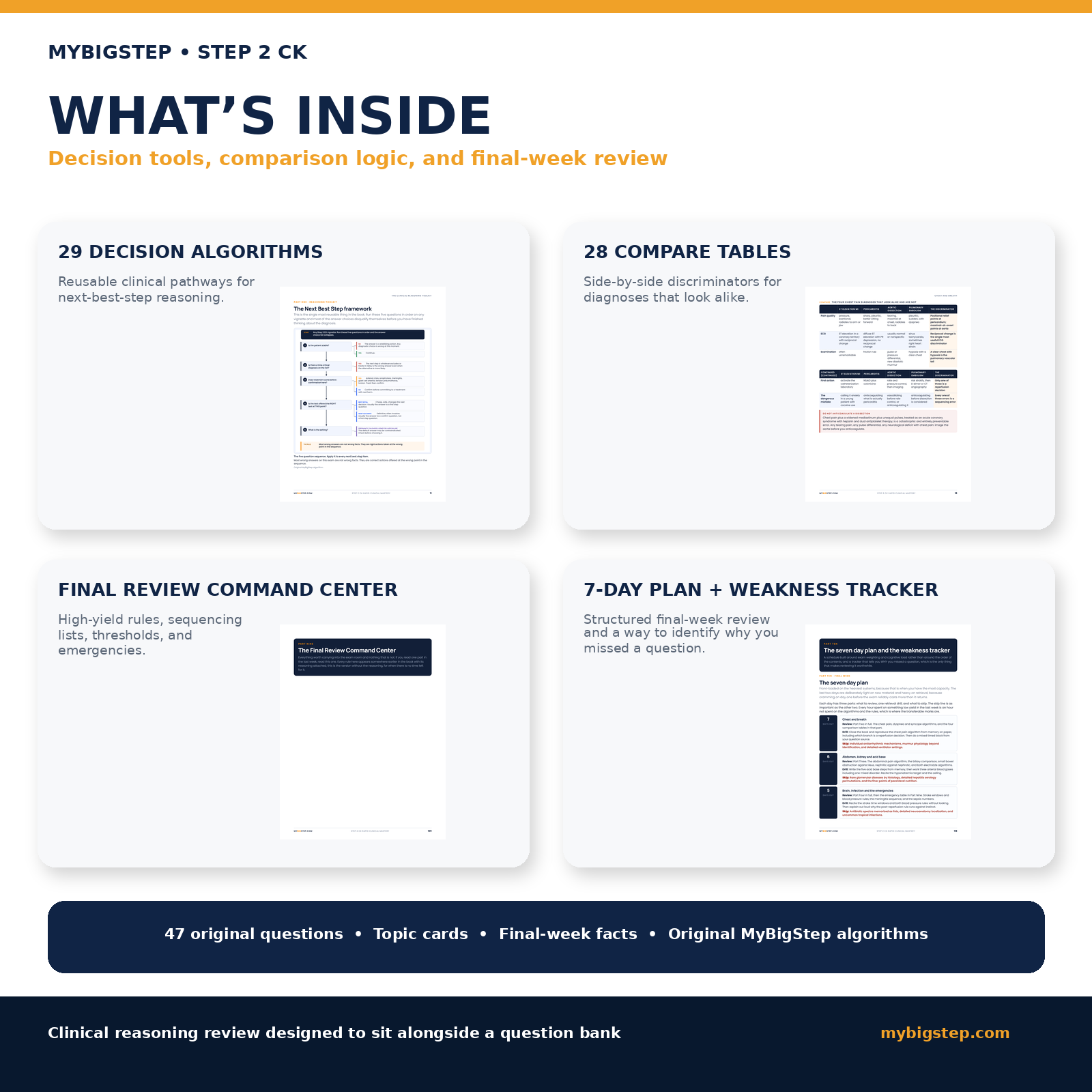
29 original decision algorithms. Chest pain, dyspnea, syncope, abdominal pain, gastrointestinal bleeding, altered mental status, headache, stroke, seizure, hyponatremia, hyperkalemia, acid base, acute kidney injury, fever and infection, shock, trauma, postoperative fever, breast mass, thyroid nodule, bleeding in pregnancy, hypertension in pregnancy, labor and the fetal tracing, pediatric fever, neonatal jaundice, pediatric respiratory distress, suicide risk, agitation, and capacity and consent. Each one is a sequence with side exits rather than a list of diagnoses, and each ends with the single rule that survives.
28 differentiation tables. Every one has a final column naming the discriminator, so what actually separates these is findable in seconds. STEMI against pericarditis against dissection against pulmonary embolism. Crohn against ulcerative colitis. Nephritic against nephrotic. TTP against HUS against DIC. Serotonin syndrome against neuroleptic malignant syndrome. Placenta previa against abruption. Bronchiolitis against croup against epiglottitis. Delirium against dementia. The four shock states.
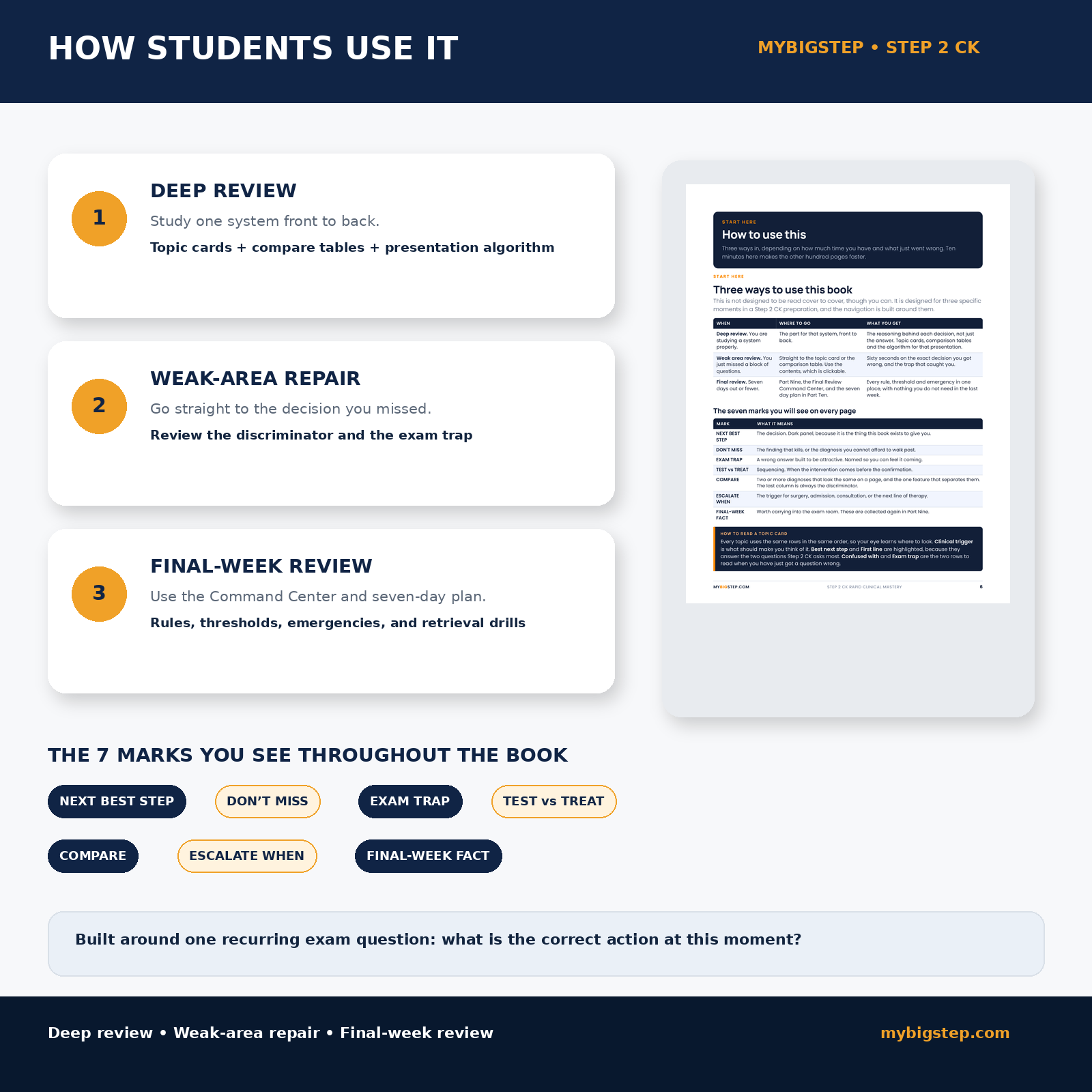
A fixed callout grammar on every page. Next best step, do not miss, exam trap, test versus treat, compare, escalate when, and final week fact. You learn the page shape once and never relearn it.
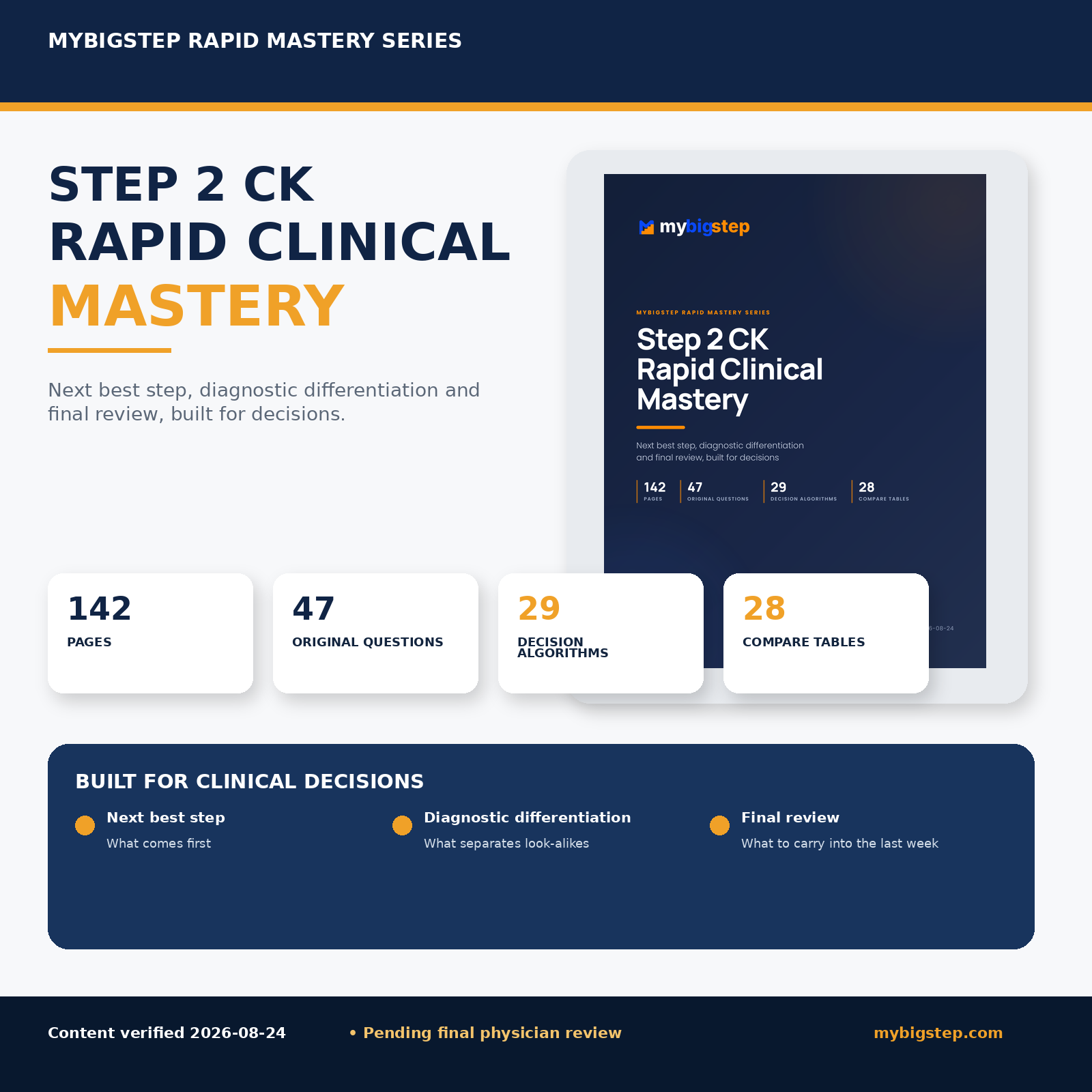
47 original practice questions, six of which require reading a data table to answer. Every one has a vignette, five options, the reasoning, an explanation of why each distractor is wrong, an exam takeaway and an educational objective.
The Final Review Command Center. Thirty next best step rules, every emergency in one table with its recognizing feature and its dangerous mistake, the two sequencing lists for treat before confirm and confirm before treat, the numbers worth knowing exactly, the current screening and vaccination positions, and the pregnancy rules that recur.
A seven day plan with a skip line for every day, because in the last week what you do not do matters as much as what you do.
A weakness tracker that records why you missed it, not what you missed. Five error codes: knowledge, interpretation, reasoning, sequencing and behavior. Counting the codes tells you what to change. Counting the topics does not.
It tells you where current guidance has moved. The recommendations that changed are the ones most likely to be wrong in older material, so they are flagged as changes rather than presented as though they had always been true. The 2026 stroke guidance including tenecteplase and the post reperfusion blood pressure rule. The 2025 hypertension and acute coronary syndrome guidelines. Breast screening from 40, colorectal from 45, lung at 50 with 20 pack years. Cervical screening with primary HPV testing. Pneumococcal vaccination from 50. Fidaxomicin ahead of metronidazole. Each carries its source, its year and the date it was checked, in a references file that is included with the download.
Who it is for. Students already using a question bank who want the reasoning layer around it, students who understand explanations when they read them and still miss the same kind of item, anyone in the final two weeks who needs a review structure rather than more content, and international medical graduates who want current guidance stated explicitly with sources.
Who it is not for. Anyone looking for a question bank: 47 items is self assessment, not volume practice. Anyone looking for a comprehensive textbook: low yield topics are short or absent on purpose. Anyone looking for drug doses: this exam asks which drug and when.
Everything in it is original. No question, image, content outline or specification table belonging to the USMLE program, the NBME or the FSMB is reproduced, and MyBigStep is not affiliated with or endorsed by any of them. Nothing here predicts, estimates or guarantees any examination outcome. This is an educational aid for examination preparation. It is not medical advice, it is not a prescribing reference, and it must not be used to make decisions about the care of a real patient. Content verified August 2026. Delivered as a zip holding the 142 page PDF and the references file. Licensed for personal use by the purchaser.
You finish a block, you review the explanations, and you understand every one of them. Then the same kind of item catches you again a week later. That is not a knowledge problem, and reading more notes does not fix it.
Step 2 CK is a decision exam. Almost every vignette resolves to one of six questions: what is this, what now, test or treat, which test, how do I treat it, and when do I escalate. Learning to name which one you are being asked eliminates two or three answer choices before you have thought about the medicine at all. This is the decision layer, built to sit alongside a question bank rather than replace one.
What is inside
29 original decision algorithms. Chest pain, dyspnea, syncope, abdominal pain, gastrointestinal bleeding, altered mental status, headache, stroke, seizure, hyponatremia, hyperkalemia, acid base, acute kidney injury, fever and infection, shock, trauma, postoperative fever, breast mass, thyroid nodule, bleeding in pregnancy, hypertension in pregnancy, labor and the fetal tracing, pediatric fever, neonatal jaundice, pediatric respiratory distress, suicide risk, agitation, and capacity and consent. Each one is a sequence with side exits rather than a list of diagnoses, and each ends with the single rule that survives.
28 differentiation tables. Every one has a final column naming the discriminator, so what actually separates these is findable in seconds. STEMI against pericarditis against dissection against pulmonary embolism. Crohn against ulcerative colitis. Nephritic against nephrotic. TTP against HUS against DIC. Serotonin syndrome against neuroleptic malignant syndrome. Placenta previa against abruption. Bronchiolitis against croup against epiglottitis. Delirium against dementia. The four shock states.
A fixed callout grammar on every page. Next best step, do not miss, exam trap, test versus treat, compare, escalate when, and final week fact. You learn the page shape once and never relearn it.
47 original practice questions, six of which require reading a data table to answer. Every one has a vignette, five options, the reasoning, an explanation of why each distractor is wrong, an exam takeaway and an educational objective.
The Final Review Command Center. Thirty next best step rules, every emergency in one table with its recognizing feature and its dangerous mistake, the two sequencing lists for treat before confirm and confirm before treat, the numbers worth knowing exactly, the current screening and vaccination positions, and the pregnancy rules that recur.
A seven day plan with a skip line for every day, because in the last week what you do not do matters as much as what you do.
A weakness tracker that records why you missed it, not what you missed. Five error codes: knowledge, interpretation, reasoning, sequencing and behavior. Counting the codes tells you what to change. Counting the topics does not.
It tells you where current guidance has moved. The recommendations that changed are the ones most likely to be wrong in older material, so they are flagged as changes rather than presented as though they had always been true. The 2026 stroke guidance including tenecteplase and the post reperfusion blood pressure rule. The 2025 hypertension and acute coronary syndrome guidelines. Breast screening from 40, colorectal from 45, lung at 50 with 20 pack years. Cervical screening with primary HPV testing. Pneumococcal vaccination from 50. Fidaxomicin ahead of metronidazole. Each carries its source, its year and the date it was checked, in a references file that is included with the download.
Who it is for. Students already using a question bank who want the reasoning layer around it, students who understand explanations when they read them and still miss the same kind of item, anyone in the final two weeks who needs a review structure rather than more content, and international medical graduates who want current guidance stated explicitly with sources.
Who it is not for. Anyone looking for a question bank: 47 items is self assessment, not volume practice. Anyone looking for a comprehensive textbook: low yield topics are short or absent on purpose. Anyone looking for drug doses: this exam asks which drug and when.
Everything in it is original. No question, image, content outline or specification table belonging to the USMLE program, the NBME or the FSMB is reproduced, and MyBigStep is not affiliated with or endorsed by any of them. Nothing here predicts, estimates or guarantees any examination outcome. This is an educational aid for examination preparation. It is not medical advice, it is not a prescribing reference, and it must not be used to make decisions about the care of a real patient. Content verified August 2026. Delivered as a zip holding the 142 page PDF and the references file. Licensed for personal use by the purchaser.