

USMLE Risk Factors and Prognosis: The Associations You Cannot Afford to Miss - CK
You narrowed it to two answers and picked the wrong one.
Almost every question of that shape is asking about a risk relationship, and there are several different kinds. What most increases the chance of getting a disease is not what most predicts a bad outcome once you have it, which is not what most predicts it coming back, which is not the one detail that changes what you actually do next. The examination knows the difference. Most study material does not label it.
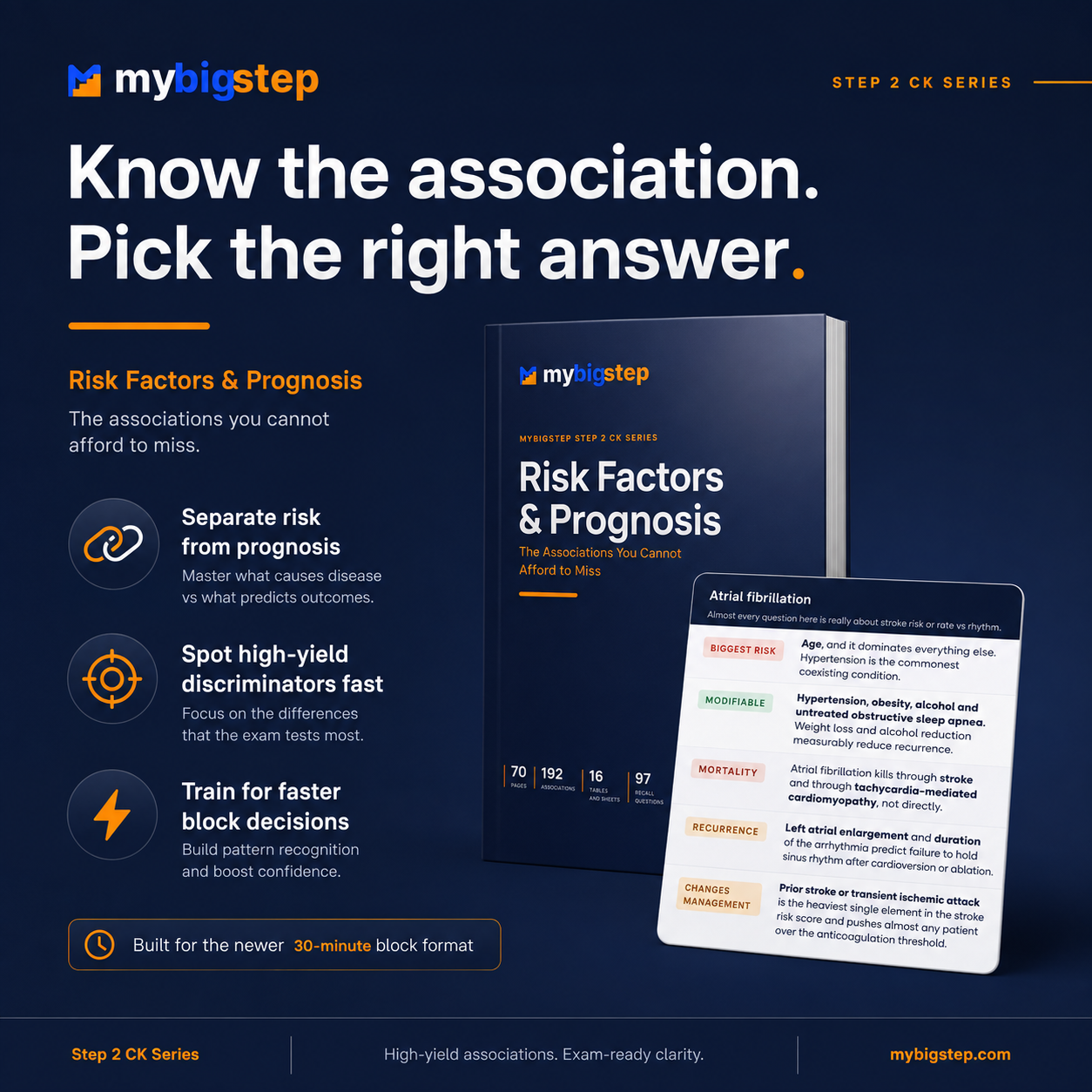
This does. Every claim in this product carries a tag naming the kind of claim it is: Biggest risk, Modifiable, Most common cause, Prognosis, Mortality, Recurrence, Complications, or Changes management. You never have to work out which job the word risk is doing in a given row.
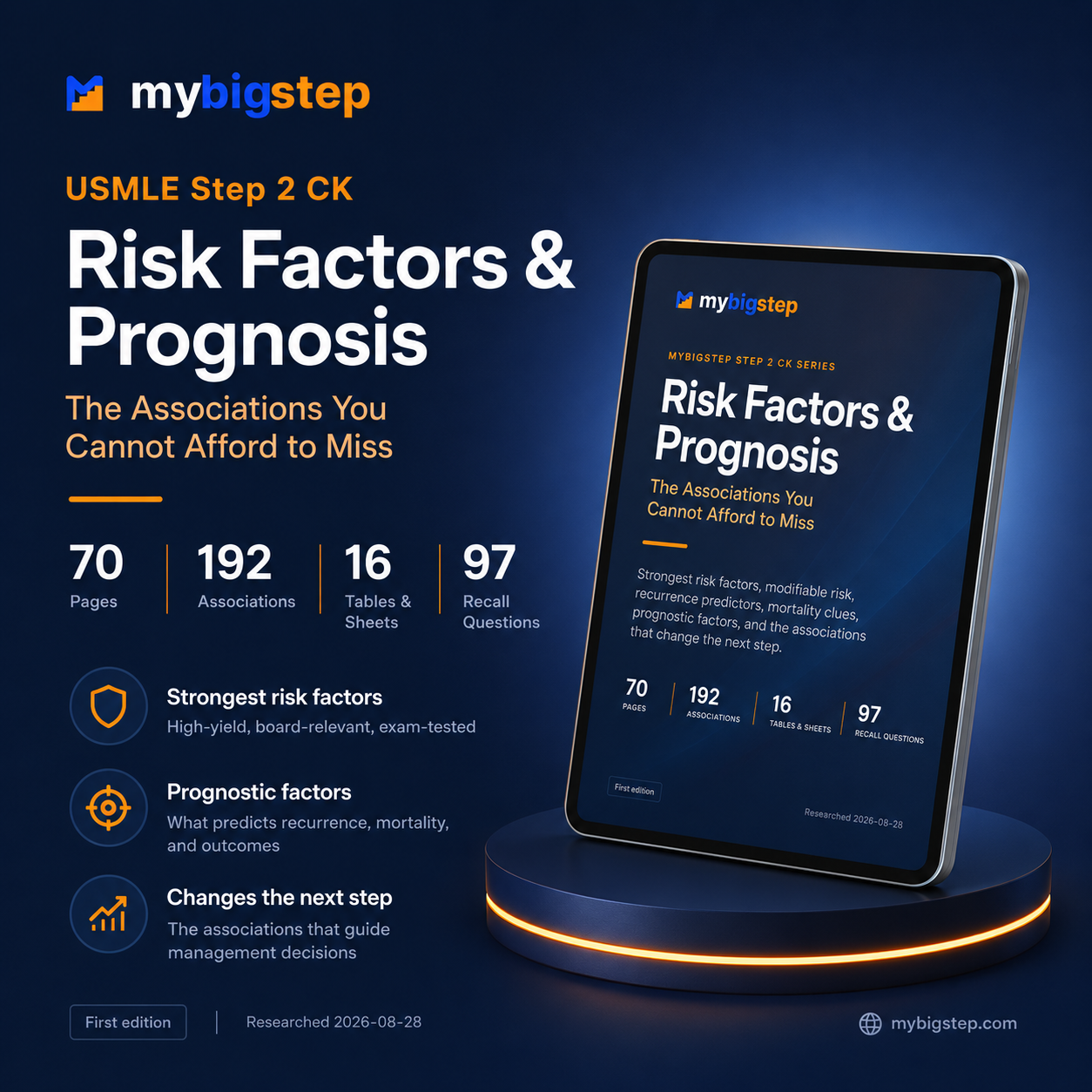
70 pages that teach the difference between a risk factor, a prognostic factor, a mortality predictor, and the one detail that changes what you do next.
What is inside
192 associations, each labeled with the relationship type it asserts.
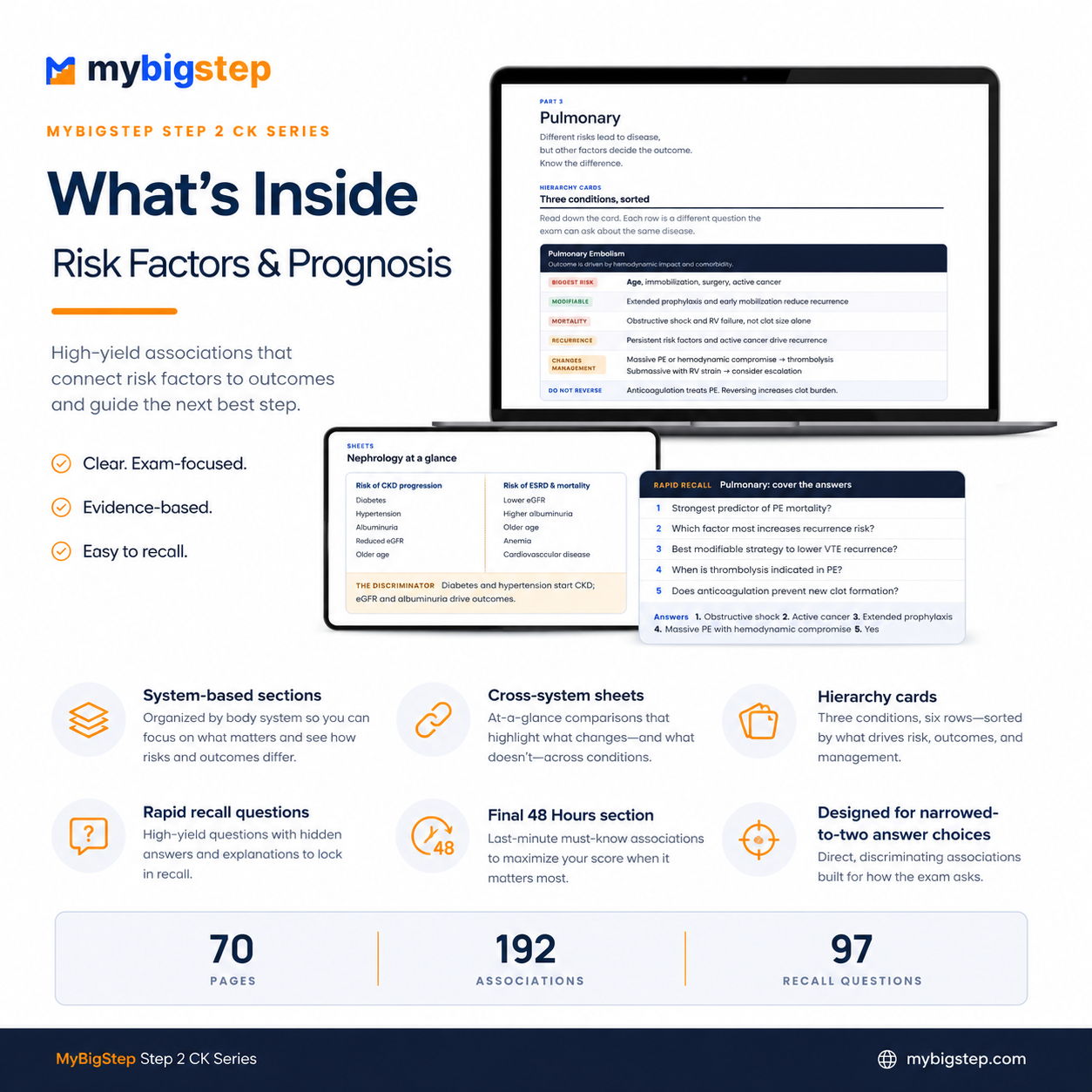
18 risk hierarchy cards, the signature component: one condition sorted into every relationship type that actually applies to it, so you can see at a glance that the strongest risk factor and the strongest mortality predictor are different things.
67 association cards with the association, why it matters, the examination implication and the trap.
16 tables and sheets, including cross system master sheets for strongest risk factors, modifiable factors, mortality predictors, recurrence predictors and most common causes.
28 stem clue rows: the detail, why the examiner put it there, and what it changes.
6 do not reverse pair cards for the confusions that survive everything else.
4 red herring drills that train prioritization rather than recall.
7 scoring systems, each explained by what it predicts and what the examination wants, never a points table.
97 recall questions: 50 original micro questions and 47 cover the answer prompts.
84 compressed lines in a Final 48 Hours section, plus a one page Twenty.
A rapid index of 84 terms pointing at the sheet that answers each one.
Built on a rule about superlatives
Phrases like strongest risk factor become false very easily. Before any of them appears here, three things had to be true: the evidence supports the ranking, the ranking does not flip across the populations a Step 2 CK question would use, and it is clear whether the claim is about incidence, mortality, recurrence or complications. Where the evidence does not establish a winner, this product says major risk factor instead and tells you that is what it is doing. Every ranking claim is registered with its qualification, and several are verified against a named professional body with the date the source was read.
What is deliberately not here
No drug dosing. No staging tables. No claim about how often the examination tests a topic, because nobody outside the National Board of Medical Examiners can substantiate one. No general disease review: this assumes you know what preeclampsia is, and asks which factor about this patient changes what you do.
Format
A single PDF, 70 pages, US Letter, text searchable, with a linked contents and a rapid index. Instant download after purchase. Licensed to one individual for personal study.
Frequently asked
Is this a review book? No. It assumes you already know the diseases. You lose these questions after you have narrowed to two answers, where both remaining options are real risk factors and only one of them is the strongest, or the modifiable one, or the one that predicts death rather than recurrence.
Are these real exam questions? No. Every table, card, hierarchy and question is original work created for this product. No question from any question bank or examination has been reproduced or paraphrased.
Has a physician reviewed it? No, and the guide says so on its own pages. Human review here means editorial and source review by MyBigStep, which is not a specialty board certification and not an independent physician endorsement.
How current is it? Researched in August 2026, with each sourced claim carrying the body that publishes it and the date it was read. Guidance changes, so check anything decision critical against the current published source.
From MyBigStep, drawing on over a decade of experience guiding medical students and graduates through the USMLE and into the Match.
An educational resource for examination preparation. It is not medical advice and nothing in it should be used to make a decision about the care of a real patient. No outcome is promised, and nothing here guarantees a passing result or any particular score. Modern AI assisted tools supported the research, organization, editing and visual production of this guide; no tool determined or verified a clinical claim on its own, and the finished guide was reviewed by a person before release. MyBigStep is not affiliated with, endorsed by or sponsored by the National Board of Medical Examiners, the Federation of State Medical Boards, or the United States Medical Licensing Examination program. All trademarks belong to their respective owners.
You narrowed it to two answers and picked the wrong one.
Almost every question of that shape is asking about a risk relationship, and there are several different kinds. What most increases the chance of getting a disease is not what most predicts a bad outcome once you have it, which is not what most predicts it coming back, which is not the one detail that changes what you actually do next. The examination knows the difference. Most study material does not label it.
This does. Every claim in this product carries a tag naming the kind of claim it is: Biggest risk, Modifiable, Most common cause, Prognosis, Mortality, Recurrence, Complications, or Changes management. You never have to work out which job the word risk is doing in a given row.
70 pages that teach the difference between a risk factor, a prognostic factor, a mortality predictor, and the one detail that changes what you do next.
What is inside
192 associations, each labeled with the relationship type it asserts.
18 risk hierarchy cards, the signature component: one condition sorted into every relationship type that actually applies to it, so you can see at a glance that the strongest risk factor and the strongest mortality predictor are different things.
67 association cards with the association, why it matters, the examination implication and the trap.
16 tables and sheets, including cross system master sheets for strongest risk factors, modifiable factors, mortality predictors, recurrence predictors and most common causes.
28 stem clue rows: the detail, why the examiner put it there, and what it changes.
6 do not reverse pair cards for the confusions that survive everything else.
4 red herring drills that train prioritization rather than recall.
7 scoring systems, each explained by what it predicts and what the examination wants, never a points table.
97 recall questions: 50 original micro questions and 47 cover the answer prompts.
84 compressed lines in a Final 48 Hours section, plus a one page Twenty.
A rapid index of 84 terms pointing at the sheet that answers each one.
Built on a rule about superlatives
Phrases like strongest risk factor become false very easily. Before any of them appears here, three things had to be true: the evidence supports the ranking, the ranking does not flip across the populations a Step 2 CK question would use, and it is clear whether the claim is about incidence, mortality, recurrence or complications. Where the evidence does not establish a winner, this product says major risk factor instead and tells you that is what it is doing. Every ranking claim is registered with its qualification, and several are verified against a named professional body with the date the source was read.
What is deliberately not here
No drug dosing. No staging tables. No claim about how often the examination tests a topic, because nobody outside the National Board of Medical Examiners can substantiate one. No general disease review: this assumes you know what preeclampsia is, and asks which factor about this patient changes what you do.
Format
A single PDF, 70 pages, US Letter, text searchable, with a linked contents and a rapid index. Instant download after purchase. Licensed to one individual for personal study.
Frequently asked
Is this a review book? No. It assumes you already know the diseases. You lose these questions after you have narrowed to two answers, where both remaining options are real risk factors and only one of them is the strongest, or the modifiable one, or the one that predicts death rather than recurrence.
Are these real exam questions? No. Every table, card, hierarchy and question is original work created for this product. No question from any question bank or examination has been reproduced or paraphrased.
Has a physician reviewed it? No, and the guide says so on its own pages. Human review here means editorial and source review by MyBigStep, which is not a specialty board certification and not an independent physician endorsement.
How current is it? Researched in August 2026, with each sourced claim carrying the body that publishes it and the date it was read. Guidance changes, so check anything decision critical against the current published source.
From MyBigStep, drawing on over a decade of experience guiding medical students and graduates through the USMLE and into the Match.
An educational resource for examination preparation. It is not medical advice and nothing in it should be used to make a decision about the care of a real patient. No outcome is promised, and nothing here guarantees a passing result or any particular score. Modern AI assisted tools supported the research, organization, editing and visual production of this guide; no tool determined or verified a clinical claim on its own, and the finished guide was reviewed by a person before release. MyBigStep is not affiliated with, endorsed by or sponsored by the National Board of Medical Examiners, the Federation of State Medical Boards, or the United States Medical Licensing Examination program. All trademarks belong to their respective owners.