

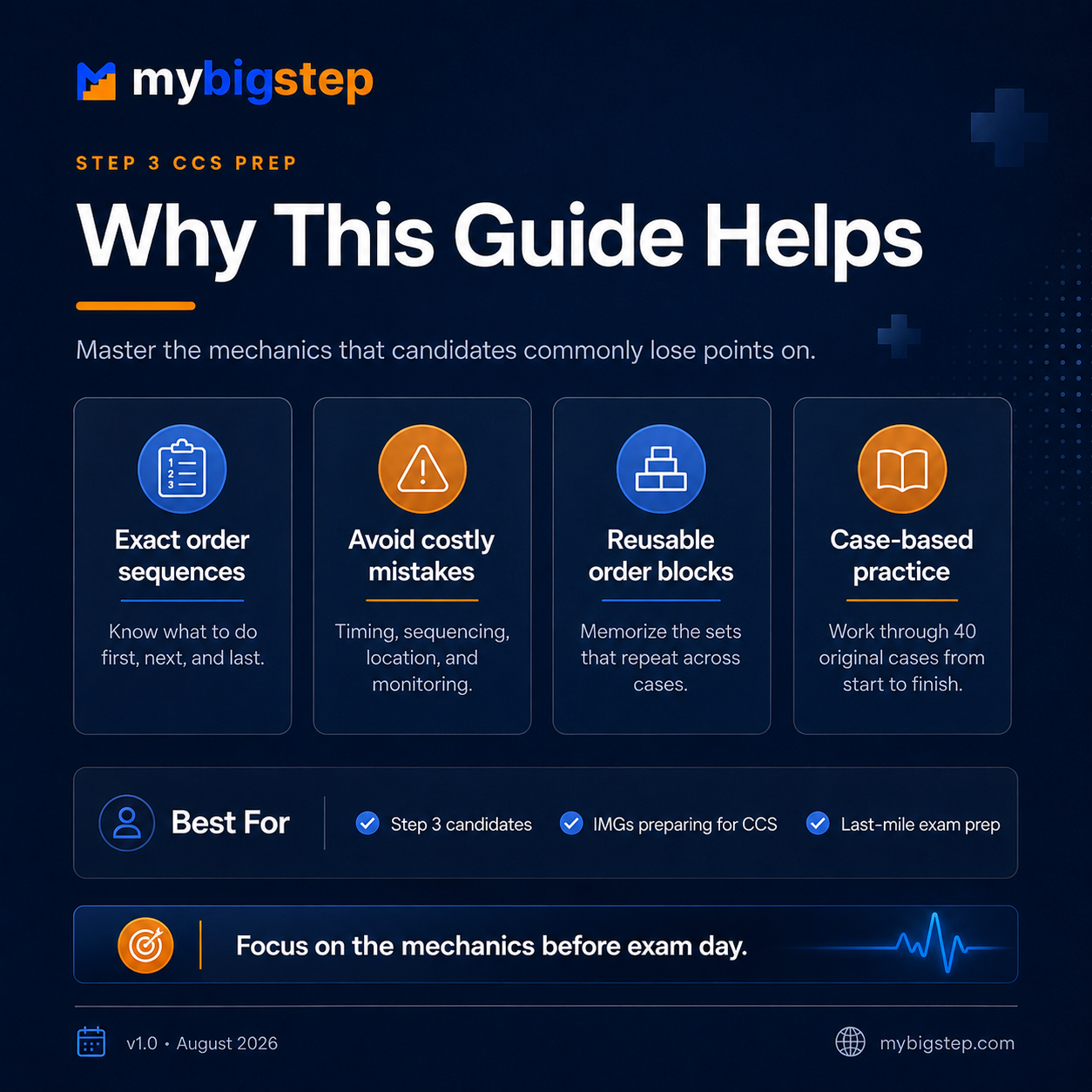
The case simulations are the part of Step 3 that candidates prepare for last and understand least, and the medicine is usually not the problem. Points go on sequencing, on letting the simulated clock run while you think, on treating before stabilizing, and on reaching the end of a case without rechecking the patient you just treated.
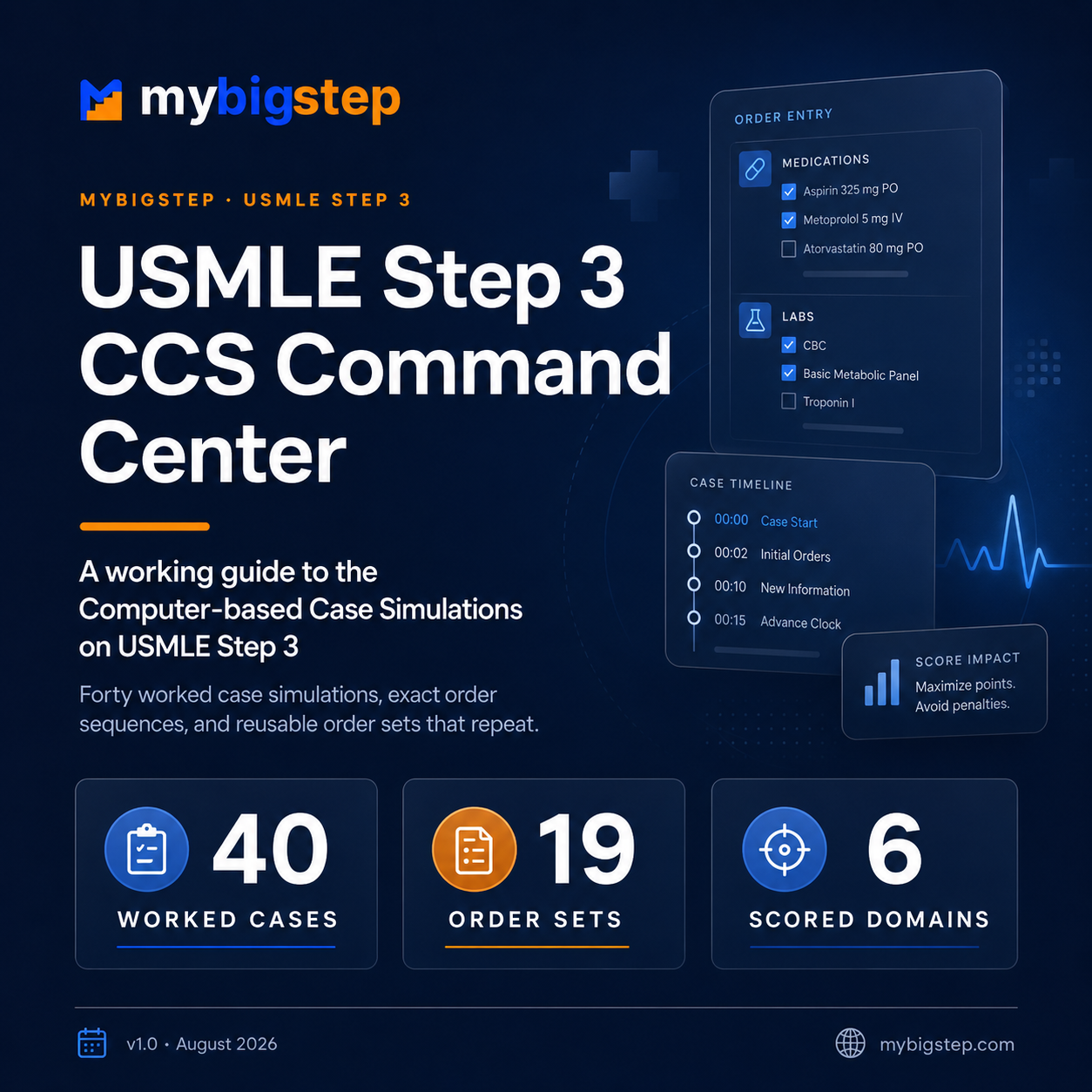
This guide is built for exactly that gap. It explains what the examiners actually score, gives you the order sets that repeat so you recall one block instead of nine, and then works forty original cases end to end with the simulated clock attached to every single order and the reason it earns credit.
What is inside
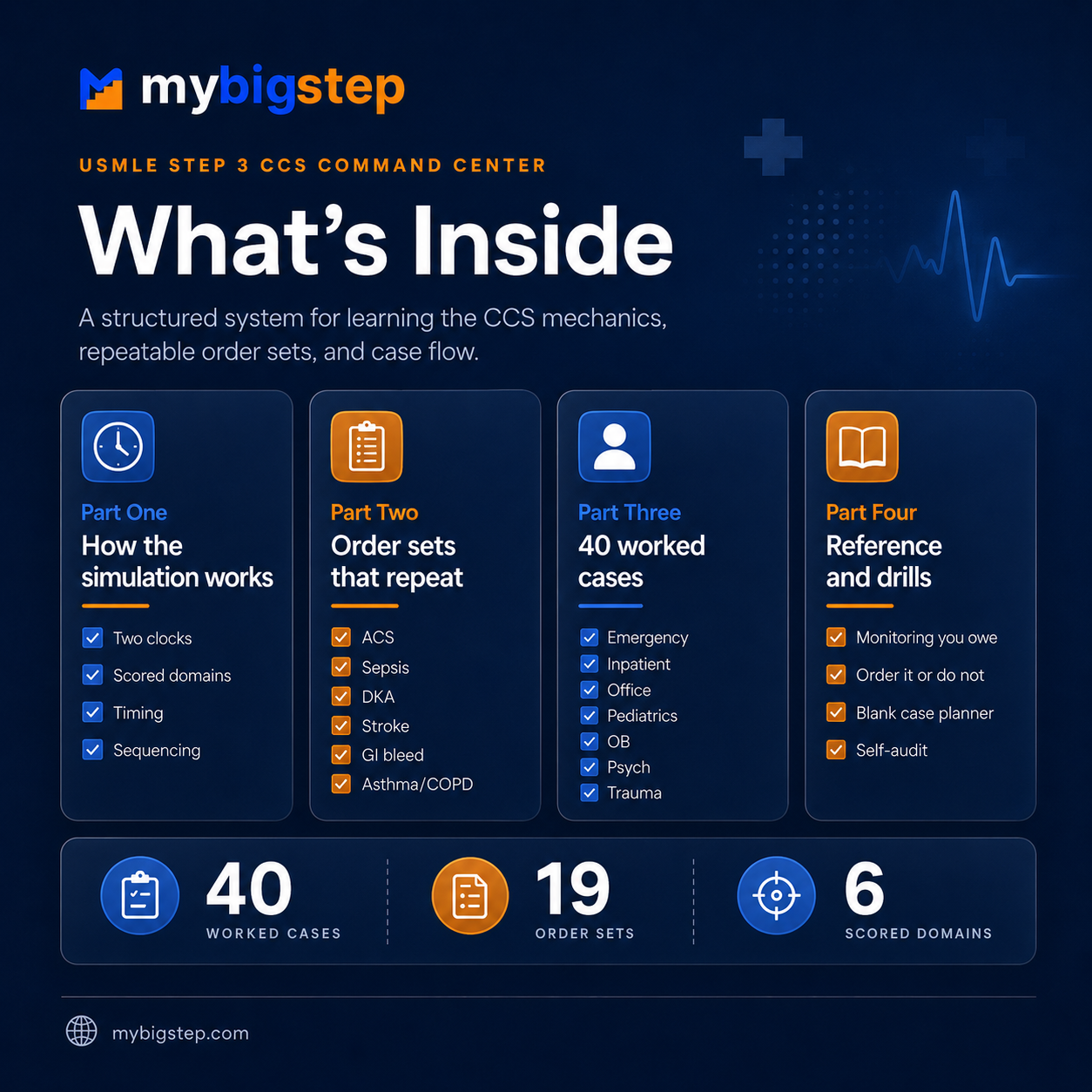
Forty worked case simulations, all original, distributed to mirror the published Step 3 content weighting across emergency, office, inpatient and intensive care settings. Every case gives you the opening screen, the first five actions, the full order sequence with timings, the one decision the case is really testing, the high yield scoring point, and the trap.
Nineteen reusable order sets, from acute coronary syndrome, sepsis, stroke and diabetic ketoacidosis through to the four structural sets that fit almost every case: the unstable opening, the stable opening, the admission set and the preoperative set. Each one names the orders that lose credit, not just the ones that earn it.
The six scored domains explained. The examiners publish that they score diagnosis, therapy, monitoring, timing, sequencing and location. Four of those six have nothing to do with knowing the right answer, and most resources never mention them.
The closing screen chapter. What you can and cannot do once the end of case warning appears, and the error that has cost candidates the whole component: treating that screen as an instruction to stop treatment.
The monitoring you owe, a reference covering thirty six therapies and the recheck each one obliges you to schedule. Monitoring is a scored domain and it is the cheapest credit in the software.
Order it, or do not, forty two alphabetized verdicts on the orders candidates argue about, from a fecal occult blood test before anticoagulation to a head CT before lumbar puncture.
A blank case planner and a forty case self audit, both designed to be printed.
Written for the current exam. The Step 3 delivery software and the multiple choice block structure changed in March 2026, and the case simulation format did not. Every clinical recommendation carries the guideline it was written from and the date it was verified, including the 2026 stroke and sepsis guidelines, the 2025 acute coronary syndrome and hypertension guidelines, and the 2024 diabetic ketoacidosis consensus. The software is described functionally rather than by screenshot, so it survives interface changes.
One hundred percent original content. Every case was written from published standard of care. Nothing here is recalled, reconstructed or reproduced from any live examination or question bank.
Scope. This is a working guide, not a simulator and not a question bank, and it does not replace either. Use it for the reasoning and use the free official practice cases at usmle.org for the interface. Instant download, 330 pages, licensed for personal use by the purchaser.
The case simulations are the part of Step 3 that candidates prepare for last and understand least, and the medicine is usually not the problem. Points go on sequencing, on letting the simulated clock run while you think, on treating before stabilizing, and on reaching the end of a case without rechecking the patient you just treated.
This guide is built for exactly that gap. It explains what the examiners actually score, gives you the order sets that repeat so you recall one block instead of nine, and then works forty original cases end to end with the simulated clock attached to every single order and the reason it earns credit.
What is inside
Forty worked case simulations, all original, distributed to mirror the published Step 3 content weighting across emergency, office, inpatient and intensive care settings. Every case gives you the opening screen, the first five actions, the full order sequence with timings, the one decision the case is really testing, the high yield scoring point, and the trap.
Nineteen reusable order sets, from acute coronary syndrome, sepsis, stroke and diabetic ketoacidosis through to the four structural sets that fit almost every case: the unstable opening, the stable opening, the admission set and the preoperative set. Each one names the orders that lose credit, not just the ones that earn it.
The six scored domains explained. The examiners publish that they score diagnosis, therapy, monitoring, timing, sequencing and location. Four of those six have nothing to do with knowing the right answer, and most resources never mention them.
The closing screen chapter. What you can and cannot do once the end of case warning appears, and the error that has cost candidates the whole component: treating that screen as an instruction to stop treatment.
The monitoring you owe, a reference covering thirty six therapies and the recheck each one obliges you to schedule. Monitoring is a scored domain and it is the cheapest credit in the software.
Order it, or do not, forty two alphabetized verdicts on the orders candidates argue about, from a fecal occult blood test before anticoagulation to a head CT before lumbar puncture.
A blank case planner and a forty case self audit, both designed to be printed.
Written for the current exam. The Step 3 delivery software and the multiple choice block structure changed in March 2026, and the case simulation format did not. Every clinical recommendation carries the guideline it was written from and the date it was verified, including the 2026 stroke and sepsis guidelines, the 2025 acute coronary syndrome and hypertension guidelines, and the 2024 diabetic ketoacidosis consensus. The software is described functionally rather than by screenshot, so it survives interface changes.
One hundred percent original content. Every case was written from published standard of care. Nothing here is recalled, reconstructed or reproduced from any live examination or question bank.
Scope. This is a working guide, not a simulator and not a question bank, and it does not replace either. Use it for the reasoning and use the free official practice cases at usmle.org for the interface. Instant download, 330 pages, licensed for personal use by the purchaser.