

Psychiatry Residency Interview Mastery
Free lists tell you what they might ask. They do not tell you why.
Knowing that someone will ask why psychiatry is not the hard part. The hard part is knowing what different answers signal, how to build one that is actually yours, and what they will ask next when they decide to go deeper. In psychiatry interviews, they usually do go deeper.
The psychiatry interview is not a knowledge test. It is a conversation in which someone decides whether they would trust you with a frightened patient at two in the morning.
This is a training system rather than a question list. Every one of the 178 questions comes with the interviewer’s reasoning behind it. The 50 highest value questions get the full treatment: what is really being assessed, what a strong answer demonstrates, two complete sample responses from different applicant backgrounds, a realistic weak answer with an explanation of the concern it creates, a strategy for standing out, the follow up questions that will come next, and an exercise to make it yours.
What is inside
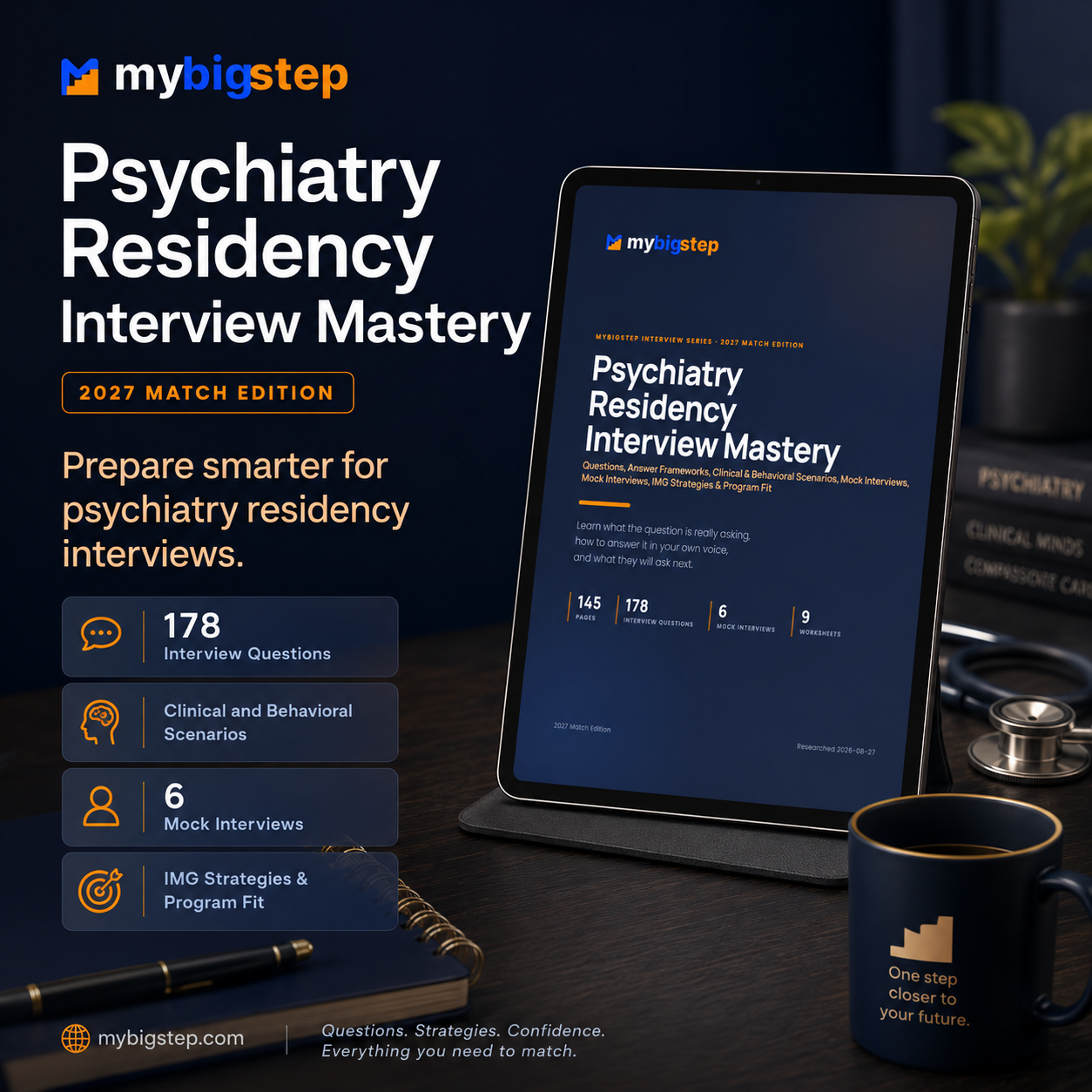
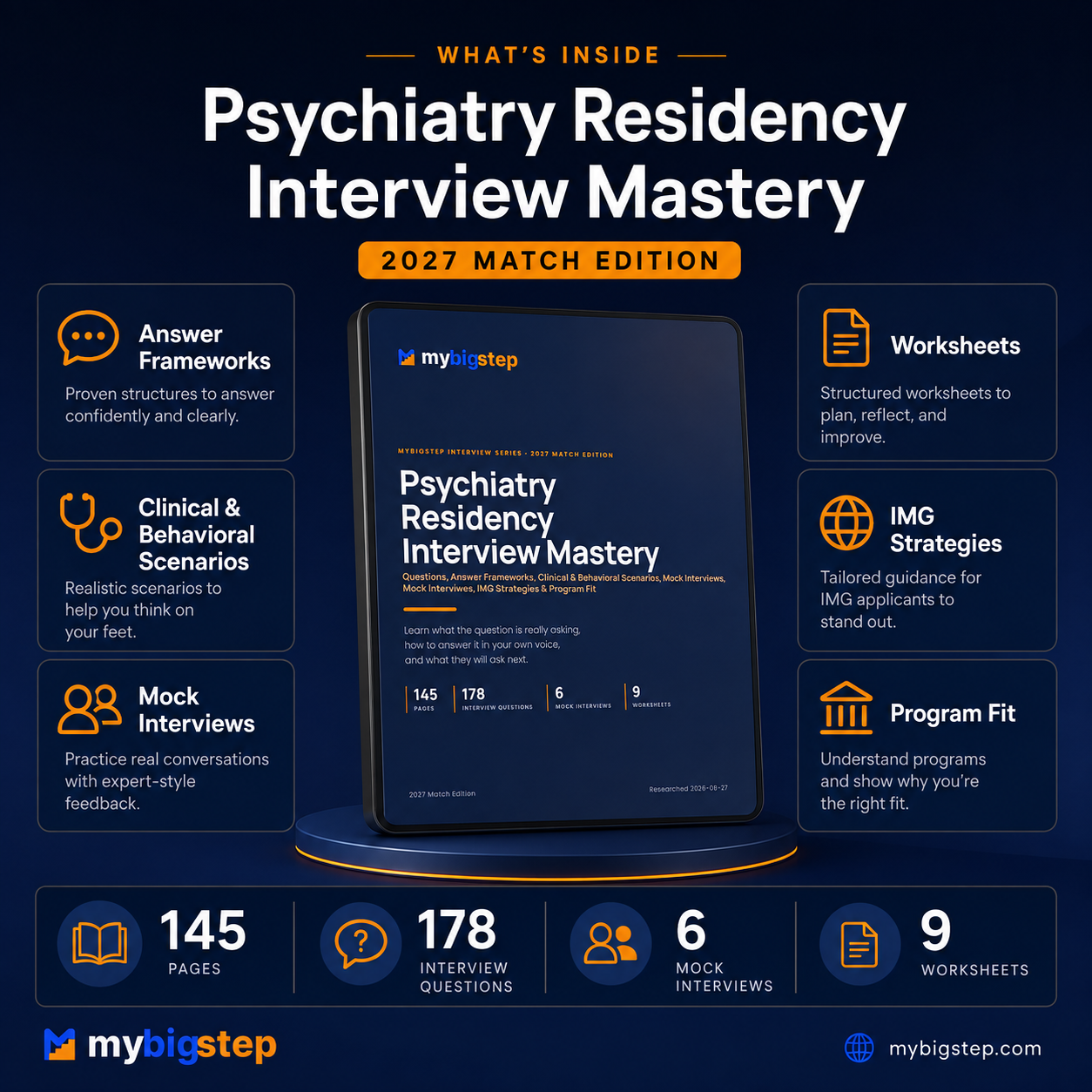
178 unique interview questions, tiered by depth so the highest value 50 get full coaching rather than every question getting a shallow paragraph.
100 sample answers across 57 applicant profiles: US MD, DO, US and non US international graduates, older graduates, career changers, specialty switchers, reapplicants, and applicants with examination attempts or gaps.
Four original frameworks. MIND for questions about you, SAFE for safety and ethics scenarios, ACT Forward for application red flags, FIND for program fit.
20 branching follow up sequences showing exactly how interviewers drill into an answer, and the five moves they use to do it.
Six complete mock interviews, from a core psychiatry interview through to a pressure interview where every answer gets challenged, plus a 17 dimension scoring rubric.
50 weak answers written out in full, each with the specific concern it creates in the interviewer’s mind.
A full application red flag chapter: examination failures, gaps, dismissals, reapplication, specialty switching and late psychiatry interest, each with a 30 second answer structure.
Substantial coaching for international graduates: why United States training, adapting to a new system, communicating across languages, positioning international experience, and how to answer visa questions factually.
Nine printable worksheets including a program intelligence sheet, a psychotherapy curriculum evaluation, a story depth test and a final readiness assessment.
Eleven templates and eleven AI practice prompts with privacy guidance, so you can practice against an interviewer that will not let a vague answer pass.
A seven day boot camp and a 24 hour emergency plan.
Current for the 2027 Match
Psychiatry uses 10 program signals for 2027, applied flat rather than in gold and silver tiers. Psychosomatic Medicine has been called Consultation Liaison Psychiatry since 2018, and saying the old name in an interview is a checkable currency signal. Every accredited psychiatry program already meets the 48 month requirement including 12 months of continuous supervised outpatient care, so being told that a program offers psychotherapy training differentiates nothing. This guide teaches you what to ask instead.
Format
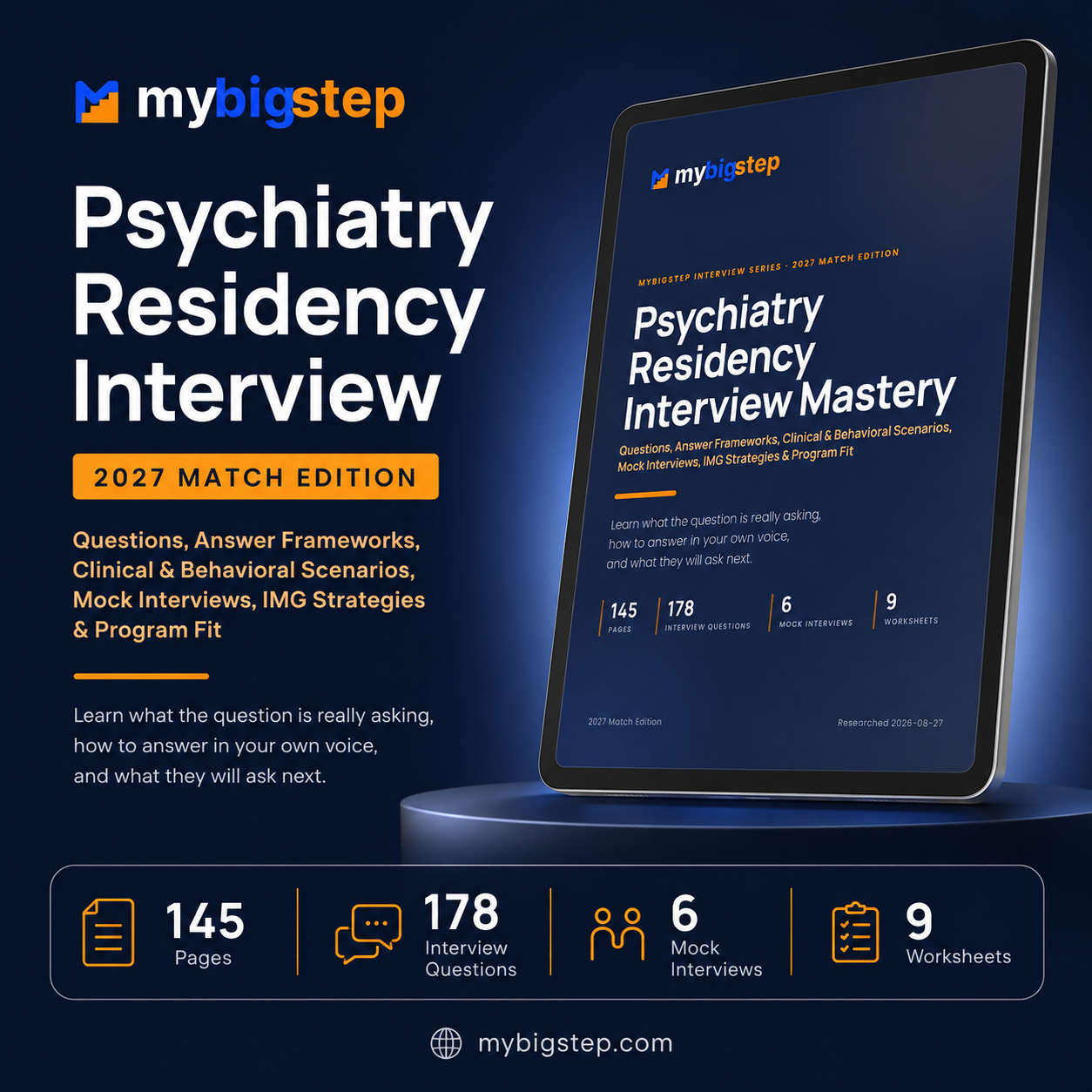
One PDF, 145 pages, US Letter, with clickable contents and bookmarks. Instant download after purchase.
Frequently asked
Is this just a list of questions? No. Every question carries the reasoning behind it, and the 50 highest value ones carry full coaching including two sample answers and a weak answer with the concern it creates.
Are these real interview questions? No. Every question, sample answer and scenario was written for this guide. Nothing is transcribed from any real interview, and every applicant described is fictional.
Will it give me a script? The opposite. The sample answers are attributed to 57 specific applicant profiles precisely so that none of them reads as the answer for you, and every coached question ends with an exercise to build your own.
I am an international graduate. Is this written for me? Yes, substantially. There is a dedicated part on international experience, adapting to a new system and answering visa questions factually, and the applicant profiles include both US and non US international graduates.
How current is it? This is the 2027 Match Edition, verified in August 2026 against the published sources. Match and application policy changes, so check anything decision critical against the current published version.
From MyBigStep, drawing on over a decade of experience guiding medical students and graduates through the USMLE and into the Match.
An educational aid for interview preparation. Not medical advice, not legal advice and not immigration advice. No Match or interview outcome is guaranteed. Modern AI assisted tools supported the research, organization, editing and visual production of this guide, and the finished guide was reviewed by a person before release. MyBigStep is not affiliated with, endorsed by, or sponsored by the National Resident Matching Program, the Association of American Medical Colleges, ERAS, the ACGME, ECFMG or Intealth, or any residency program. All trademarks belong to their respective owners.
Free lists tell you what they might ask. They do not tell you why.
Knowing that someone will ask why psychiatry is not the hard part. The hard part is knowing what different answers signal, how to build one that is actually yours, and what they will ask next when they decide to go deeper. In psychiatry interviews, they usually do go deeper.
The psychiatry interview is not a knowledge test. It is a conversation in which someone decides whether they would trust you with a frightened patient at two in the morning.
This is a training system rather than a question list. Every one of the 178 questions comes with the interviewer’s reasoning behind it. The 50 highest value questions get the full treatment: what is really being assessed, what a strong answer demonstrates, two complete sample responses from different applicant backgrounds, a realistic weak answer with an explanation of the concern it creates, a strategy for standing out, the follow up questions that will come next, and an exercise to make it yours.
What is inside
178 unique interview questions, tiered by depth so the highest value 50 get full coaching rather than every question getting a shallow paragraph.
100 sample answers across 57 applicant profiles: US MD, DO, US and non US international graduates, older graduates, career changers, specialty switchers, reapplicants, and applicants with examination attempts or gaps.
Four original frameworks. MIND for questions about you, SAFE for safety and ethics scenarios, ACT Forward for application red flags, FIND for program fit.
20 branching follow up sequences showing exactly how interviewers drill into an answer, and the five moves they use to do it.
Six complete mock interviews, from a core psychiatry interview through to a pressure interview where every answer gets challenged, plus a 17 dimension scoring rubric.
50 weak answers written out in full, each with the specific concern it creates in the interviewer’s mind.
A full application red flag chapter: examination failures, gaps, dismissals, reapplication, specialty switching and late psychiatry interest, each with a 30 second answer structure.
Substantial coaching for international graduates: why United States training, adapting to a new system, communicating across languages, positioning international experience, and how to answer visa questions factually.
Nine printable worksheets including a program intelligence sheet, a psychotherapy curriculum evaluation, a story depth test and a final readiness assessment.
Eleven templates and eleven AI practice prompts with privacy guidance, so you can practice against an interviewer that will not let a vague answer pass.
A seven day boot camp and a 24 hour emergency plan.
Current for the 2027 Match
Psychiatry uses 10 program signals for 2027, applied flat rather than in gold and silver tiers. Psychosomatic Medicine has been called Consultation Liaison Psychiatry since 2018, and saying the old name in an interview is a checkable currency signal. Every accredited psychiatry program already meets the 48 month requirement including 12 months of continuous supervised outpatient care, so being told that a program offers psychotherapy training differentiates nothing. This guide teaches you what to ask instead.
Format
One PDF, 145 pages, US Letter, with clickable contents and bookmarks. Instant download after purchase.
Frequently asked
Is this just a list of questions? No. Every question carries the reasoning behind it, and the 50 highest value ones carry full coaching including two sample answers and a weak answer with the concern it creates.
Are these real interview questions? No. Every question, sample answer and scenario was written for this guide. Nothing is transcribed from any real interview, and every applicant described is fictional.
Will it give me a script? The opposite. The sample answers are attributed to 57 specific applicant profiles precisely so that none of them reads as the answer for you, and every coached question ends with an exercise to build your own.
I am an international graduate. Is this written for me? Yes, substantially. There is a dedicated part on international experience, adapting to a new system and answering visa questions factually, and the applicant profiles include both US and non US international graduates.
How current is it? This is the 2027 Match Edition, verified in August 2026 against the published sources. Match and application policy changes, so check anything decision critical against the current published version.
From MyBigStep, drawing on over a decade of experience guiding medical students and graduates through the USMLE and into the Match.
An educational aid for interview preparation. Not medical advice, not legal advice and not immigration advice. No Match or interview outcome is guaranteed. Modern AI assisted tools supported the research, organization, editing and visual production of this guide, and the finished guide was reviewed by a person before release. MyBigStep is not affiliated with, endorsed by, or sponsored by the National Resident Matching Program, the Association of American Medical Colleges, ERAS, the ACGME, ECFMG or Intealth, or any residency program. All trademarks belong to their respective owners.