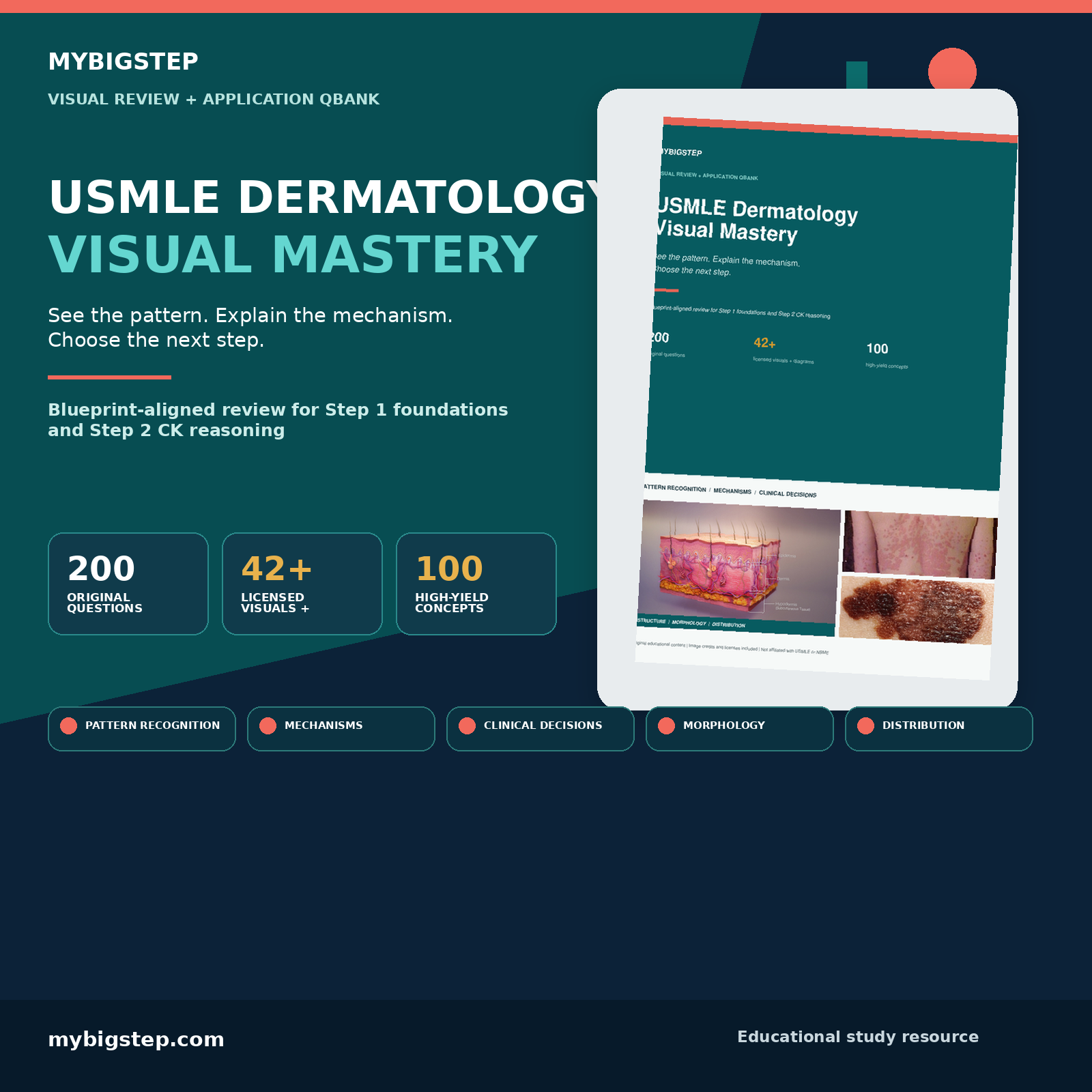
A 130 page dermatology workbook for the USMLE, built around 200 questions that each print the answer, the mechanism and the management directly underneath.
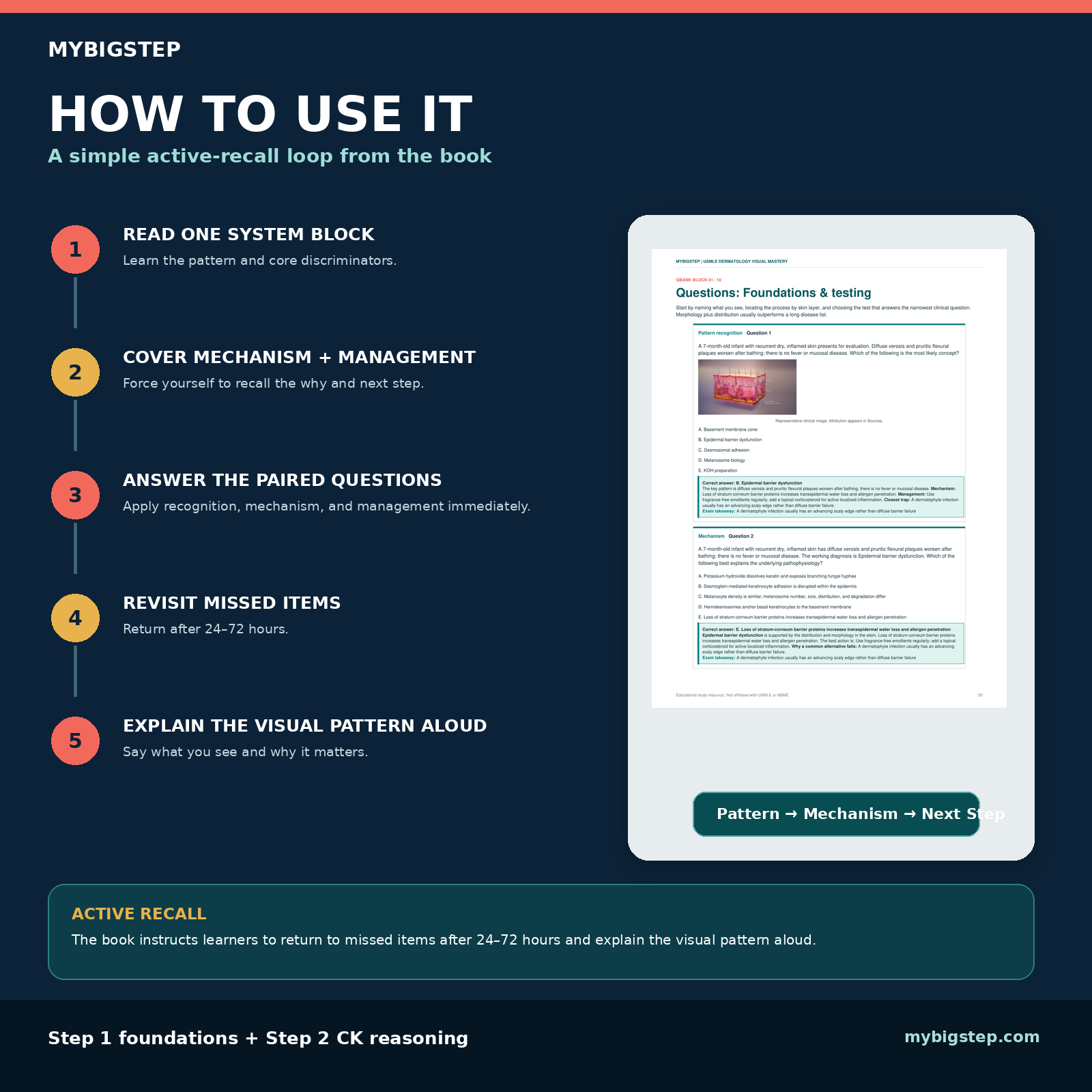
Dermatology is decided on sight, so this workbook is built to be worked in two passes. First name the pattern. Then explain why it is that and not the look alike sitting next to it.
What is inside
A lesion morphology foundation: macule, patch, papule, plaque, vesicle, bulla, pustule and nodule with the size rules, set against a labeled diagram of the skin layers.
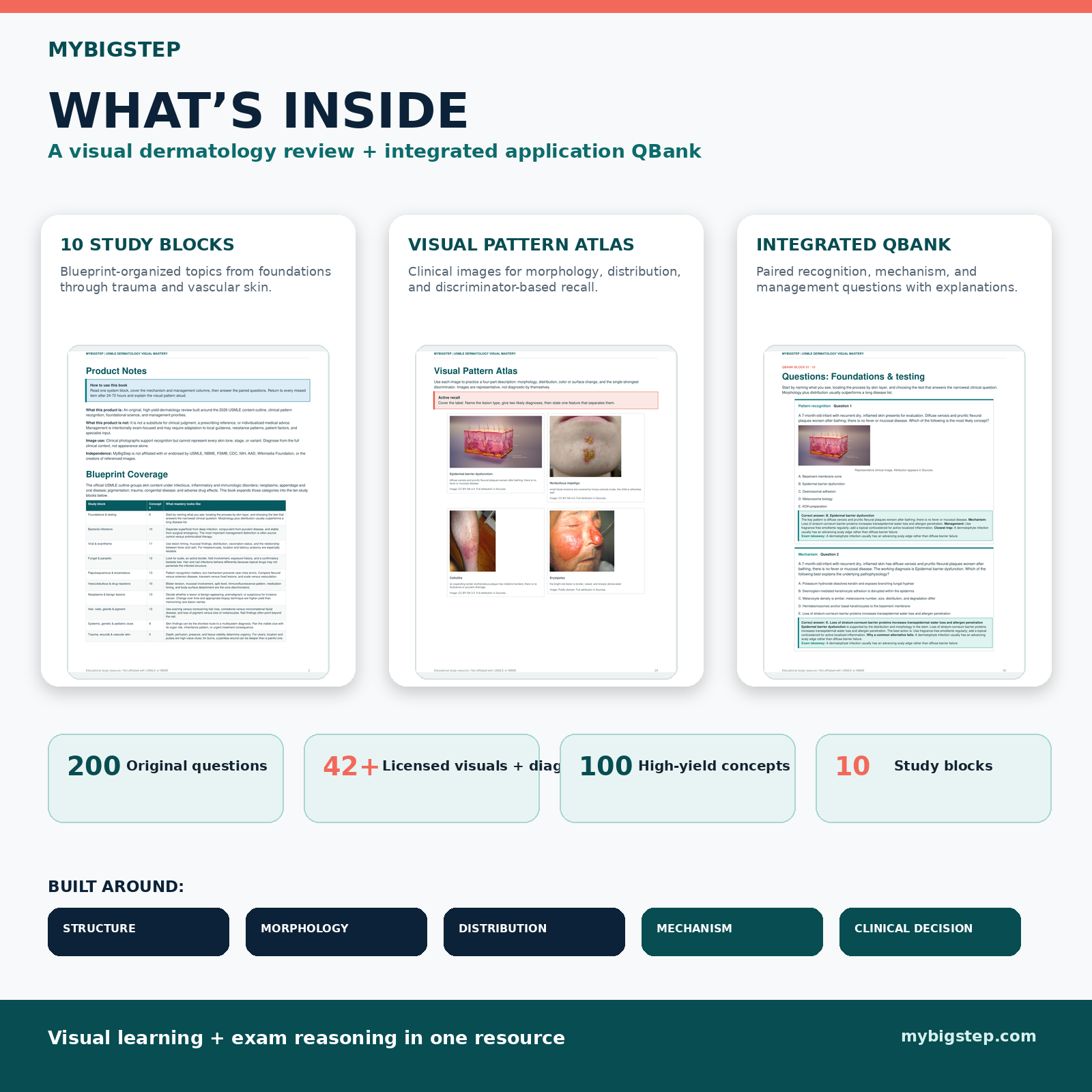
Ten study blocks covering foundations and testing, bacterial infections, viral infections and exanthems, and fungal and parasitic disease.
Papulosquamous and eczematous disease, vesiculobullous disease and drug reactions, and neoplasms and benign lesions.
Hair, nails, glands and pigment, systemic, genetic and pediatric clues, and trauma, wounds and vascular skin.
A concept table in every block, laid out as what to recognize, the mechanism behind it, and the exam focused action.
A visual pattern atlas of clinical photographs, each captioned with the single clue that separates it from its closest look alike.
Two hundred questions across three types: one hundred on pattern recognition, fifty on mechanism and fifty on management.
Every question is a clinical vignette with five options, and prints the correct answer, the mechanism, the management and the closest trap directly underneath.
Coverage aimed at both Step 1 foundations and Step 2 CK reasoning.
A clinical sources page citing the USMLE content outline, the American Academy of Dermatology, the CDC, the IDSA, the National Cancer Institute and NCBI Bookshelf.
Full image credits, with every external visual listed against its creator, its license and a link to the source.
The 200 questions are built on 100 clinical scenarios, each asked twice: once to name the pattern, and once to give the mechanism or the next step. Every question is original and written for this workbook. Visuals are public domain or licensed for commercial use and are credited in full at the back. This is a study aid. It is not an official USMLE product, it is not affiliated with USMLE, NBME or FSMB, and it is not a guarantee of any exam outcome. Delivered as a PDF.
A 130 page dermatology workbook for the USMLE, built around 200 questions that each print the answer, the mechanism and the management directly underneath.
Dermatology is decided on sight, so this workbook is built to be worked in two passes. First name the pattern. Then explain why it is that and not the look alike sitting next to it.
What is inside
A lesion morphology foundation: macule, patch, papule, plaque, vesicle, bulla, pustule and nodule with the size rules, set against a labeled diagram of the skin layers.
Ten study blocks covering foundations and testing, bacterial infections, viral infections and exanthems, and fungal and parasitic disease.
Papulosquamous and eczematous disease, vesiculobullous disease and drug reactions, and neoplasms and benign lesions.
Hair, nails, glands and pigment, systemic, genetic and pediatric clues, and trauma, wounds and vascular skin.
A concept table in every block, laid out as what to recognize, the mechanism behind it, and the exam focused action.
A visual pattern atlas of clinical photographs, each captioned with the single clue that separates it from its closest look alike.
Two hundred questions across three types: one hundred on pattern recognition, fifty on mechanism and fifty on management.
Every question is a clinical vignette with five options, and prints the correct answer, the mechanism, the management and the closest trap directly underneath.
Coverage aimed at both Step 1 foundations and Step 2 CK reasoning.
A clinical sources page citing the USMLE content outline, the American Academy of Dermatology, the CDC, the IDSA, the National Cancer Institute and NCBI Bookshelf.
Full image credits, with every external visual listed against its creator, its license and a link to the source.
The 200 questions are built on 100 clinical scenarios, each asked twice: once to name the pattern, and once to give the mechanism or the next step. Every question is original and written for this workbook. Visuals are public domain or licensed for commercial use and are credited in full at the back. This is a study aid. It is not an official USMLE product, it is not affiliated with USMLE, NBME or FSMB, and it is not a guarantee of any exam outcome. Delivered as a PDF.